Hotel and resort web design Thailand: what actually drives visibility and bookings
Hotels and resorts in Thailand compete in one of the most crowded and visually driven hospitality markets in Southeast Asia. A property website is not just a digital brochure. It is a core revenue asset that shapes first impressions, supports organic visibility, and influences whether a potential guest books directly or returns to an OTA.
That makes hotel and resort web design in Thailand a strategic discipline rather than a purely creative one. A strong site needs to present the property convincingly, load quickly across devices, support search visibility, and reduce friction in the booking journey. If design, SEO, and usability are handled separately, the result is often a site that looks polished but underperforms in search or loses users before they convert.
This article explains how hotel and resort websites should be approached in the Thai market, where design decisions affect SEO, user trust, and direct booking potential.
What hotel and resort web design in Thailand really involves
Hotel and resort web design in Thailand sits at the intersection of branding, user experience, technical performance, and local search behavior.
For hospitality businesses, the website has to do several jobs at once:
- communicate the property’s positioning clearly
- help users understand rooms, amenities, and location fast
- build confidence through visuals and practical information
- support organic rankings for relevant destination and hotel-related searches
- move users toward direct enquiries or bookings
That last point matters. Many hotel sites are designed as visual showcases first and commercial assets second. Large image sections, heavy animations, and vague page structures may look impressive, but they often weaken performance, dilute relevance, and create unnecessary friction for users who simply want to evaluate the property and take action.
A better approach treats the website as both a brand experience and a search-driven acquisition channel.
Why this matters for hotels and resorts in Thailand
Thailand’s hospitality market has several characteristics that make web design and SEO especially important.
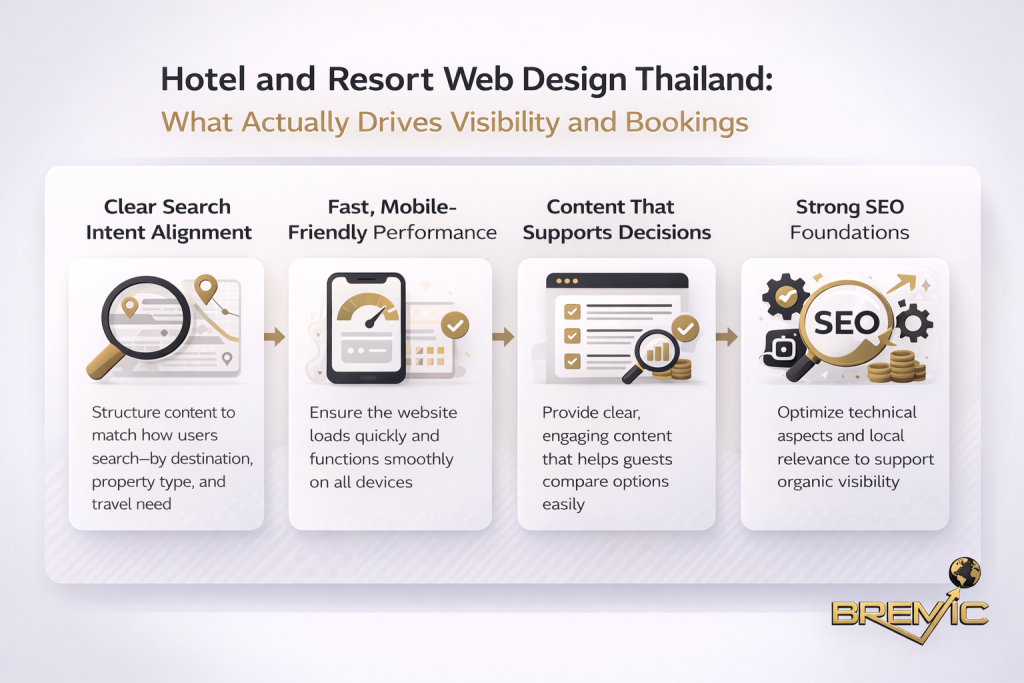
First, search demand is broad and fragmented. People search by destination, property type, travel style, amenities, and intent. A user may look for a beach resort in Phuket, a family-friendly hotel in Hua Hin, a luxury villa resort in Koh Samui, or a boutique hotel near Chiang Mai Old City. A website that is not structured around real search behavior will struggle to compete.
Second, the visual standard is high. Hotels and resorts sell atmosphere, comfort, and location. Users expect strong photography, but they also expect clarity. If room categories are confusing, policies are hard to find, or the booking path is slow, trust drops quickly.
Third, mobile experience is critical. Many users discover and compare hospitality options on mobile first. In Thailand and across international travel markets, a hotel website that performs poorly on mobile will lose both rankings and conversions.
Finally, direct booking strategy matters more than ever. Properties that rely too heavily on third-party platforms often give away margin and customer relationship control. A well-designed, search-optimized website helps balance that dependency by strengthening organic acquisition and direct conversion potential.
What a strong hotel website should do
A hotel or resort website should help a visitor answer five questions with minimal effort:
Is this property relevant to my trip?
The homepage and landing pages should immediately clarify the property type, destination, experience, and ideal guest profile. Users should not need to infer whether the hotel suits couples, families, business travelers, wellness guests, or destination wedding groups.
Does it look credible and high quality?
Visual presentation matters, but credibility is built through more than photography. Clean layouts, readable typography, clear room information, accurate location details, and obvious contact options all contribute to trust.
Can I find the information I need quickly?
Guests want practical answers. Room types, rates context, dining, facilities, check-in policies, transport access, nearby attractions, and booking options should be easy to find. Hidden navigation and overly artistic layouts often create frustration.
Is the site fast and easy to use on mobile?
Performance is part of both UX and SEO. Slow pages, oversized media, intrusive pop-ups, and inconsistent mobile layouts hurt engagement and make the site less competitive in search.
Can I take the next step without friction?
Whether the goal is booking, sending an enquiry, checking availability, or contacting the property, the path should be obvious. Good hospitality web design reduces hesitation rather than adding complexity.
How web design and SEO should work together
For hotel and resort businesses, SEO should not be added after the website is finished. The site structure, templates, content layout, and technical setup should be built with search in mind from the start.
Site architecture should reflect search intent
A hospitality website should group content in a way that matches how users search. Core pages often include:
- homepage
- rooms or accommodation pages
- dining and facilities pages
- location or destination pages
- offers or packages
- contact and booking-related pages
Where relevant, supporting content can also target informational intent around destinations, travel planning, venue use cases, or guest experiences. This broader structure strengthens topical relevance and supports internal linking.
For businesses thinking more broadly about sector-specific strategy, it helps to review how digital planning changes across different verticals in industry-focused web and SEO work.
Page templates must support content relevance
Many hotel sites prioritize visuals so heavily that the pages end up thin in searchable content. Search engines still need clear topical signals. That does not mean writing long blocks of filler text. It means structuring pages so that important information is visible, crawlable, and contextually placed.
A room page, for example, should not only show photos. It should explain room size, occupancy, key amenities, view type, bed configuration, and who the room suits. That improves user decision-making and strengthens page relevance.
Technical SEO cannot be treated as optional
A visually rich hospitality website can easily become bloated. Common technical weaknesses include:
- oversized image files
- slow mobile performance
- JavaScript-heavy page elements
- inconsistent heading structures
- poor internal linking
- indexation issues caused by duplicated or thin pages
These are not minor details. They directly affect crawl efficiency, rankings, and engagement.
Local and destination relevance matters
A property website should be optimized around the real geography and intent of the business. That includes destination terms, nearby landmarks, local attractions, and practical travel context where relevant. The goal is not to force location keywords into every paragraph. The goal is to make the site genuinely useful for users comparing options in a specific place.
What good hotel and resort web design in Thailand looks like in practice
The strongest websites in this space usually share a similar set of principles.
Clear positioning above the fold
Users should immediately understand what the property is, where it is, and why it is distinct. A vague hero line over a slideshow is not enough. The opening section should communicate the offer with precision.
Navigation built around user priorities
Hotels often organize navigation around internal preferences rather than guest needs. A better structure prioritizes rooms, dining, facilities, location, offers, and contact or booking pathways.
High-quality visuals with controlled performance
Photography is essential, but image strategy matters. Not every image needs to load at full size immediately. Good implementations balance visual impact with page speed.
Content that supports decision-making
Users need concise, useful content that helps them compare and choose. This is especially important on room, resort, wedding, spa, and dining pages. Content should answer realistic questions rather than repeat generic hospitality language.
Strong internal pathways
Visitors do not always land on the homepage first. They may enter through a room page, a blog article, or a destination-related page. Internal linking should help them move naturally between informational content, property pages, and conversion pages.
Common weaknesses that hold hotel websites back
Many hospitality sites in Thailand face the same structural problems.
One is treating design as separate from search performance. A site may look premium but lack the information architecture needed to rank for anything beyond branded searches.
Another is overusing visual effects that slow the site down. Motion-heavy banners, uncompressed galleries, and complicated interactive elements often hurt more than they help.
Thin content is also common. Pages for rooms, amenities, and experiences are often too short to be useful, which weakens both relevance and conversion support.
Another issue is unclear differentiation. Many hotel websites describe themselves with interchangeable phrases such as luxury, exclusive, serene, or unforgettable. Those terms do little unless supported by concrete details that show what is actually distinctive about the property.
Finally, many sites underperform because the booking journey is fragmented. Users move from a polished marketing site into a clunky booking engine or encounter confusing calls to action. That disconnect reduces trust at the exact moment conversion should happen.
How to evaluate whether a hotel website strategy is strong
A hotel or resort website strategy is usually on the right track if it can answer yes to the following questions:
- Does the site reflect how users search by destination, property type, and intent?
- Are the most important commercial pages easy to crawl, understand, and navigate?
- Does the site load efficiently on mobile?
- Does each major page help both rankings and user decision-making?
- Are there clear internal links between informational and transactional content?
- Is the site set up to support direct bookings, not just general brand visibility?
If the answer is no to several of these, the problem is usually not just “design.” It is a structural issue involving SEO, UX, content planning, and conversion strategy.
Realistic expectations for results
Website improvements in this space can create meaningful gains, but expectations need to be grounded.
A better website does not automatically lead to immediate ranking growth or a sudden increase in direct bookings. Search visibility depends on competition, existing authority, technical condition, content depth, and market demand. Design improvements may help quickly with usability and engagement, while SEO gains often take longer and depend on consistent execution.
For most hotel and resort businesses, the right expectation is gradual improvement across multiple indicators: stronger visibility for relevant searches, better mobile engagement, clearer user journeys, and a healthier direct booking foundation over time.
Strategic takeaway
Hotel and resort web design in Thailand should not be approached as a style exercise. The strongest websites are built to support search visibility, user confidence, and direct conversion at the same time.
That requires more than attractive visuals. It requires clear positioning, thoughtful architecture, fast performance, useful content, and SEO built into the foundation. For hospitality brands competing in a crowded market, that combination is what turns a website from a passive brand asset into an active business tool.