Ecommerce web development Thailand: how to build an online store that can rank and grow
For many businesses, ecommerce success is not limited by product demand. It is limited by the quality of the website behind it. A store may look modern, but still struggle with slow performance, weak category architecture, poor crawlability, or product pages that never earn visibility in search.
That is why ecommerce web development Thailand should not be treated as a design project alone. It is a technical and strategic build process that affects how well a store can scale, rank, convert, and adapt over time. In Thailand, that also includes practical considerations such as mobile-first usage, local payment and shipping expectations, bilingual content decisions, and the structure needed to support SEO from the start.
This article explains what ecommerce web development means in practical terms, why SEO should be part of the build phase, what a strong build should include, and how to evaluate the quality of the work before problems become expensive to fix.
What ecommerce web development in Thailand actually involves
At a basic level, ecommerce web development is the process of planning, designing, and building an online store that allows users to browse products, complete transactions, and manage post-purchase actions.
In practice, a serious ecommerce build is far more than that.
A well-built ecommerce site in Thailand needs to balance several layers at once:
- storefront usability
- technical performance
- product and category structure
- mobile experience
- search engine accessibility
- localized trust signals
- payment, shipping, and operational integration
This matters because ecommerce websites are rarely static. Product ranges change. Categories expand. Promotions come and go. New landing pages are added. Inventory systems connect. Search demand shifts. A store that works for 50 products may break down at 5,000 if the architecture and templates were not designed properly.
For businesses targeting the Thai market, development choices also need to reflect local buying behavior. That may include Thai-language content, dual-language requirements, pricing in baht, clear delivery information, and a checkout experience aligned with local customer expectations. These are not side issues. They directly affect trust, conversion, and organic performance.
Why SEO should be built into ecommerce development from day one
Many ecommerce sites treat SEO as something to “add later.” That usually creates avoidable technical debt.
When SEO is excluded from the build phase, common issues appear quickly:
- category pages with no strategic structure
- product pages that are thin or duplicated
- faceted navigation creating indexation problems
- slow mobile performance
- weak internal linking
- poor URL conventions
- pagination and canonical errors
- template limitations that block content expansion
These are not minor details. They influence whether search engines can crawl the site efficiently, understand the product hierarchy, and assign relevance to key commercial pages.
A strong ecommerce build supports SEO in three ways.
First, it creates a site structure that aligns with search demand. That means category and subcategory pages are not just navigation elements. They are strategic landing pages built around real search behavior.
Second, it ensures the platform can scale without creating technical noise. Search engines need a clean signal. When the site generates unnecessary duplicate URLs, thin filtered pages, or inconsistent metadata at scale, ranking becomes harder.
Third, it gives content and internal linking a place to work. SEO is not just about page speed and metadata. It depends on how category pages, product pages, supporting content, and cluster pages reinforce one another across the site.
That is especially relevant for businesses with different operational models, customer needs, and compliance considerations across sectors. Where relevant, a broader view of industry-specific website requirements can help shape the right ecommerce approach.
What a strong ecommerce web development Thailand project should include
A professional ecommerce build should solve for both users and search engines. That requires more than a clean homepage and a functioning cart.
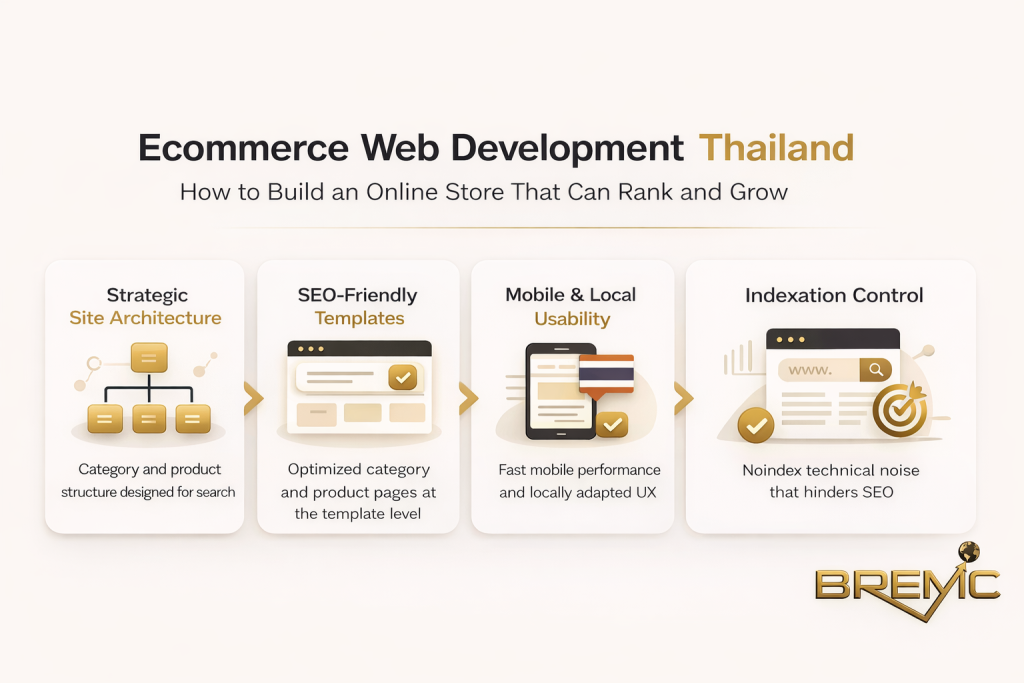
Site architecture that reflects search intent
The site structure should be based on how customers actually search, not just how the product database is organized internally.
That means defining:
- primary category pages
- logical subcategories
- product groupings
- brand or use-case pages where justified
- clear URL paths
- scalable navigation
A weak structure makes every later SEO task harder. A strong structure gives the business a foundation for rankings, internal linking, filtering logic, and future content expansion.
Search-friendly category and product templates
Templates matter because ecommerce SEO is heavily template-driven. If the template is weak, every page built on it is limited.
Category pages should be able to support more than product grids. In most cases, they need room for optimized headings, supporting copy, internal links, and helpful context that improves relevance without getting in the way of usability.
Product pages should support unique content, structured product information, clean image handling, technical specs where relevant, and trust-building elements such as policies, delivery details, and FAQs when appropriate.
Mobile performance and technical stability
In Thailand, mobile usability is often central to ecommerce performance. A store that looks polished on desktop but loads poorly on mobile will lose both rankings and revenue.
Development quality should account for:
- stable page rendering
- fast asset loading
- clean code output
- efficient image delivery
- controlled use of scripts and apps
- responsive navigation and filtering
- checkout usability on smaller screens
Performance is not only a user experience issue. It also affects crawl efficiency, engagement, and conversion rates.
Localized user experience
A store serving Thailand should feel operationally credible to Thai users. That does not always mean building everything in Thai, but it does mean making deliberate localization decisions.
That may include:
- Thai and English language handling
- local currency display
- address and delivery clarity
- tax and invoice communication
- local contact signals
- payment methods that users recognize
Localization should be handled structurally, not as an afterthought. This is especially important for bilingual or multi-market ecommerce sites, where language and content duplication can create SEO problems if implemented poorly.
Indexation control and crawl management
Large ecommerce sites often create unnecessary pages through filters, search parameters, tag combinations, or sorting options. Left unmanaged, these pages dilute crawl budget and generate duplication.
A strong build should control what gets indexed, what gets canonicalized, and how faceted navigation behaves. This is one of the most common failure points in ecommerce SEO because it is often invisible until the site has already grown.
How to evaluate an ecommerce development partner from an SEO perspective
Not every web developer is equipped to build a store that performs in search. A visually attractive site can still be structurally weak.
When evaluating ecommerce web development Thailand providers, look beyond design samples. Focus on how they think about long-term performance.
A capable partner should be able to explain:
- how they plan category hierarchy
- how templates support SEO content and metadata
- how they manage filtering and duplicate URL risks
- how they handle technical performance on mobile
- how product and category pages will scale
- how internal linking is supported
- how the CMS or platform limits future SEO work, if at all
The quality of these answers usually tells you more than a polished sales pitch.
It is also worth asking whether the development process includes collaboration with SEO strategy early in the project. If SEO is only mentioned after launch, the workflow is already misaligned.
Common mistakes in ecommerce web development
Some problems show up repeatedly across ecommerce projects, regardless of industry.
Treating design as the main deliverable
Visual design matters, but it is only one layer. A store can look premium and still underperform because key pages are hard to crawl, difficult to expand, or poorly aligned with search demand.
Using platform defaults without strategic review
Many ecommerce platforms can launch quickly, but default settings are not the same as a sound SEO setup. Out-of-the-box collections, tags, filters, and URL logic often need refinement.
Building category pages with no real content value
Category pages should not exist only to hold products. They are often the most important SEO landing pages on the site. If they are thin, duplicated, or structurally weak, visibility suffers.
Ignoring content governance at scale
As ecommerce stores grow, content quality often drops. Product descriptions get reused. metadata becomes inconsistent. category copy turns generic. This is not just a content issue. It is usually a systems issue caused by weak planning.
Launching without technical QA for search
A site can be fully functional for users and still have SEO-critical problems at launch. Common examples include incorrect canonicals, broken redirects, blocked resources, indexing issues, and inconsistent internal linking.
Strategic recommendations for businesses planning an ecommerce build
Businesses usually get better results when they treat ecommerce development as part of a broader growth system, not as a one-time website task.
A sound approach is to start with four strategic decisions:
Define the search and category model first
Before design begins, identify the commercial categories, product themes, and search-led landing pages the site needs to support. This reduces rework and leads to a cleaner architecture.
Separate platform convenience from business fit
The easiest platform to launch is not always the best platform to scale. The right choice depends on product complexity, content needs, operational integrations, and how much control the business needs over templates and technical SEO.
Build templates for expansion, not just launch
The first version of the site should support future SEO work. That includes editable headings, metadata controls, on-page content blocks, schema implementation where relevant, and flexible internal linking opportunities.
Plan post-launch improvement as part of the project
No ecommerce site is perfect at launch. That is normal. The goal is to launch with a strong foundation and a clear roadmap for technical refinement, content expansion, and category growth.
Realistic expectations
A high-quality ecommerce website can improve visibility, usability, and conversion potential, but it does not create instant organic results.
SEO gains usually depend on several factors working together:
- the competitiveness of the market
- the quality of the category structure
- the strength of product and category content
- internal linking depth
- technical stability
- the authority of the domain over time
That means businesses should expect ecommerce web development to create the conditions for growth, not replace the need for ongoing SEO work. The build establishes the framework. Rankings are earned through consistent execution on top of that framework.
Conclusion
Good ecommerce performance starts long before a customer reaches checkout. It starts with how the store is built.
A strong ecommerce web development Thailand project should align technical structure, user experience, localization, and SEO from the beginning. When those elements are planned together, the site is easier to scale, easier to optimize, and more capable of earning qualified traffic over time.
For businesses operating in Thailand, the real question is not whether the site can go live. It is whether the site is being built in a way that supports visibility, trust, and growth once it does.