Legal and financial services web design in Thailand: what firms need to get right
Legal and financial services websites operate under a different standard from most business sites. A law firm, accounting practice, financial advisory company, or corporate services provider is not just trying to attract traffic. It is trying to build confidence with people making high-stakes decisions.
That is why legal and financial services web design Thailand should never be approached as a generic design project with SEO added later. The site has to communicate credibility, explain complex services clearly, support local and international search behavior, and make it easy for the right prospects to take the next step.
For firms in Thailand, the challenge is even more specific. Many websites need to speak to multiple audiences at once: local clients, foreign business owners, investors, expats, and companies entering the Thai market. That affects structure, content, language, trust signals, and search strategy.
This article explains what effective legal and financial services website design and SEO looks like in practical terms, what weak sites often get wrong, and how firms can build a stronger foundation for visibility and lead quality.
Why this niche needs a different web strategy
Legal and financial services are trust-led categories. People do not choose a provider the same way they choose a restaurant, fashion brand, or SaaS tool. The buying process is slower, more deliberate, and more risk-sensitive.
A website in this category needs to do several things at once:
- present the firm as credible and established
- explain services in language that is accurate but still accessible
- reduce uncertainty for prospective clients
- support organic visibility for high-intent searches
- guide users toward consultation, inquiry, or contact without pressure
That combination is what makes this niche difficult. A site can look polished and still underperform if the structure is weak, the messaging is vague, or the SEO strategy is disconnected from how legal and financial clients actually search.
For firms building a broader industry-specific web strategy, this sector is one of the clearest examples of why templated design and generic SEO rarely hold up.
What strong legal and financial services web design in Thailand looks like
Good design in this space is not mainly about visual style. It is about usability, trust, clarity, and decision support.
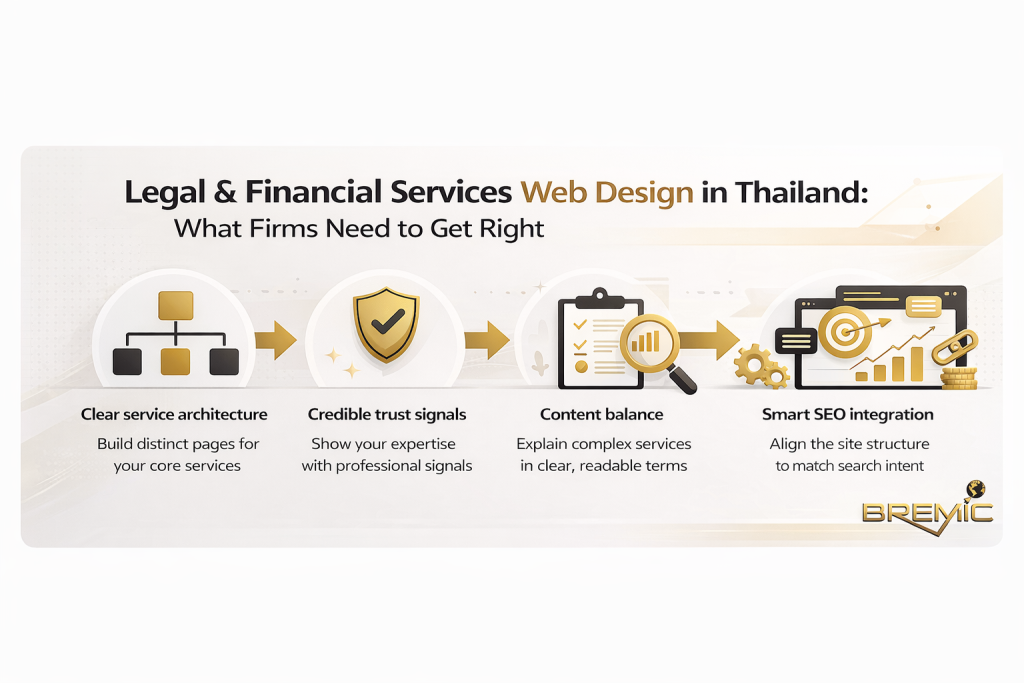
Clear service architecture
Most firms offer multiple services, but many websites bury them inside broad menu labels or one oversized services page. That creates friction for both users and search engines.
A stronger approach is to create distinct pages for meaningful service categories, such as:
- corporate legal services
- dispute resolution
- tax advisory
- audit and accounting
- business setup support
- compliance consulting
- financial planning or wealth services
Each page should target a specific user need, explain scope clearly, and answer the questions a serious prospect is likely to have before making contact.
Professional trust signals that feel earned
Trust signals matter more in legal and financial services than in many other verticals, but they need to be used carefully. Empty claims such as “best,” “leading,” or “top-rated” do very little if the rest of the site feels thin.
More credible trust signals include:
- clear firm background and service focus
- named professionals where appropriate
- office location and contact transparency
- language capabilities
- well-written practice area or service pages
- useful articles that reflect real subject knowledge
- professional memberships, certifications, or affiliations only where accurate and relevant
The goal is not to overload the page with badges. It is to reduce doubt.
Content that balances precision and readability
Legal and financial topics can become either too technical or too simplified. Both are problems.
If the content is overly dense, prospects may leave because they cannot quickly understand whether the firm fits their needs. If the content is too vague, the site may sound polished but unconvincing.
The strongest pages explain complex services in direct language without losing accuracy. They define the issue, outline where the service applies, set reasonable expectations, and make clear what the next step looks like.
A bilingual or multilingual structure when it serves the market
In Thailand, many firms serve both Thai-speaking and English-speaking audiences. That has implications beyond translation.
A bilingual site should not simply mirror content without strategy. It should consider:
- whether both audiences search for the same services
- whether terminology differs by audience type
- whether separate landing pages are needed for local versus international intent
- whether content should be localized, not just translated
This is especially relevant for firms working with foreign investors, regional businesses, and expat clients, where search behavior often reflects very different informational needs.
Why SEO matters more than firms often expect
For legal and financial services firms, SEO is not just about “more traffic.” It is about being discoverable at the moment someone is evaluating options, comparing providers, or trying to understand a problem before reaching out.
That matters because these services usually involve:
- high consideration
- specific intent
- strong trust requirements
- a smaller but more valuable lead pool
A well-structured SEO strategy helps a firm appear for searches that reflect real commercial relevance, not just broad informational volume.
For example, a generic page titled “Our Services” is unlikely to perform well in search or help a visitor make a decision. A focused page on Thai tax advisory for foreign-owned businesses or corporate legal support for company registration has a much clearer role.
In practice, SEO in this sector should support three things:
- Visibility for service-led searches
These are searches tied directly to what the firm does. - Authority through useful informational content
Not every visitor is ready to inquire immediately. Some are researching requirements, risks, or procedures first. - Conversion support through better page intent matching
When search intent and page purpose are aligned, lead quality usually improves.
How legal and financial SEO should be built into the site
The mistake many firms make is treating SEO as blog publishing alone. In reality, the core SEO value often starts with the site structure.
Build pages around actual search intent
Not every keyword deserves a page, and not every page should chase the broadest term available.
A practical structure usually includes:
- core service pages for commercial intent
- supporting pages for sub-services or niche use cases
- informational articles that answer recurring client questions
- location or market-specific pages only where they provide real value
This helps create topical depth without turning the website into a disorganized archive of loosely related content.
Use internal linking to reinforce relevance
Internal links are not just navigation tools. They help connect high-level service pages with supporting content and make the site easier for search engines to interpret.
For example, a main service page can link to supporting articles that explain process, requirements, common mistakes, or industry context. That gives users a clearer journey and strengthens the broader topic cluster.
Done well, internal linking supports both SEO and user confidence.
Prioritize local relevance without narrowing the audience too much
For firms serving clients in Thailand, local SEO often matters even when the business also serves international clients.
That means the website should clearly communicate:
- where the firm operates
- who it serves
- whether it handles cross-border or foreign-client matters
- which services are tied to Thai regulations, business activity, or local market conditions
This is especially useful for firms based in Bangkok or other major commercial centers, but it should be handled carefully. Local signals should sharpen relevance, not make the firm appear limited if its actual service area is broader.
Make technical performance part of trust
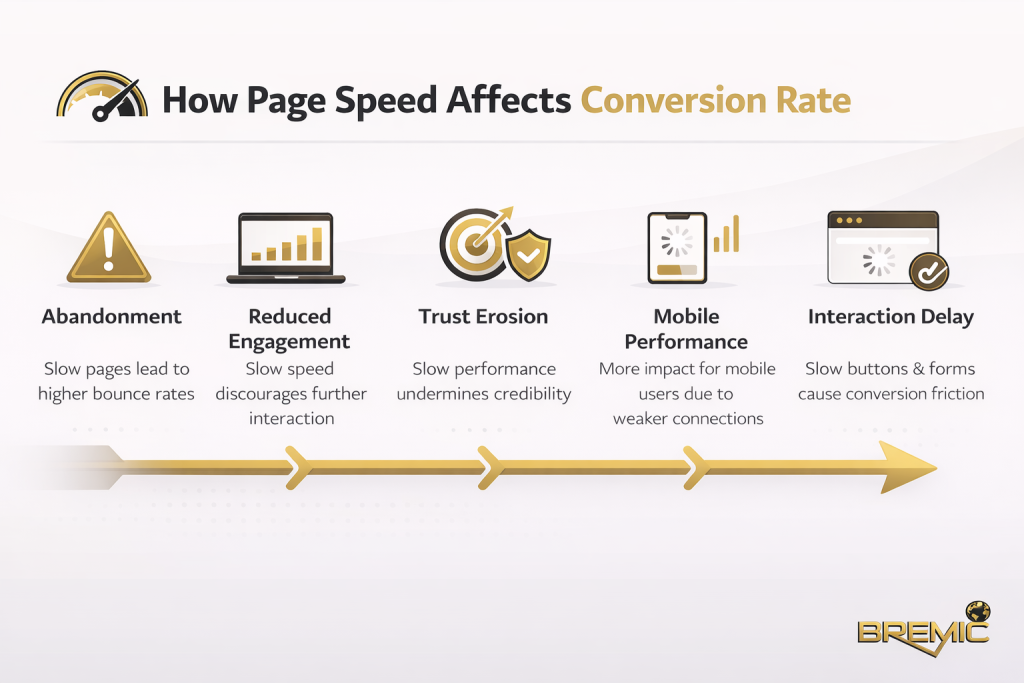
Slow, unstable, or poorly structured websites erode confidence quickly in professional services. Technical SEO and web performance are part of the user experience.
At a minimum, firms should expect:
- fast loading pages
- mobile-friendly layouts
- clean navigation
- indexable content structure
- strong page titles and meta descriptions
- secure browsing
- clear forms and contact pathways
These are basic expectations, but in trust-sensitive industries, basic failures do outsized damage.
Common mistakes in legal and financial services websites
Some of the weakest sites in this category fail for predictable reasons.
Overly generic messaging
If every page says the firm offers “high-quality solutions” and “expert advice” without defining services clearly, the site will struggle to rank and struggle to convert.
Thin service pages
A short service page with no detail gives search engines very little to work with and gives users very little reason to trust the firm.
Design that looks modern but explains nothing
Minimalist design can work, but not if it removes useful information. In legal and financial services, clarity usually beats visual cleverness.
Unfocused content marketing
Publishing broad articles with weak connection to the firm’s services may grow traffic, but often not the right traffic. Content should support a topic cluster that aligns with business intent.
Poor language handling
Direct translations, inconsistent terminology, or awkward English can reduce credibility fast, especially when the target audience includes international decision-makers.
A practical strategy for firms in Thailand
For most firms, the right approach is not to redesign everything at once. It is to improve the foundation in the right order.
Start with the core commercial pages first. Clarify service structure, strengthen messaging, and make sure each important service has a dedicated page with a clear purpose.
Then review the site through an SEO lens:
- Are the main services mapped to clear search intent?
- Do the pages explain enough to be genuinely useful?
- Is the site structured for both users and search engines?
- Are there obvious content gaps around client questions?
- Does the site reflect the actual markets and audiences the firm serves?
After that, build supporting content deliberately. Focus on topics that help prospects understand services, obligations, risks, procedures, or decision criteria. That is usually more valuable than chasing broad traffic keywords with limited business relevance.
What realistic results look like
Legal and financial SEO is rarely a quick-win channel. It typically rewards consistency, structure, and credibility over time.
A stronger website and SEO strategy should lead to:
- better visibility for relevant service searches
- clearer differentiation from weaker competitors
- more qualified inquiries
- stronger engagement on service pages
- improved trust before the first consultation
What it should not be expected to do is produce instant rankings or large spikes from low-quality content. In this sector, sustainable performance comes from disciplined execution.
Strategic takeaway
Effective legal and financial services web design Thailand is not about adding a professional-looking interface to a basic brochure site. It is about building a credible digital platform that supports trust, search visibility, and serious client decision-making.
For firms in Thailand, that usually means combining clear service architecture, accurate and readable content, local and bilingual relevance where needed, and SEO that is embedded into the site structure from the start.
When those pieces work together, the website stops being a passive online presence and becomes a meaningful asset for authority, discovery, and lead quality.