Local SEO case study Hua Hin restaurant: what actually drives better local visibility
For restaurants in a market like Hua Hin, local SEO is not a side channel. It is one of the main ways people decide where to eat. Searchers look for immediate answers: nearby options, opening hours, menus, directions, photos, reviews, and proof that a place is worth visiting. That makes local search especially important for any restaurant competing for high-intent traffic from both residents and visitors.
This local SEO case study Hua Hin restaurant article explains the practical work behind stronger local visibility for a restaurant business in Hua Hin. Rather than relying on inflated claims or vanity metrics, the focus here is on the strategy, execution, and the types of improvements that matter in real local search: better map visibility, stronger relevance signals, improved discovery for non-branded searches, and a smoother path from search to visit.
If you want broader context around how this fits into a wider performance strategy, see our SEO case studies and project examples.
Why local SEO matters more for restaurants than many businesses
Restaurants live and die by intent. A user searching for a place to eat is usually much closer to taking action than someone browsing a general service or information page. That creates a different kind of SEO environment.
For a restaurant in Hua Hin, local SEO is shaped by a few realities:
- Searchers often make decisions on mobile, in the moment
- Google Maps visibility can influence foot traffic directly
- Reviews, photos, and business profile completeness affect clicks and trust
- Search behavior is often mixed between branded, category, and location-modified searches
- Tourist demand introduces more varied query patterns than many purely local businesses face
In practice, that means a restaurant does not only need a website that ranks. It needs a local presence that sends consistent quality signals across Google Business Profile, on-site location content, reviews, menu-related relevance, and local citations.
The starting point: visibility gaps that are common in restaurant SEO
In many restaurant SEO projects, the issue is not that the business has no online presence. The issue is that the presence is incomplete, inconsistent, or not aligned with how local search actually works.
Typical starting problems include:
Weak Google Business Profile optimization
A profile may exist, but key elements are underdeveloped. Categories may be too broad. Services or menu-related details may be thin. Photos may be outdated or low quality. Business descriptions are often generic. Posts, updates, and engagement features are rarely used well.
Limited relevance for non-branded searches
A restaurant may appear when someone searches its name, but not when users search for what it offers in the area. Queries such as “seafood restaurant Hua Hin,” “romantic dinner Hua Hin,” or “family restaurant near beach” depend on stronger topical and location relevance than many restaurant sites provide.
Inconsistent business information
NAP consistency still matters in local SEO. If the business name, address, map pin, hours, or contact details vary across platforms, Google receives weaker trust signals. This is especially damaging when users are comparing options quickly.
Thin or generic website content
Many restaurant websites function more like digital brochures than local search assets. They list a menu and contact details, but they do not help Google understand location relevance, service intent, or differentiators. Thin homepage copy rarely does enough on its own.
Underused review signals
Reviews are not just social proof. They shape click behavior, local trust, and topical relevance. If customers mention dishes, atmosphere, service, or location, that content reinforces important search signals. Without a review strategy, much of that value is left on the table.
What the local SEO strategy focused on
This Hua Hin restaurant case study is best understood as a local entity optimization project, not just a rankings exercise. The strategy focused on improving how clearly the restaurant communicated three things to Google and users:
- What the business is
- Where it serves
- Why it is relevant for specific local dining intent
That required work across both Google-facing and user-facing assets.
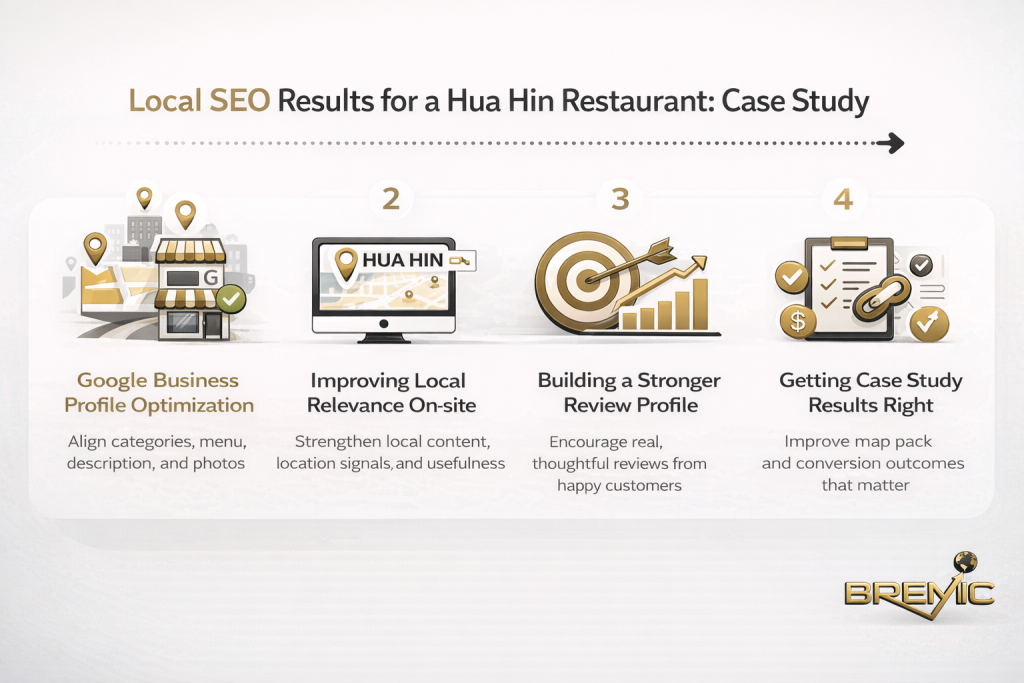
Strengthening the Google Business Profile
For restaurant SEO, the Google Business Profile is often the highest-leverage asset. It influences map pack visibility, branded search trust, and action-oriented engagement such as calls, direction requests, and website clicks.
The optimization work centered on:
- selecting the most accurate primary and secondary categories
- refining the business description to reflect actual offerings and location relevance
- improving photo coverage to better represent the restaurant experience
- validating hours, contact details, and map accuracy
- aligning menu and service details with real user search language
- building a more consistent update rhythm where appropriate
This is where many businesses either overcomplicate or underinvest. The right goal is not to stuff keywords into the profile. It is to make the profile more complete, more trustworthy, and more closely matched to the search intents the business should reasonably appear for.
Improving local relevance on the website
A Google Business Profile can help discovery, but the website still plays a major role in supporting local relevance and conversion quality. For a restaurant, the site needs to reinforce location, offering, and intent without turning into awkward SEO copy.
The on-site work focused on a few essentials.
Location clarity
The site needed to make it easy for both users and search engines to understand where the restaurant operates. That includes clear address information, embedded location context, and copy that reflects the Hua Hin market naturally rather than mechanically.
Search-intent alignment
Restaurant websites often miss the chance to connect with real local queries. The goal was not to create dozens of low-value pages. It was to make core pages more useful for actual search behavior, including cuisine intent, dining occasion intent, and location intent.
Better content depth on key pages
Instead of relying on a thin homepage and a short contact page, stronger supporting content helps explain what the restaurant is known for, who it serves best, and why it is relevant in Hua Hin specifically. When done well, this supports both rankings and conversion confidence.
Internal structure and crawl clarity
Even a small local site benefits from clean architecture. Important pages should be easy to reach, logically linked, and written for distinct purposes. A local business site does not need complexity, but it does need clarity.
The role of reviews in local restaurant performance
Reviews are often treated as something separate from SEO, but in local restaurant search they are deeply connected. They influence both perception and relevance.
A strong review profile helps in several ways:
- it reinforces credibility before a user clicks
- it introduces natural language around food, service, and atmosphere
- it supports entity understanding around the restaurant’s strengths
- it improves the quality of branded and map-based search experiences
For a Hua Hin restaurant, this matters even more because many searchers are making fast decisions in an unfamiliar area. A business with recent, specific, and credible reviews has a meaningful advantage.
The important point is that review generation should stay ethical and operationally realistic. Asking satisfied customers at the right time is effective. Incentivizing reviews or pushing unnatural language is not.
What “results” actually mean in a local SEO case study
One of the biggest problems in SEO case study content is that “results” are often reduced to a single graph or ranking screenshot. That is not how serious local SEO performance should be judged.
For a restaurant, relevant local SEO outcomes usually include a combination of:
- stronger visibility in local pack and map-driven searches
- better discovery for non-branded local queries
- improved click-through from business profile impressions
- more qualified website visits from local-intent searchers
- higher confidence signals from reviews, photos, and consistent business data
- better alignment between search appearance and actual customer expectations
These outcomes matter because they influence real commercial behavior. A restaurant does not benefit much from irrelevant traffic. It benefits from being discovered by people who are likely to visit, book, call, or navigate to the location.
Common mistakes restaurants make with local SEO
Even businesses that invest in SEO often weaken their results with a few avoidable mistakes.
Treating the website as the whole strategy
For local restaurants, website SEO alone is not enough. If the Google Business Profile is poorly managed, map visibility and trust suffer even if the site content is decent.
Chasing broad keywords with low local value
Ranking for generic food-related terms is rarely the best use of effort. Local intent and conversion proximity matter more than vanity traffic.
Publishing thin location content
Creating weak pages stuffed with place names does not build authority. Local content has to be useful, specific, and tied to real user needs.
Ignoring image and experience signals
Photos, menu presentation, business information accuracy, and review recency all influence local search performance. These are not cosmetic details. They are part of how the business is evaluated.
Expecting instant movement
Local SEO can improve relatively quickly compared with some broader organic campaigns, but durable gains still depend on consistency. Profile work, on-site relevance, review quality, and trust signals build over time.
Strategic takeaways for restaurant owners in Hua Hin
If there is one lesson from this local SEO case study Hua Hin restaurant example, it is that local visibility improves when the business becomes easier to understand, easier to trust, and easier to choose.
For restaurant owners, that usually means focusing on the fundamentals in the right order:
- Get the Google Business Profile fully aligned with the real business
- Make the website support local search intent clearly and credibly
- Keep business details consistent across platforms
- Build a steady review process based on real customer experience
- Improve content where it helps users decide, not just where it adds words
In a place like Hua Hin, where search behavior includes both locals and visitors, these basics matter even more. Local SEO is not about gaming the map pack. It is about reducing friction between search intent and business relevance.
Realistic expectations for local SEO performance
Restaurants should expect local SEO to be iterative. Some updates, such as profile improvements or business data corrections, may produce early gains. Others, especially those tied to reputation, content quality, and broader local authority, take longer to compound.
The right expectation is not immediate domination. It is stronger relevance, better visibility for the right searches, and a more reliable flow of qualified discovery over time.
That is what makes local SEO valuable for restaurants. When the strategy is grounded in real intent, accurate business signals, and practical execution, the outcome is not just better rankings. It is a stronger connection between how people search and how they decide where to eat.
Final thought
A useful local SEO case study should do more than show a headline result. It should explain why the work mattered and what actually changed.
For a Hua Hin restaurant, strong local SEO comes from aligning business profile optimization, on-site local relevance, review signals, and trust-building details into one coherent strategy. That approach is more durable than short-term tactics, and it reflects how local restaurant search really works.
If you are evaluating restaurant SEO seriously, the right question is not just whether visibility increased. It is whether the business became more discoverable for the searches that lead to real visits, real bookings, and real revenue.