Digital marketing case studies in Thailand: how to evaluate real results and apply them to your business
When businesses search for digital marketing case studies in Thailand, they are usually not looking for theory. They want proof that a strategy can work in a local market, with local buyer behavior, local competition, and realistic budgets. They also want to understand why a campaign worked, whether the same conditions apply to their business, and what a sensible next step looks like.
That is exactly where case studies become useful.
A strong case study does more than show before-and-after numbers. It reveals the business context, the marketing problem, the chosen strategy, the execution, and the limits of the result. In a market like Thailand, that context matters even more. Performance is shaped by location, language, competition level, device usage, channel mix, service area, and the maturity of the business itself.
This guide explains how to read digital marketing case studies in Thailand properly, what separates a credible case study from a weak one, and how to use case studies to make better strategic decisions for your own business. It also shows how different channels such as website redesign, local SEO, and paid advertising can solve very different growth problems.
What digital marketing case studies in Thailand actually show
A digital marketing case study is a documented example of how a business addressed a specific marketing challenge and what happened as a result. In practical terms, it should answer five questions:
- What was the business trying to achieve?
- What was not working before?
- What strategy was chosen and why?
- What was implemented?
- What changed over time?
This sounds simple, but many case studies miss the most important part: the relationship between strategy and outcome.
For example, an increase in leads may have come from better landing page structure, improved keyword targeting, faster page speed, stronger local relevance, cleaner conversion paths, or a combination of all of them. Without that context, the numbers tell you very little.
For businesses evaluating digital marketing case studies in Thailand, the most useful examples are the ones that stay grounded in real-world constraints. They show what was improved, what was prioritized first, and what kind of business situation the work was designed for.
Why Thailand-specific case studies matter
Many marketing principles are universal, but execution is not. A business operating in Thailand deals with conditions that often make imported advice less reliable when applied directly.
Local search behavior is not identical across markets
Search intent in Thailand can vary by city, industry, and language. Some businesses rely heavily on English-language search demand, especially in tourism, hospitality, real estate, and international services. Others depend on Thai-language searches, map visibility, and local trust signals. In many cases, both matter.
A case study from another country may still offer useful ideas, but it may not reflect the real search environment your business faces in Bangkok, Hua Hin, Phuket, Chiang Mai, Pattaya, or other local markets.
Competition is highly uneven
Some Thai markets are crowded and performance-driven. Others are still under-optimized, which means relatively basic improvements can produce strong gains. A credible Thailand case study helps you understand whether the result came from advanced strategy or simply from fixing issues that competitors had ignored.
That distinction matters when setting expectations.
Business models differ sharply by location and audience
A hotel, restaurant, clinic, legal office, property company, or B2B service provider may all use digital marketing, but their conversion paths are very different. A locally focused restaurant often depends on map visibility and proximity-based intent. A lead generation business may depend more on search ads, landing page quality, and follow-up speed. A hospitality brand may need stronger UX, visual trust, and booking-focused site structure.
Thailand-based case studies are useful because they reveal how channel priorities shift depending on business type.
What a credible digital marketing case study should include
Not all case studies deserve equal weight. Some are genuinely informative. Others are little more than promotional summaries with no strategic value.
When reviewing digital marketing case studies in Thailand, look for these signals.
Clear business context
A good case study explains the type of business, target market, location, and core challenge. You should understand whether the business was trying to increase bookings, improve local visibility, generate qualified leads, reduce wasted ad spend, or strengthen conversion performance from existing traffic.
Without business context, it is impossible to judge whether the result is relevant to your situation.
A defined starting point
The strongest case studies show what was happening before the work began. That does not always require exact numbers, but it should explain the starting condition clearly enough to understand the gap.
Examples include:
- weak search visibility for important service terms
- poor conversion paths on the website
- low-quality leads from paid ads
- inconsistent local SEO signals
- traffic without meaningful inquiries or sales
If a case study jumps straight to results without describing the baseline problem, treat it cautiously.
Strategic reasoning, not just activities
A list of actions is not a strategy.
A credible case study explains why specific changes were prioritized. For example, a site redesign may have been necessary because the old website blocked conversions, lacked trust elements, and made service pages difficult to navigate. Local SEO work may have focused on business profile optimization and location relevance because the company depended on nearby intent rather than national traffic.
This is where real expertise shows up.
Realistic outcomes
Useful case studies avoid dramatic language and unsupported claims. They do not suggest that one channel solves everything or that results happen instantly. Instead, they show outcomes in proportion to the problem being solved.
That makes the study more trustworthy and more useful for planning.
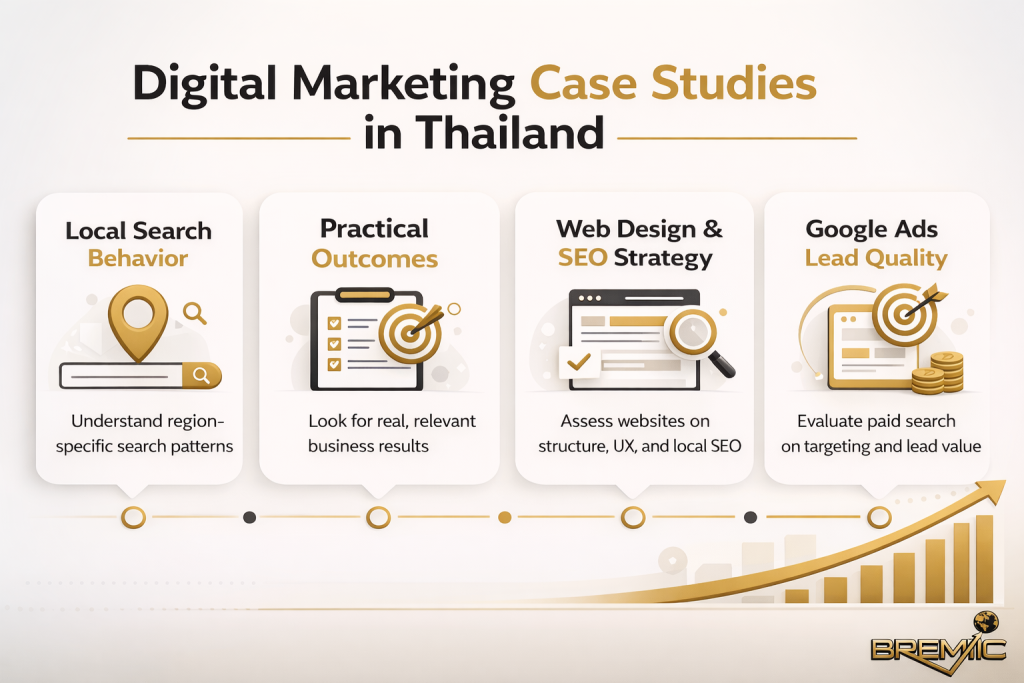
The three main types of digital marketing case studies businesses in Thailand should understand
Not all case studies answer the same question. One of the most common mistakes business owners make is comparing unlike scenarios.
Website and conversion case studies
These case studies focus on what happens when a business improves the structure, usability, trust signals, and conversion flow of its website.
This matters because traffic alone does not create growth. If the site is slow, unclear, outdated, or poorly organized, even qualified visitors may leave without taking action.
A hospitality business is a good example. In that environment, design is not just visual. It affects trust, booking intent, mobile usability, and how quickly a visitor understands the offer. A relevant example is this hotel website redesign case study in Hua Hin, which is useful for businesses evaluating how website structure and user experience can influence performance.
The broader lesson is that a website redesign should not be treated as an aesthetic project alone. The most valuable redesigns improve clarity, strengthen conversion paths, and align the site with business goals.
Local SEO case studies
Local SEO case studies are especially important for businesses whose customers search within a city, district, or service area. Restaurants, clinics, salons, trades, agencies, and local service providers often depend on high-intent searches with geographic relevance.
A good local SEO case study should show how visibility was improved for location-based searches and whether that visibility translated into real business outcomes. It should also reflect the importance of map presence, business profile quality, on-page local relevance, and consistency across core signals.
A strong example in this category is this local SEO case study for a Hua Hin restaurant. It is relevant for businesses that need to understand how local search optimization can support discoverability when customers are searching nearby and ready to act.
The strategic takeaway is simple: local SEO is not about traffic in the abstract. It is about visibility at the moment of local intent.
Paid advertising and lead generation case studies
Paid search case studies answer a different question. They are not mainly about long-term organic visibility. They are about demand capture, targeting, cost control, and conversion quality.
In Thailand, Google Ads often plays a practical role for businesses that need leads sooner, want to test service demand, or operate in competitive categories where organic growth takes time. But ad performance depends heavily on campaign structure, landing pages, keyword intent, and tracking quality.
This Google Ads lead generation case study in Thailand is relevant for businesses assessing how paid search can support lead acquisition when the objective is not broad awareness but qualified inquiry generation.
The main point is that paid advertising works best when it is connected to strong conversion infrastructure. Better targeting without a good landing experience usually does not solve the core problem.
How to evaluate whether a case study is relevant to your business
A case study can be credible and still be irrelevant to you. Relevance is about fit.
Compare the business model, not just the channel
Two businesses may both run SEO campaigns, but one may depend on local walk-ins while the other depends on high-value lead forms. Their success metrics will differ, and so will the strategy.
Before taking lessons from a case study, ask:
- Is the business model similar to mine?
- Is the buyer intent similar?
- Is the location dynamic similar?
- Is the average conversion value similar?
- Is the decision cycle short or long?
If those conditions are very different, copy-pasting the approach is risky.
Check what problem was actually solved
Businesses often focus on the headline result and miss the underlying problem.
A website redesign case study may be relevant if your issue is weak conversion and poor user trust. It may be much less relevant if your real problem is lack of traffic. A local SEO case study may be highly relevant if you need better map visibility in a specific city, but less helpful if your business serves clients nationally with non-local intent.
Case studies should help you match strategy to problem.
Look for channel dependency
Sometimes the success in a case study came from one core change. Other times it came from multiple connected improvements. For example, better ad performance may have depended on landing page changes. Better SEO performance may have depended on stronger site architecture and content targeting.
This matters because businesses often try to isolate one tactic from a broader system. That usually leads to disappointing results.
What digital marketing case studies do not tell you on their own
Case studies are valuable, but they are not forecasting tools. They cannot guarantee that your business will produce similar results in the same timeframe.
That is because performance depends on variables a case study cannot fully transfer:
- existing brand strength
- sales process quality
- speed of lead follow-up
- competition level
- review profile
- pricing position
- location demand
- website quality before the campaign
- internal team responsiveness
A case study should guide your thinking, not replace strategic diagnosis.
The right way to use one is to ask, “What principles can I apply?” rather than, “Will I get the same result?”
Common mistakes businesses make when reading case studies
Focusing only on headline outcomes
A result without context is not strategy. If you only read the outcome, you miss the mechanism behind it.
Assuming every result came from one tactic
Growth usually comes from alignment across targeting, messaging, UX, landing pages, local relevance, and follow-up systems. Case studies are most useful when they reveal how those pieces worked together.
Ignoring timing and maturity
Some businesses are starting from a weak foundation, so early gains come faster. Others are already optimized in key areas, which means improvements are harder won and more incremental. Expectations should reflect that.
Treating channel choice as a matter of preference
Businesses sometimes choose channels based on familiarity rather than fit. A local restaurant often needs strong local SEO before it needs a broad content strategy. A lead-driven service business may need paid search and conversion-focused landing pages before investing heavily in top-of-funnel content.
The best case studies help correct that mismatch.
How businesses in Thailand should use case studies strategically
The most effective use of digital marketing case studies in Thailand is not inspiration. It is decision support.
Use them to prioritize the right problem first
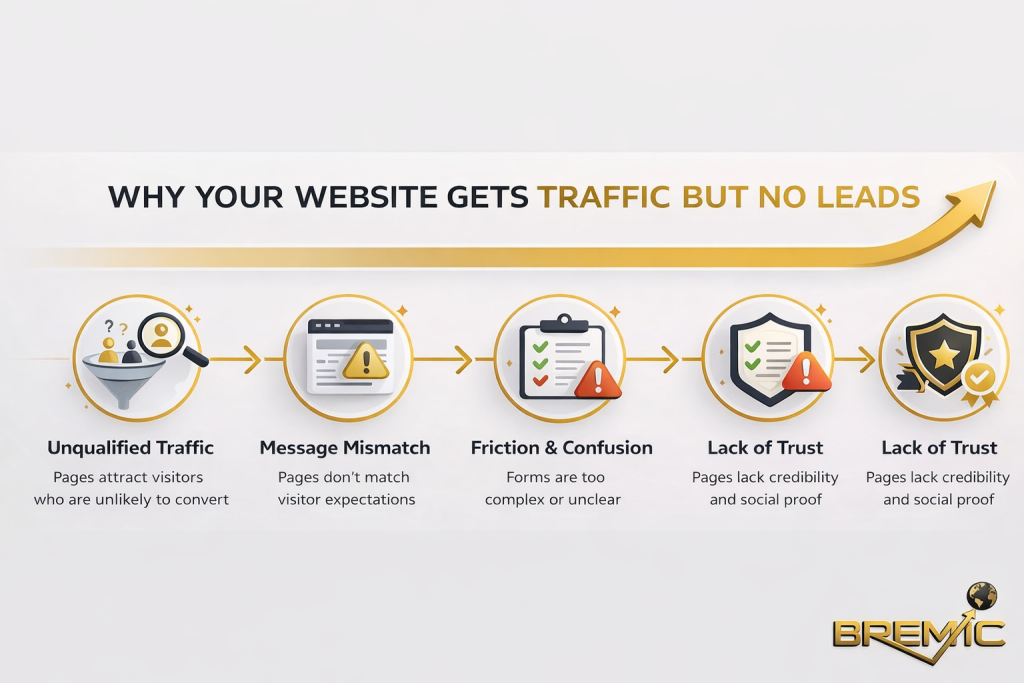
If your website is getting traffic but not converting, study cases related to site structure, trust, and UX. If your issue is local visibility, focus on local SEO examples. If your pipeline is too slow and you need to test demand quickly, paid search case studies may be more relevant.
This sounds obvious, but many businesses start with the channel they have heard of rather than the issue they actually need to fix.
Use them to ask better questions
A strong case study should help you ask more precise questions:
- Do we have a traffic problem or a conversion problem?
- Are people finding us locally when they search nearby?
- Is our website helping visitors take action or slowing them down?
- Are we measuring qualified leads or just clicks and sessions?
- Which changes are foundational, and which are secondary?
These questions lead to better strategic planning than broad requests for “more marketing.”
Use them to set realistic expectations
Case studies can show what progress looks like, but they should also help businesses think in stages. In many situations, early wins come from fixing basic problems. More competitive gains usually require deeper work across content, SEO structure, landing pages, tracking, and ongoing optimization.
That is why good marketing strategy is usually sequential. The first job is not to do everything at once. It is to identify the bottleneck that most limits performance.
Practical framework for choosing the right next move
If you are reviewing digital marketing case studies in Thailand because you want to decide what to do next, this framework is more useful than chasing trends.
If your business has traffic but weak inquiries
Look first at:
- website clarity
- mobile usability
- trust signals
- service page structure
- form friction
- call-to-action placement
In this scenario, website and conversion-focused case studies are usually the most relevant.
If your business depends on nearby customers
Look first at:
- Google Business Profile performance
- location page quality
- local keyword targeting
- review quality and recency
- map visibility
- NAP consistency and local trust signals
Here, local SEO case studies deserve close attention.
If your business needs leads quickly or wants to test demand
Look first at:
- search intent targeting
- campaign structure
- landing page alignment
- lead quality
- cost efficiency
- conversion tracking accuracy
This is where paid search case studies become useful.
If your business has multiple issues at once
Start with the constraint that most directly blocks revenue. For one company that may be visibility. For another it may be conversion. For another it may be lead quality. The right sequence matters more than doing more channels.
Realistic expectations for digital marketing performance
One of the most practical lessons from good case studies is that digital growth is rarely linear.
Website improvements can sometimes affect conversion behavior relatively quickly, but only if the business is already receiving relevant traffic. Local SEO can build meaningful visibility, but it takes consistency and depends on competition and business profile strength. Google Ads can produce leads faster, but only when targeting, budget, and landing experience are aligned.
That is why serious businesses should evaluate progress at the level of business outcomes, not vanity metrics alone. Rankings, sessions, and clicks matter, but only when they connect to inquiry quality, bookings, calls, or revenue opportunity.
The best case studies help businesses avoid two extremes: expecting instant transformation or dismissing strategic work because it is not immediate.
The strategic takeaway
The value of digital marketing case studies in Thailand is not that they promise repeatable outcomes. Their value is that they show how specific business problems can be solved with the right strategy, in the right sequence, under real market conditions.
A useful case study helps you think more clearly about fit, priority, and execution. It shows whether the issue is visibility, conversion, local discoverability, or lead generation. It reveals whether the result came from better site structure, stronger local search presence, more disciplined paid campaigns, or a combination of improvements working together.
For businesses making strategic decisions, that is far more useful than generic advice.
If you are comparing approaches, start with the problem that matters most to your business now. Review relevant examples such as a hotel website redesign in Hua Hin, local SEO results for a Hua Hin restaurant, or a Google Ads lead generation case study in Thailand. Then assess the strategic logic behind each one rather than focusing only on the headline outcome.
That is how case studies become genuinely useful: not as proof that marketing is easy, but as evidence that the right work, applied to the right problem, can move a business forward.