If you run a website, publish content, or rely on inbound demand to grow a business, SEO is not a side tactic. It is part of how your market finds you, evaluates you, and decides whether you are worth trusting.
That is why the question what is SEO and how does it work matters more than it appears to at first glance. Most people hear a short definition, assume it is mainly about keywords, and miss the real point. Search Engine Optimization is not a trick for “getting to the top of Google.” It is the process of making your website easier for search engines to understand and easier for users to trust, navigate, and act on.
When SEO is done properly, it improves much more than rankings. It sharpens site structure, strengthens content quality, clarifies relevance, and helps a website earn visibility for topics that matter to the business. It also compounds over time. A well-structured SEO strategy can keep generating qualified traffic long after a paid campaign ends.
This article explains what Search Engine Optimization (SEO) actually is, why it matters, how it works in practice, what people commonly get wrong, and what realistic results look like. The goal is not to oversimplify it, but to make it clear enough to apply strategically.
What Is Search Engine Optimization (SEO)?
Search Engine Optimization (SEO) is the process of improving a website so that search engines can understand its pages, evaluate their relevance, and show them to users searching for related topics.
In practical terms, SEO helps your content appear in organic search results when people look for information, products, services, or solutions connected to your business.
That definition is accurate, but incomplete.
SEO is not just about helping search engines find a page. Search engines can find millions of pages. The real challenge is helping them decide that your page deserves visibility over other available options.
That means SEO sits at the intersection of three things:
- Relevance — Does the page match the searcher’s intent?
- Quality — Is the content genuinely useful, accurate, and complete?
- Authority and trust — Does the site appear credible enough to be ranked for the topic?
A page might be technically accessible but still fail because it does not satisfy intent. Another page might be well written but buried in poor site architecture. Another might be relevant but published on a site with little topical depth or weak credibility signals.
This is why SEO should be viewed as a system rather than a single tactic.
SEO is about matching search intent
Every search query carries intent. A user searching “what is seo and how does it work” is not looking for a pricing page or a hard sell. They want an explanation. They want clarity. They want to understand the mechanics before making decisions.
Good SEO starts by recognizing that intent and building the page around it.
For an informational keyword like this one, the job of the page is to educate clearly, explain the process, address misconceptions, and guide the reader toward a stronger understanding of the subject. If the content jumps too quickly into promotion, tool recommendations, or generic tips, it fails the intent.
SEO is broader than content alone
A lot of SEO advice focuses heavily on writing content, and content is important. But Search Engine Optimization (SEO) also includes technical foundations, site structure, internal linking, user experience, indexation, crawlability, and off-page trust signals.
That is why strong SEO performance usually comes from alignment across the whole website, not from isolated blog posts.
Why It Matters
SEO matters because search remains one of the clearest signals of active demand. Someone typing a query into a search engine is already expressing a need, question, or commercial interest. That makes organic visibility strategically valuable.
For businesses, SEO can support several outcomes at once.
It can increase qualified traffic by bringing in users who are already searching for relevant topics. It can strengthen authority by building a visible library of useful content around your expertise. It can improve conversions by aligning the right pages with the right stage of the customer journey. And it can reduce dependency on paid acquisition by creating a durable source of inbound traffic.
That said, the value of SEO is not just traffic volume.
Traffic without relevance does not help much. Rankings for low-intent or mismatched keywords can look good in a report and still produce little business impact. Strong SEO focuses on visibility that supports meaningful outcomes, whether that means leads, sales, demo requests, newsletter signups, or simply better market visibility in a competitive niche.
SEO supports authority at the topic level
Modern SEO is not only about ranking one page. It is increasingly about demonstrating depth across a subject area.
If your site has one article about SEO and nothing else, it may be harder to compete than a site with a coherent content ecosystem covering technical SEO, on-page optimization, keyword research, internal linking, content strategy, site audits, and measurement.
This is where pillar-and-cluster models become strategically useful. A broad page introduces and organizes a core topic, while related cluster pages go deeper into supporting subtopics. Together, they help users and search engines understand the scope of your expertise.
SEO improves website performance beyond rankings
A solid SEO strategy often improves the website itself.
It pushes teams to fix crawl issues, clean up duplicate pages, clarify navigation, improve page speed, strengthen messaging, and create content that answers real questions more effectively. Even before rankings improve, those changes can make the site more usable and easier to manage.
How SEO Works
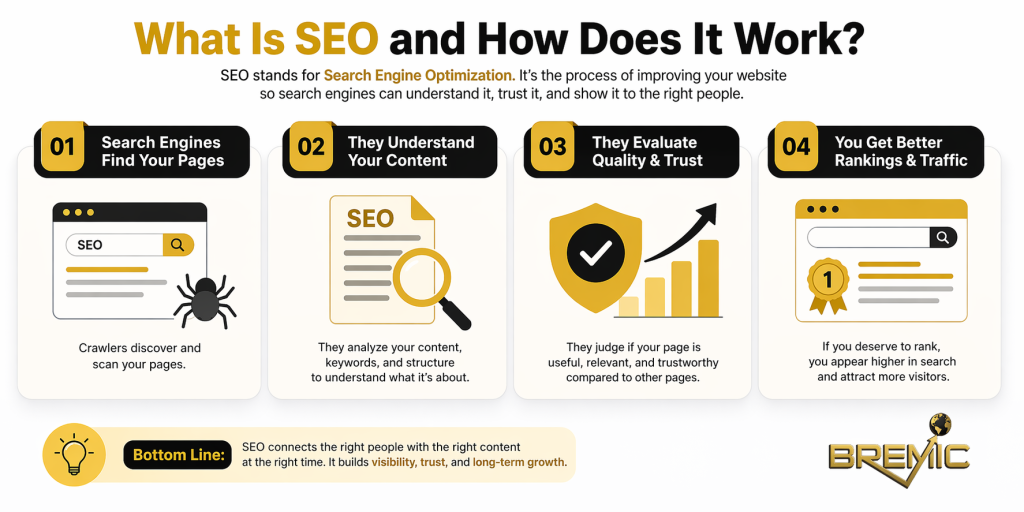
At a high level, SEO works by helping search engines discover your pages, understand what they are about, evaluate their value, and decide whether they deserve to rank for relevant searches.
That process sounds simple. In practice, it depends on many signals working together.
Crawling and indexing
Before a page can rank, search engines need to access it.
Crawlers follow links, discover pages, and process site structure. If pages are blocked, orphaned, buried too deeply, or duplicated across weak URL structures, search engines may not properly crawl or index them.
Indexing means the page is stored and eligible to appear in search results. But being indexed is not the same as being competitive. It only means the page is in the system.
This is why technical SEO matters. If search engines cannot reliably access and interpret your site, even strong content may underperform.
Understanding relevance
Once a page is accessible, search engines evaluate what it is about.
They use page titles, headings, body content, internal links, structured context, anchor text, and broader site signals to understand topical relevance. Keywords still matter here, but not in the old, mechanical sense.
Using the primary topic naturally in the title, headings, and copy helps clarify relevance. So does covering related concepts, questions, and subtopics. A page about what SEO is should logically mention search intent, crawling, indexing, rankings, content quality, internal linking, technical SEO, and authority signals. That depth helps define the topic more clearly.
This is where many low-quality pages fail. They repeat the target phrase but do not explain the subject well enough to deserve visibility.
Evaluating quality and usefulness
Search engines are trying to rank content that actually helps users.
That means a page needs more than surface-level definitions. It should answer the likely follow-up questions a user would have. It should be clearly structured, easy to read, and grounded in real understanding rather than paraphrased generalities.
Useful content usually has a few traits in common:
- It matches the search intent accurately
- It explains the topic with enough depth to be genuinely helpful
- It is structured logically
- It avoids misleading claims and vague filler
- It shows evidence of real subject understanding
A page can be optimized and still fail if it is thin, generic, or indistinguishable from dozens of other articles.
Measuring trust and authority
Search engines also consider whether the site appears trustworthy and credible.
That can involve off-page signals such as backlinks from relevant, reputable sites. It can also involve on-site signals such as topical consistency, content quality, brand clarity, author expertise, editorial standards, and overall site experience.
Authority is not built by claiming expertise. It is built by demonstrating it repeatedly across a body of work.
This is why one-off SEO tactics rarely sustain results. Search performance tends to improve when the whole site becomes more coherent, more useful, and more credible over time.
Important Subtopics Within SEO
To understand how SEO works, it helps to break it into the major areas that shape performance.
On-page SEO
On-page SEO refers to the elements on the page itself that influence relevance and usability.
This includes the page title, headings, URL, body copy, internal links, image alt text, and overall content structure. It also includes how clearly the page satisfies the searcher’s intent.
Effective on-page SEO does not mean inserting the same keyword everywhere. It means making the topic unmistakably clear while keeping the page readable and useful.
Content quality
Content is the clearest place where strategy and execution meet.
A strong SEO page does not just mention the topic. It resolves the user’s question better than competing pages. That often means going beyond the initial query and addressing the surrounding context.
For example, a page answering “what is SEO and how does it work” should not stop at a definition. It should explain why SEO matters, how search engines process content, what the main components are, and what realistic expectations look like.
Internal linking
Internal linking helps search engines discover pages, understand relationships between topics, and distribute authority across the site.
It also improves the user journey by connecting broader pages to more specific resources. In a pillar-and-cluster structure, this is especially important. A main SEO guide might link naturally to deeper articles on technical SEO, keyword research, content optimization, link building, and SEO reporting.
Good internal links feel editorially useful. They should support the reader, not simply exist for keyword targeting.
Technical SEO
Technical SEO focuses on whether the site can be crawled, indexed, and interpreted efficiently.
This includes factors such as:
- site architecture
- crawl depth
- XML sitemaps
- canonical tags
- robots directives
- page speed
- mobile usability
- duplicate content management
- structured data where relevant
Technical SEO does not replace content strategy, but it creates the conditions for content to perform. A website with major technical problems often struggles no matter how good its articles are.
Off-page SEO
Off-page SEO refers to signals that come from outside your site, especially links and brand mentions that support credibility.
Backlinks still matter because they can act as endorsements of value or relevance. But quality matters far more than raw volume. A few links from respected, relevant sites can be more valuable than a large number of weak ones.
Off-page SEO also overlaps with digital PR, brand building, and reputation. Businesses with clear positioning and strong market presence often benefit from stronger trust signals over time.
User experience and engagement alignment
SEO and user experience are not identical, but they overlap heavily.
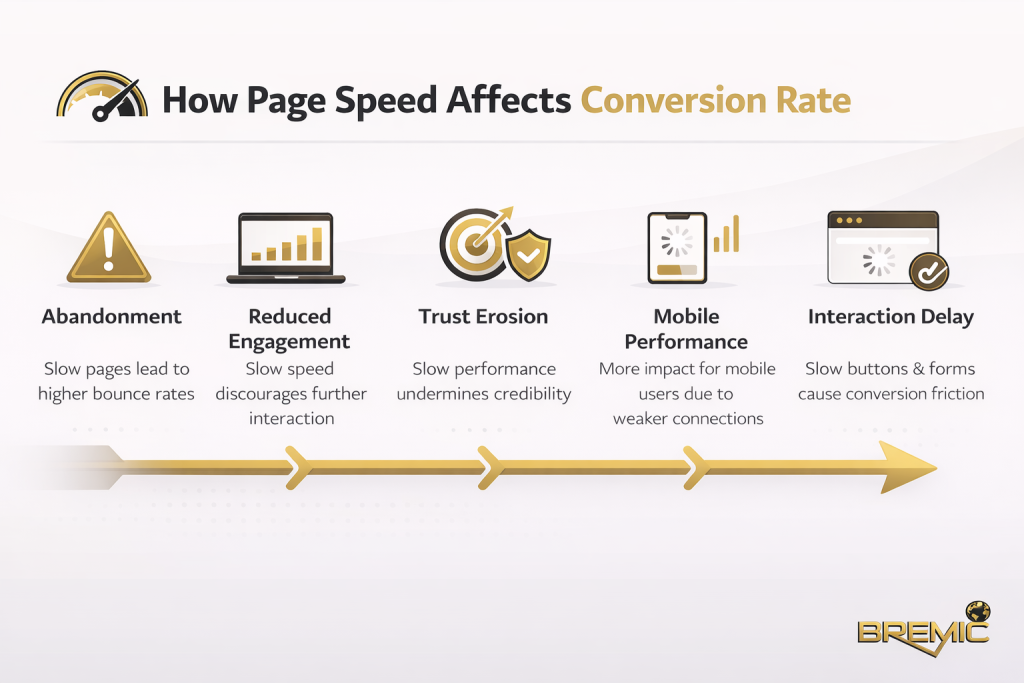
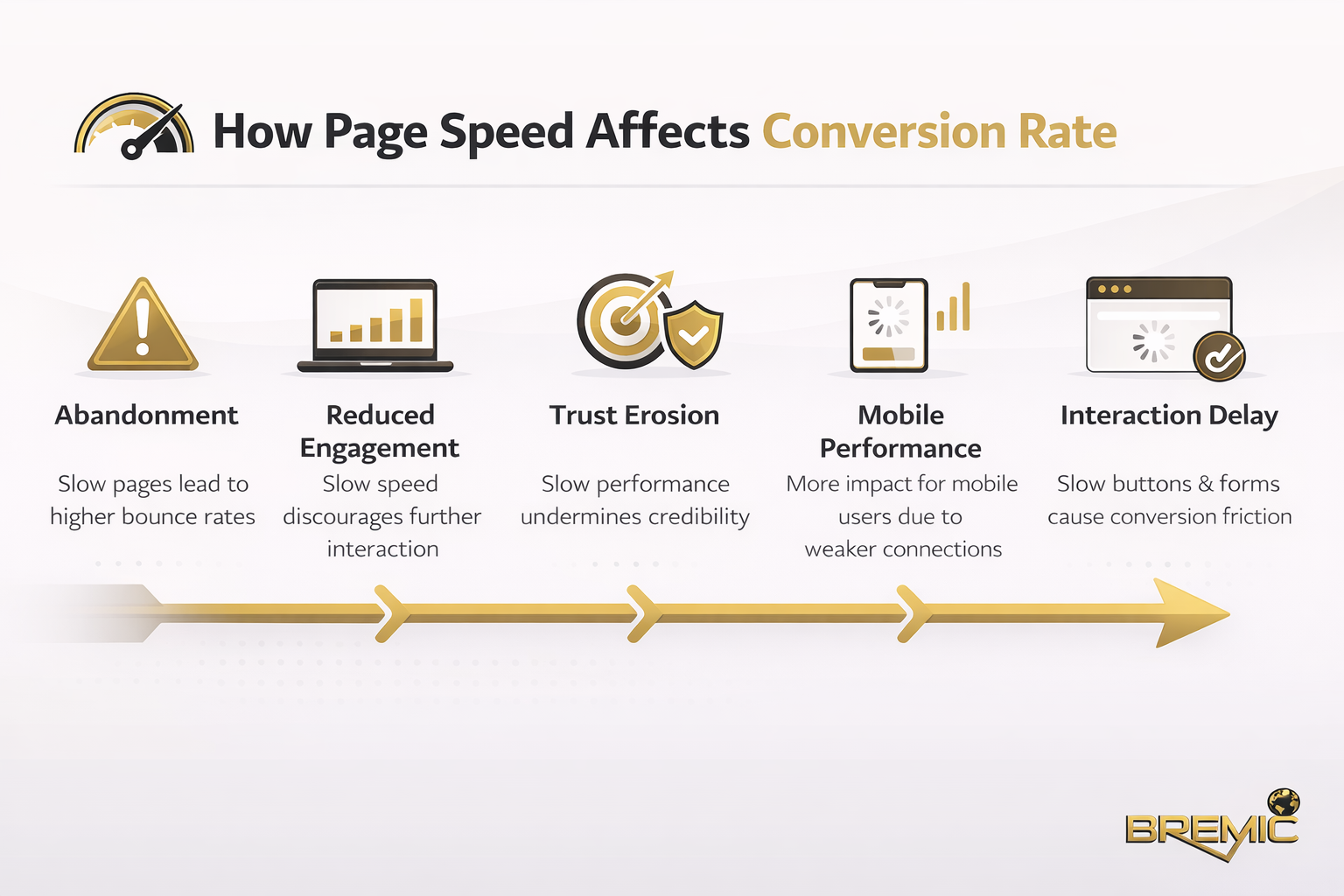
A confusing layout, intrusive design, slow pages, weak navigation, or unclear messaging can undermine performance even if the keyword targeting is correct. Search engines aim to rank pages that users can actually use.
That is why SEO should not be reduced to metadata. It is closely tied to how effectively the page serves the visitor.
Common Mistakes
Many SEO problems come from misunderstanding the purpose of the discipline rather than from minor tactical errors.
Treating SEO as only keywords
Keywords matter, but they are not the strategy. A page does not rank because it repeats a phrase often enough. It ranks because it is relevant, useful, well structured, and supported by a site that demonstrates authority.
When people reduce SEO to keyword placement, the result is usually shallow content.
Publishing content without topical structure
A site that publishes disconnected articles often struggles to build momentum. Search engines understand topics more effectively when related pages are connected through clear architecture and internal linking.
Random content may bring occasional traffic, but it rarely builds sustained topical authority.
Ignoring technical foundations
Some teams invest heavily in content while leaving major technical issues unresolved. If pages are slow, difficult to crawl, duplicated, or poorly structured, that limits performance.
Technical SEO is not glamorous, but it often determines whether strategic content can succeed.
Chasing volume over intent
High search volume looks attractive, but volume alone is a poor targeting metric.
A lower-volume keyword with tight relevance to your business can be far more valuable than a broad query that attracts the wrong audience. Good SEO prioritizes fit, intent, and business alignment.
Expecting immediate results
SEO is not a switch you turn on. It is a compounding channel that depends on trust, consistency, and iteration.
Unrealistic expectations often lead businesses to abandon sound strategies too early or chase shortcuts that create long-term problems.
Practical Guidance for Doing SEO Properly
A strategic SEO approach usually starts with clarity, not activity.
First, define the topics you genuinely want to be known for. These should reflect your services, products, expertise, and the questions your audience actually asks.
Next, map those topics into a content and site structure. Broad, high-level pages should cover core themes, while focused cluster pages address subtopics in more depth. This makes your content easier to scale and easier for search engines to interpret.
Then build each page around real search intent. Ask what the user is trying to accomplish with that query. Are they learning, comparing, evaluating, or buying? The page should match that stage cleanly.
It also helps to think in layers:
Build a technically sound foundation
Make sure important pages are crawlable, indexable, mobile-friendly, and reasonably fast. Clean architecture and clear internal linking often have more impact than people expect.
Create content with a clear job
Every page should target one main intent. A page about what SEO is should educate. A page about SEO services should persuade and convert. Blending too many goals into one page often weakens performance.
Strengthen topic depth over time
Authority is usually built through breadth and consistency. One strong page is useful. A strong network of related pages is much more powerful.
Measure the right outcomes
Track rankings and traffic, but do not stop there. Look at qualified traffic, engagement, conversions, assisted conversions, and visibility across your target topic set. SEO performance should be judged in business context, not just by vanity metrics.
Timing and Expectations
One of the most common questions around Search Engine Optimization (SEO) is how long it takes to work.
The honest answer is that it depends on the site’s starting point, competition level, technical condition, content quality, domain trust, and execution consistency.
In lower-competition niches, some pages can gain traction relatively quickly. In more competitive markets, meaningful results may take months of sustained work. Newer websites often need more time because they have less established authority and fewer trust signals.
What matters is understanding that SEO is cumulative.
Technical improvements can create early gains. Better content can start ranking for long-tail queries. Internal linking can strengthen discoverability. Over time, those improvements can reinforce each other.
The wrong expectation is “publish a page and rank immediately.” The right expectation is “build relevance, quality, and trust systematically, then improve based on evidence.”
That mindset usually leads to better decisions and more durable results.
Conclusion
So, what is SEO and how does it work?
SEO is the process of improving a website so search engines can understand it, trust it, and rank it for relevant searches. It works by aligning technical accessibility, topical relevance, content quality, site structure, and authority signals around the needs of the user.
The important point is that SEO is not a single tactic and not a shortcut. It is a strategic discipline that helps a website earn visibility rather than simply chase it.
Businesses that approach SEO seriously tend to do a few things well: they build content around real search intent, organize it into a clear site structure, improve technical foundations, and invest in trust over time. That is what turns SEO from a checklist into a long-term growth asset.
When done properly, Search Engine Optimization (SEO) does more than help pages rank. It helps a website become more useful, more credible, and more aligned with the audience it wants to reach.