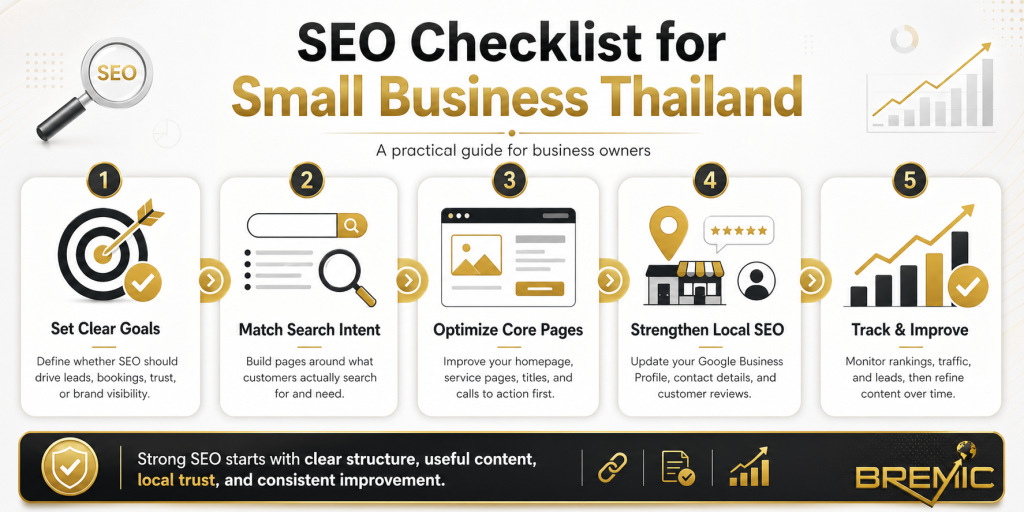
For many small businesses in Thailand, SEO feels either too technical to start or too slow to matter. Both assumptions are costly. A clear SEO checklist gives business owners a practical way to improve visibility, earn more qualified traffic, and build a stronger digital foundation without turning the website into a long-term backlog of unfinished fixes.
This guide is built for business owners and managers who want a realistic approach. It does not assume a large team, an in-house SEO specialist, or unlimited budget. It focuses on the essentials that move the needle first, then shows how to improve the site in a way that supports long-term growth.
What a small business SEO checklist should actually do
A good small business SEO checklist is not a random collection of tips. It should help you answer four practical questions:
- Can search engines crawl and understand your website?
- Does each important page match a clear search intent?
- Does your business look credible and relevant for the topics you want to rank for?
- Are you improving pages that can realistically generate leads, enquiries, bookings, or sales?
For small businesses in Thailand, this matters even more because competition often comes from multiple directions at once. You may be competing with local businesses, directory sites, marketplaces, Facebook pages, and larger brands. That means your SEO basics need to be in place before advanced tactics make sense.
Start with the pages that matter most
Before changing titles, writing blogs, or installing new plugins, identify the pages that support actual business goals. In most cases, these include:
- the homepage
- key service pages
- key product or category pages
- contact page
- location pages if you serve specific areas
- a small number of supporting content pages that answer buyer questions
This step matters because SEO should not begin with volume for its own sake. A small business site usually gets better results by improving a limited number of commercially relevant pages than by publishing large amounts of disconnected content.
Each important page should have one clear job. A service page should target a service-related query. A local page should target a location-specific query. A guide should answer an informational question. When one page tries to target everything, it usually ranks poorly for all of it.
Check your technical foundation first
Technical SEO for a small business does not need to be overly complex, but the fundamentals must be correct.
Make sure search engines can access your site
Check that your site is indexable. Important pages should not be blocked by robots.txt, marked as noindex, or hidden behind poor internal navigation. A surprising number of small business websites lose visibility because pages are technically published but difficult for search engines to reach and understand.
You should also verify that:
- the site loads on HTTPS
- there is one preferred version of the domain
- broken pages and redirect chains are limited
- your XML sitemap is active and reflects live pages
- important pages are linked from the main navigation or relevant content
Improve page speed and mobile usability
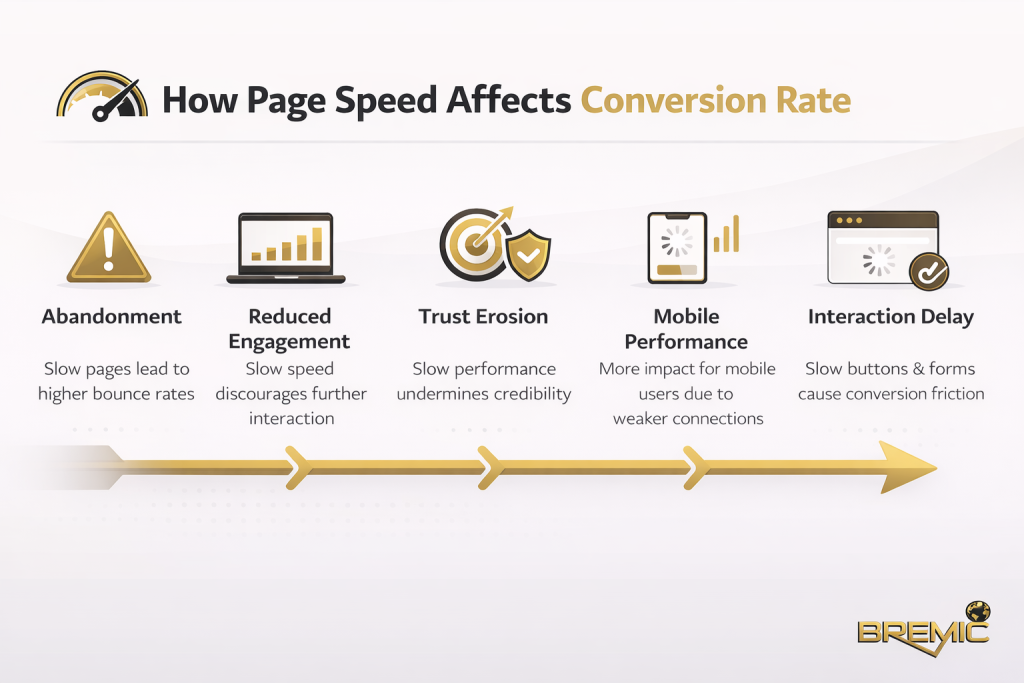
In Thailand, a large share of traffic comes from mobile users. If the site is slow, unstable, or hard to use on a phone, rankings and conversions both suffer. This is not just a development issue. It is an SEO issue because user experience affects whether visitors stay, engage, and convert.
Focus on the basics first:
- compress oversized images
- remove unnecessary scripts and plugins
- improve mobile layout and tap targets
- reduce intrusive popups
- keep page templates clean and consistent
You do not need a perfect speed score before doing anything else, but you do need a site that feels fast enough to use without friction.
Align each page with clear search intent
This is where many small business websites go wrong. They publish pages around broad topics without matching what users actually want when they search.
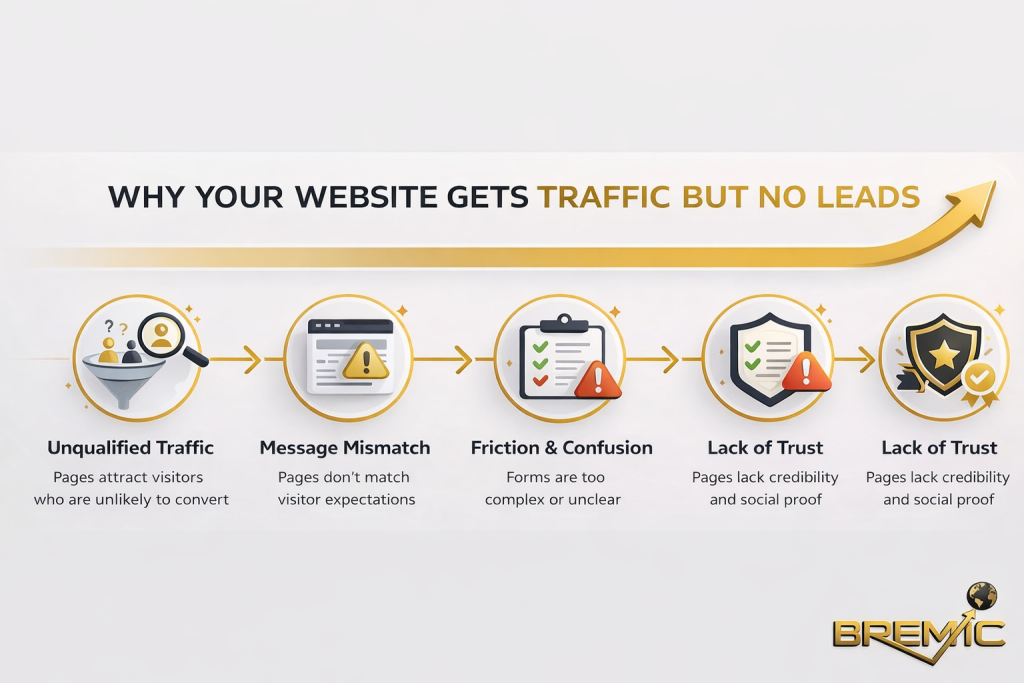
For example, someone searching for a service usually wants commercial information: what the service is, who it is for, where it is available, and how to contact you. They do not want a vague article with no pricing context, no trust signals, and no obvious next step.
Someone searching an informational query wants useful explanation, not a hard sell.
That is why one of the most important parts of any SEO guide for business owners is intent mapping. For each key page, define:
- the primary keyword theme
- the likely intent behind that search
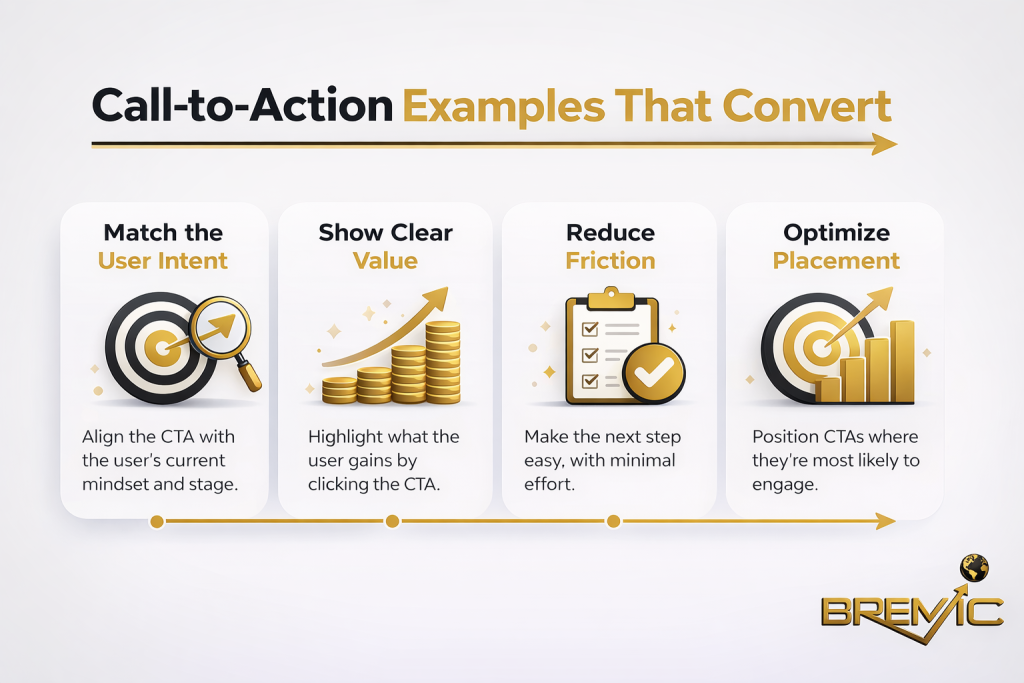
- the action you want the visitor to take
- the information they need before they are ready to act
When intent is clear, the page structure becomes easier to build. You know what questions to answer, what proof to include, and what next step to offer.
Get your on-page SEO basics right
Once the page purpose is clear, review the on-page essentials.
Titles and headings
Your page title should reflect the main topic naturally and clearly. It should not be overloaded with variations of the same keyword. Headings should help readers scan the page and should organize information logically, not just repeat search terms.
For a page targeting the primary keyword “SEO checklist for small business Thailand,” the title and headings should make the topic obvious while still reading like professional editorial content.
URL structure and content focus
Keep URLs simple and descriptive. Avoid long, cluttered slugs and avoid creating multiple pages that target the same topic with slight variations. That creates internal competition and weakens relevance.
Each page should cover one core topic deeply enough to satisfy the search intent. A useful page typically includes:
- a clear opening that frames the issue
- practical explanation, not abstract theory
- supporting detail based on real business needs
- a next step or conversion path that fits the page
Internal linking
Internal links help search engines understand site structure and help users move to related information. They should support a pillar-and-cluster model rather than exist as an afterthought.
For example, if your site has supporting guides, link to them where they genuinely add context. Likewise, relevant supporting articles should link back to key commercial or strategic pages. This creates topic relationships that strengthen authority over time.
A good place to support that structure is through your broader SEO and digital marketing resources, especially if you are building multiple supporting articles around business growth topics.
Strengthen local relevance for Thailand
Small business SEO in Thailand often requires more than generic optimization. Your pages should reflect how your real market searches and evaluates businesses.
That may include:
- English-language, Thai-language, or bilingual search behavior
- location references where geography affects service delivery
- local business details that support trust and contact intent
- clear business information across your website and profiles
If local visibility matters, your Google Business Profile should be complete and consistent with your website. Business name, phone number, service categories, and address details should match across major listings and platforms where your business appears.
Local SEO is often strongest when the website and local business profile support each other rather than operating separately.
Build credibility into the page
Small businesses do not need inflated claims to demonstrate E-E-A-T. They need clarity, transparency, and evidence that a real business stands behind the content.
That means including signals such as:
- clear business identity
- accurate service descriptions
- contact details that are easy to find
- author or company attribution where relevant
- case-based explanation without inventing data
- realistic language about timelines and outcomes
In other words, trust is often built through precision. Overpromising undermines credibility. Vague claims such as “guaranteed rankings” or “instant traffic growth” are not just risky from a brand perspective. They also make the content sound less authoritative.
Common SEO mistakes small businesses in Thailand should avoid
The most common weak approach is trying to do everything at once without fixing priorities. That usually leads to scattered content, inconsistent optimization, and little measurable progress.
Other common mistakes include:
- targeting keywords that are too broad for the site’s authority
- publishing content with no clear search intent
- creating multiple pages around nearly identical terms
- neglecting service pages while overinvesting in blog content
- ignoring mobile experience
- relying only on homepage rankings
- treating internal linking as optional
- expecting results before the site has enough relevance and trust
A strong small business SEO checklist should reduce wasted effort. It should help you focus on what is foundational, commercially relevant, and realistically achievable.
A practical order of execution
If you need a realistic sequence, use this one:
1. Fix crawlability, indexing, and mobile usability
If search engines or users cannot properly access the site, content improvements will underperform.
2. Identify your priority pages
Choose the pages most tied to enquiries, leads, bookings, or sales.
3. Map keywords and intent to each page
Avoid overlap. Give each page a clear role.
4. Improve titles, headings, content structure, and internal links
This is where the page becomes easier to rank and easier to use.
5. Strengthen local relevance and business trust signals
Make sure your site reflects the reality of your market and business footprint.
6. Add supporting content around real customer questions
Only after the core pages are solid should you expand the cluster with supporting informational content.
Set realistic expectations
SEO is rarely immediate, especially for small businesses starting from a weak foundation. Early progress often comes from improving relevance, fixing structural issues, and helping important pages perform better. Broader authority growth takes longer.
You should expect SEO to be iterative. Some pages will need repositioning. Some keywords will prove too competitive. Some content will need stronger internal support. That does not mean the strategy is failing. It means SEO is a process of refinement, not a one-time setup.
The goal is not to complete a checklist once and move on. The goal is to build a site that becomes more understandable, useful, and trustworthy over time.
Conclusion
A useful SEO checklist for small business Thailand is not about chasing every tactic. It is about getting the fundamentals right in the right order: technical health, clear page intent, strong on-page optimization, local relevance, trust signals, and disciplined internal linking.
For small business owners, that approach is more sustainable than trying to outpublish larger competitors or relying on vague SEO advice. When the site structure is clear and each page has a defined purpose, SEO becomes easier to manage and far more likely to support real business outcomes.