For many businesses in Thailand, the real question is not whether search marketing matters. It is where to invest first.
When comparing SEO vs Google Ads Thailand, business owners are usually trying to solve a practical problem: how to generate qualified leads, sales, or visibility without wasting budget. That means the decision should not be based on trends, broad marketing advice, or personal preference. It should be based on your timeline, competition, margins, search demand, and internal capacity to execute well.
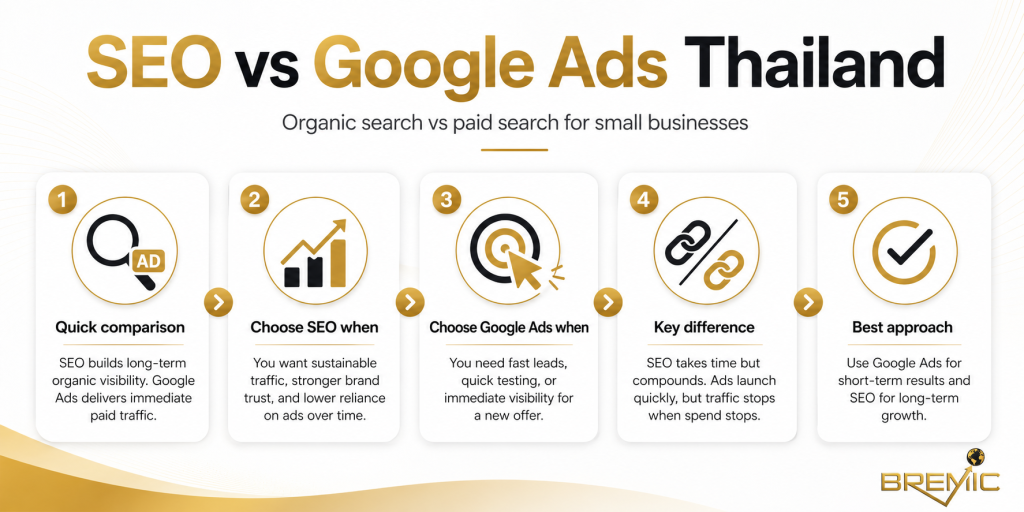
This is also why the debate around SEO or Google Ads often gets framed too simply. One channel is not universally better than the other. Organic search vs paid search is really a question of trade-offs. Google Ads can create immediate visibility, but traffic stops when spend stops. SEO takes longer, but it can build durable visibility and lower acquisition costs over time.
For digital marketing for small business in Thailand, the right choice usually depends on your stage of growth and the role search needs to play in your wider strategy. This article breaks down how both channels work, where each one performs best, and how to decide which deserves priority.
What SEO and Google Ads actually do
SEO and Google Ads both help you appear in Google search results, but they operate very differently.
SEO focuses on earning visibility in the unpaid results. That means improving your website structure, content quality, technical health, internal linking, and topical authority so Google sees your pages as relevant and trustworthy for the searches that matter to your business.
Google Ads, by contrast, buys placement in the sponsored results. You bid on keywords, write ad copy, send traffic to landing pages, and pay when someone clicks.
That difference affects far more than traffic source.
SEO is an asset-building channel. Good SEO work strengthens your website itself. Over time, your content, internal architecture, and topical relevance can support more rankings across a wider set of queries. Done properly, it compounds.
Google Ads is a demand-capture channel with immediate control. You can launch quickly, target specific commercial keywords, test offers, and increase or reduce spend based on performance. It is flexible, but it does not create lasting visibility in the same way.
That is why the question of organic search vs paid search should never be reduced to “free traffic versus paid traffic.” SEO is not free. It requires strategy, content, technical work, and patience. Google Ads is not instant profit. It requires disciplined keyword selection, landing page quality, bid control, and conversion tracking.
Why this decision matters more in the Thai market
Thailand presents a few practical considerations that make the comparison more nuanced.
First, search behavior can be fragmented by language. Some businesses target English-language searches, some Thai-language searches, and many need both. Keyword intent, competition, and conversion behavior can vary significantly depending on whether the query is in Thai or English. That changes both SEO strategy and paid search economics.
Second, many small and mid-sized businesses in Thailand operate with limited internal marketing resources. In that environment, choosing the wrong channel first can delay results or create budget inefficiency. A company that needs leads in the next 30 days should not rely only on long-term SEO. A company that depends entirely on paid traffic for years may end up with high acquisition costs and no real organic footprint.
Third, local competition matters. In some sectors, the paid search landscape is crowded and expensive. In others, organic search is weak and there is a realistic opportunity to build authority faster than competitors.
So the answer to SEO vs Google Ads Thailand is not just about search mechanics. It is about business reality.
When SEO is the better investment
SEO is usually the better primary channel when your business needs sustainable visibility rather than short bursts of traffic.
You want long-term lead generation
If your goal is to build a steady stream of qualified inbound traffic over time, SEO is usually the stronger strategic investment. A well-built search presence can continue generating leads long after a page is published, especially when content is supported by strong internal linking and a clear pillar-and-cluster structure.
You sell a higher-trust or higher-consideration service
For services where users compare options carefully before making contact, strong organic visibility often performs well. Ranking for informational and commercial-intent queries allows you to educate buyers before they are ready to convert. That is especially valuable in B2B, professional services, consulting, and considered purchases.
You need authority, not just clicks
Good SEO does more than bring visitors. It strengthens brand credibility. When your site ranks consistently across relevant topics, it signals expertise. That matters when potential customers are evaluating whether your business is a credible option.
Your paid search economics are weak
In some industries, ad costs are difficult to justify, especially for smaller businesses with tight margins or lower conversion rates. If each click is expensive and your landing pages are not yet strong enough to convert efficiently, building organic visibility may create better long-term economics.
You are prepared to invest consistently
SEO works best when it is treated as an ongoing process rather than a one-off project. Businesses that publish useful content, improve site structure, and build topical depth usually get much better results than those that expect rankings from a few isolated pages.
For businesses trying to build that foundation, it helps to review broader digital marketing resources that support long-term planning and execution.
When Google Ads is the better choice
Google Ads is usually the better first move when speed and control matter more than long-term compounding.
You need leads or sales quickly
If your business needs immediate pipeline, ads can get you in front of high-intent searchers fast. You do not have to wait for new pages to rank. That makes Google Ads especially useful for new websites, new services, seasonal campaigns, and short-term growth pushes.
You are testing demand
One of the strongest uses of Google Ads is validation. If you are not sure which offer, service angle, or keyword group converts best, paid search lets you test quickly. That insight can later inform your SEO roadmap.
Your website has low organic authority
A newer domain or a site with limited content often struggles to rank competitively at first. Ads can bridge that gap while SEO work is still in progress.
You target highly commercial keywords
For bottom-funnel keywords with strong purchase intent, Google Ads can be highly effective if the traffic is properly qualified and the landing page matches the search intent.
You need tight geographic or campaign control
Google Ads gives you more control over timing, audience, location, budget pacing, and message testing. If your business serves specific areas, promotes limited-time offers, or needs direct response measurement, that flexibility matters.
SEO or Google Ads: how to decide strategically
Most serious businesses should not think in terms of channel loyalty. They should think in terms of fit.
Here is the practical framework.
Choose SEO first if:
- you can invest for six months or more
- your sales cycle involves research and comparison
- brand credibility matters in the buying process
- you want traffic growth that compounds over time
- your website can support content depth and internal linking
Choose Google Ads first if:
- you need results in the near term
- your site is too new to rank competitively
- you want to test commercial intent before building content
- your team needs more control over spend and targeting
- you already have strong landing pages and tracking in place
Use both when:
- you need short-term lead flow and long-term visibility
- you want paid search data to inform SEO priorities
- you want to occupy more search real estate for high-value terms
- you are building a durable acquisition strategy rather than relying on one channel
In practice, this combined approach often works best. Google Ads can generate immediate traffic while SEO builds the long-term asset. Over time, strong organic performance can reduce overdependence on paid traffic.
Common mistakes businesses make in Thailand
A lot of businesses do not fail because they chose the wrong channel. They fail because they execute the right channel poorly.
Treating SEO as just blog writing
SEO is not a content publishing exercise by itself. Without proper topic targeting, search intent alignment, internal linking, technical health, and page quality, content alone rarely performs well.
Running Google Ads without conversion fundamentals
Ads do not fix weak offers, weak landing pages, or poor tracking. If conversion tracking is unreliable or the page experience is weak, paid spend becomes difficult to evaluate and easy to waste.
Comparing SEO and Ads on the wrong timeline
SEO should not be judged after a few weeks. Google Ads should not be judged only on click volume. Each channel needs to be evaluated using the right time horizon and the right metrics.
Ignoring language and query differences
For businesses in Thailand, search intent may differ between Thai and English queries. Copying the same strategy across both without keyword research or audience understanding often leads to weak performance.
Expecting one channel to solve everything
SEO is not the answer to every urgent lead problem. Google Ads is not a substitute for building authority. Overreliance on either creates strategic weakness.
A practical recommendation for small businesses
For most digital marketing for small business scenarios in Thailand, the smartest answer is phased prioritization.
If the business needs immediate commercial traction, start with Google Ads in a tightly controlled way. Focus on high-intent keyword groups, strong landing pages, accurate tracking, and disciplined spend. Use the data to understand what users actually search for and which offers convert.
At the same time, begin building SEO properly. That means creating the right site architecture, defining priority service pages, publishing useful supporting content, and building internal links that strengthen topical relevance.
If the business already has some traffic, some authority, and a website capable of supporting structured content, SEO may deserve heavier investment from the start. In that case, Google Ads can still play a targeted supporting role rather than carrying the whole acquisition burden.
The key is sequencing. Immediate demand capture and long-term asset building should support each other, not compete with each other.
Final takeaway
The real answer to SEO vs Google Ads Thailand is not ideological. It is strategic.
If you need speed, testing, and precise control, Google Ads is usually the better short-term channel. If you need durable visibility, stronger authority, and lower dependence on paid acquisition over time, SEO is the better long-term investment.
For many businesses, the best decision is not SEO or Google Ads in isolation. It is using paid search to capture demand now while building organic search visibility that grows into a more resilient channel later.
That is the difference between buying traffic and building presence. The strongest businesses in search usually learn how to do both, in the right order, for the right reasons.