For small businesses, on-page SEO is one of the few areas of search visibility you can improve without waiting on press coverage, backlinks, or a large content budget. It is also where many sites underperform. Not because the business lacks expertise, but because the website does not clearly communicate relevance, structure, and trust to search engines.
A strong on-page SEO checklist for small businesses helps solve that problem. It turns SEO from a vague ambition into a repeatable publishing standard. Instead of guessing whether a page is “optimized,” you can assess whether it is aligned with search intent, easy to crawl, clear to users, and strong enough to support rankings over time.
This matters even more for smaller sites building topical authority. If your content cluster is trying to compete in a crowded market, every page has to do its job properly. On-page SEO is not about adding keywords everywhere. It is about making each page more useful, more focused, and easier for both users and search engines to understand.
What Is Search Engine Optimization (SEO)?
Search Engine Optimization (SEO) is the process of improving a website so it can earn more visibility in search results for relevant queries. In practical terms, SEO helps search engines understand what a page is about, how valuable it is, and whether it deserves to rank for a specific search.
On-page SEO is one part of that broader process. It focuses on the elements you control directly on the page itself, such as:
- the title tag
- headings
- content structure
- internal links
- image optimization
- topical relevance
- user experience signals on the page
For small businesses, on-page SEO is often the most accessible starting point because it does not require a large technical team or aggressive link-building campaigns. It requires clarity, consistency, and a solid understanding of what the page is supposed to rank for.
Why It Matters
A well-optimized page does more than target a keyword. It improves how efficiently your site communicates value.
When on-page SEO is handled properly, it can help with:
- stronger relevance for target queries
- better alignment with search intent
- improved click-through from search results
- clearer site architecture through internal linking
- stronger topical depth across related pages
- better user engagement because the page is easier to read and act on
For small businesses, that last point is important. Rankings matter, but rankings alone are not the goal. You want qualified traffic that understands your offer and moves closer to contact, enquiry, or purchase. Good on-page SEO supports both visibility and conversion readiness.
It also creates consistency across your content cluster. If your pillar page targets a broad SEO topic and your cluster pages address narrower subtopics, each page needs a clear role. A focused page with strong on-page SEO is more likely to support the wider structure than a vague page trying to cover everything at once.
How It Works: The Core On-Page SEO Checklist
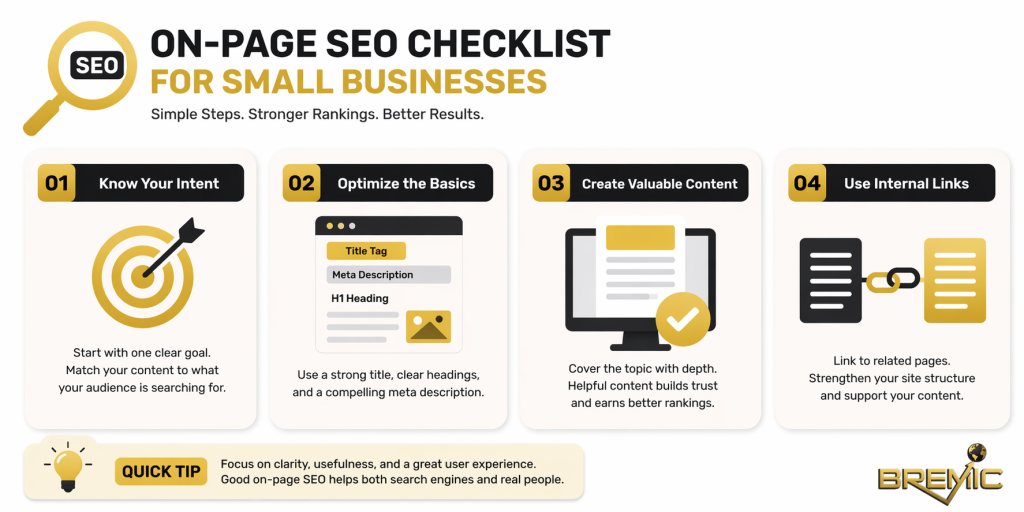
A useful on-page SEO checklist for small businesses should be practical enough to use during content creation, not just during audits. The goal is to make sure each page has a clear target, a strong structure, and enough depth to satisfy the reader.
Start with one clear search intent
Before you write or optimize anything, define the page’s main intent. In this case, the intent is informational. The reader wants to understand what should be included in an on-page SEO checklist and how to apply it to a small business website.
That means the page should educate first. It should not drift into a service pitch or try to become a complete guide to all SEO disciplines. If you blur informational intent with commercial intent, the page usually becomes weaker for both.
Use the primary keyword naturally
The primary keyword should appear where it helps clarify the topic:
- in the H1
- in the introduction
- in at least one H2 or H3 where natural
- in the title tag and meta description when publishing
- in the body copy where it fits contextually
The key is relevance, not repetition. Search engines are good at understanding topic relationships. You do not need to force the exact phrase into every section. Natural language, semantically related wording, and good topical coverage are more effective than keyword stuffing.
Write a title and meta description that match intent
Even though the body content does the ranking work, the title tag and meta description shape how the page appears in search results.
For a page like this, the title should make the value obvious. A vague title such as “SEO Tips for Websites” is too broad. A sharper title that reflects the specific need performs better because it attracts the right click.
The meta description should reinforce the practical benefit. It is not a ranking shortcut, but it can improve click quality by setting clear expectations.
Structure the page with clear headings
Headings matter because they help search engines interpret page hierarchy and help readers scan quickly.
A small business audience often wants answers without unnecessary theory. Good headings make that possible. Each section should do one job. If a heading is too vague, the section usually becomes unfocused as well.
Use H2s for the main sections and H3s only when they genuinely improve clarity. Over-structuring can make a page feel mechanical.
Cover the topic with enough depth
Thin content is still one of the most common on-page SEO problems. A page may mention the right terms but still fail because it does not answer the underlying question well enough.
For this topic, depth means explaining the checklist items in a way that a business owner or marketer can actually apply. That includes context, trade-offs, and prioritization. It is not enough to say “optimize headings” or “add internal links.” You need to explain what good implementation looks like and why it matters.
Important Subtopics Small Businesses Should Not Miss
Content quality and topical focus
The page should stay tightly aligned with its target topic. A common mistake is turning every SEO article into a broad explanation of rankings, algorithms, and traffic growth.
If the page is about an on-page SEO checklist for small businesses, it should remain centered on that use case. It can reference the wider role of Search Engine Optimization (SEO), but it should not become a general beginner guide.
That focus helps the page rank for its intended query and also prevents overlap with other articles in the cluster.
Internal linking and cluster support
Internal links are not just navigation elements. They help define topical relationships across the site.
For a page like this, internal linking should support the broader content architecture. In practice, that could include links to:
- a pillar page about SEO strategy
- related cluster articles on keyword research, title tags, local SEO, technical SEO, or content audits
- supporting articles on search intent, metadata, or content optimization
The anchor text should feel natural. Exact match can be used occasionally, but forcing the same phrase repeatedly often looks manipulative and weakens the reading experience.
URL, readability, and user experience
On-page SEO is not limited to text optimization. The overall usability of the page matters as well.
A clean URL, readable formatting, concise paragraphs, and sensible spacing all improve how the content performs. They reduce friction. If the page is difficult to scan or cluttered with repetitive blocks of text, that affects how users engage with it.
A page does not need to be flashy. It needs to be clear.
Image optimization and supporting media
Images can strengthen a page, especially when they illustrate a checklist, workflow, or example. But they should support the content, not distract from it.
That means using descriptive filenames, sensible alt text, and properly sized images. Alt text should describe the image in context, not repeat keywords pointlessly.
Common Mistakes
Many small business websites do some SEO work, but not in a way that compounds over time. The following issues are especially common.
Treating SEO as keyword placement only
This is one of the fastest ways to create weak content. Pages become repetitive, unnatural, and shallow because the focus shifts from helping the reader to inserting phrases.
Good on-page SEO is about relevance and usefulness, not density.
Creating pages with overlapping purpose
If you publish multiple pages that target similar topics without clear differentiation, they can compete with each other. That weakens your site architecture and makes it harder for search engines to understand which page should rank.
Every cluster page should have a distinct role.
Ignoring internal links
A page published in isolation rarely performs as well as one integrated into a strong site structure. Internal linking helps distribute relevance and authority across related topics.
Without it, even good pages can remain disconnected.
Over-optimizing headings and anchors
Repeating the exact target keyword in every heading, image alt attribute, and internal link usually makes the page feel forced. It also signals a poor understanding of modern SEO.
Natural language performs better because it reflects real topical coverage.
Practical Guidance for Small Business Websites
A realistic way to apply this checklist is to build a repeatable page review process.
Before publishing, ask:
- Does the page target one clear search intent?
- Is the main topic obvious from the title, headings, and opening section?
- Does the content go beyond surface-level advice?
- Are related pages linked where relevant?
- Is the page easy to read on both desktop and mobile?
- Does it contribute something distinct to the content cluster?
That last point matters. A small business site does not need hundreds of pages to build authority. It needs a set of pages that are clearly structured, strategically connected, and genuinely useful.
In most cases, it is better to improve fewer pages properly than to publish large volumes of lightly optimized content.
Timing and Expectations
On-page SEO improvements can help relatively quickly, especially when they resolve obvious relevance or structure issues. But SEO is still cumulative.
A better title, stronger heading structure, cleaner internal links, and improved content depth can improve performance over time, particularly when the page is already indexed and the site has some baseline authority.
Still, small businesses should approach this strategically. On-page SEO is not an instant ranking lever. It works best when combined with a sound site structure, technically accessible pages, and content that deserves to rank.
If the site is new or operating in a competitive niche, results may take longer. That does not make the work less valuable. It means the page should be judged not only by immediate rankings, but by whether it strengthens the overall foundation of the site.
Conclusion
A strong on-page SEO checklist for small businesses is not about chasing formulas. It is about creating pages that are focused, well-structured, and genuinely aligned with what the searcher needs.
Search Engine Optimization (SEO) works best when each page has a clear purpose within the wider site architecture. That means targeting one intent, covering the topic with real depth, supporting related pages through internal links, and avoiding the common habit of optimizing for keywords instead of usefulness.
For small businesses trying to build topical authority, this is one of the most practical places to improve performance. Done properly, on-page SEO does not just help a page rank. It helps the whole site become more coherent, more credible, and more competitive over time.