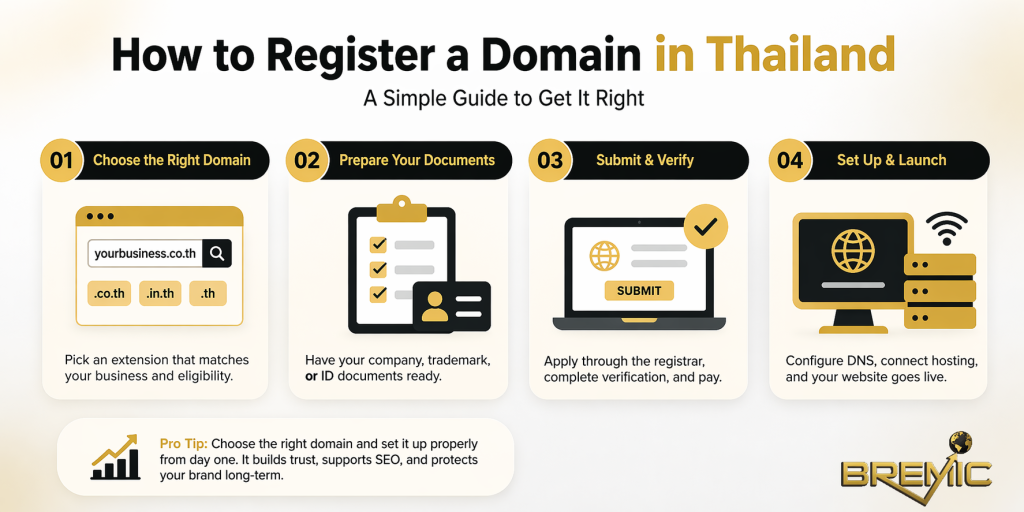
Thailand-specific domain registration is more structured than many people expect. Buying a generic domain can be simple, but registering a Thai country-code domain often depends on your legal status, the category you apply under, and whether your chosen name can be supported by documentation. For businesses targeting Thai customers, getting this right matters early because your domain affects brand credibility, compliance, and the long-term stability of your site.
If you are researching how-to-register-a-domain-in-thailand, the first strategic decision is not the registrar checkout page. It is choosing the correct namespace. In practice, most applicants are deciding between the more flexible .in.th route and the more business-specific .co.th route, while a direct second-level .th domain is a separate, limited-round process with stricter qualification and naming rules.
What Is Domain Registration?
Domain Registration is the process of reserving a domain name and linking it to a legal or identifiable holder so it can be used on the internet. In Thailand, that process is governed by the Thai Network Information Center Foundation (THNIC), with T.H.NIC Co., Ltd. acting as the current accredited registrar for .th and .ไทย names. That means Thailand-specific registrations are policy-based, not just first-come checkout purchases with no documentation.
In practical terms, registering a domain in Thailand usually means three things: proving you are eligible for the extension you want, showing that you have a legitimate basis for the name, and completing the technical setup so the domain can actually resolve online. THNIC’s current guidelines also require at least two distinct name servers before a newly registered domain can be used.
Why It Matters
From an SEO and brand perspective, your domain is not a ranking shortcut, but it is a foundational asset. It shapes how users interpret your business, how consistent your branding stays across channels, and how easy it is to build supporting content around one stable web identity.
For Thailand-focused businesses, the bigger issue is fit. A local company using the wrong Thai namespace can create friction later when ownership, renewals, transfer requests, or brand protection questions come up. Choosing the right domain class at the start is usually less costly than migrating later.
How to Register a Domain in Thailand
1. Choose the right domain category first
This is the step most people underestimate.
For most practical cases:
.in.this the most flexible Thailand-specific option. It is open to government entities, Thai legal entities, educational institutions, trademark owners, and natural persons. The current guideline also lists personal identification documents such as a Thai ID card, driver’s license, or a work permit in Thailand as acceptable evidence, depending on the holder type..co.this aimed at commercial businesses and trademark holders. It is designed for commercial operators registered with Thai authorities, as well as trademark owners, and the supporting documents typically come from company, VAT, trade, trademark, or business-license records. Foreign businesses can also qualify when operating lawfully in Thailand through a Thai-registered operator or an authorized local representative..ac.th,.go.th,.or.th,.net.th, and.mi.thare category-specific and only make sense when your organization clearly fits those institutional roles.
A direct .th domain is different. THNIC treats second-level .th registrations as a limited-round process rather than an always-open channel, and the naming rules are tighter because the applicant must qualify under specific identity or trademark criteria. For most ordinary businesses, .co.th or .in.th is the more realistic starting point.
2. Make sure the name matches your legal basis
Thailand’s domain rules are not built around creative branding alone. They are built around entitlement.
For .co.th, your chosen name usually needs to line up with your company name, trading identity, or registered trademark in a way that can be supported by the documents you submit. For direct .th, the rule is stricter still: the domain must correspond to the organization name, trademark, or personal name, subject to THNIC’s naming criteria.
That matters because the fastest way to get delayed is to pick a domain that sounds marketable but is hard to justify on paper. If your brand name and your legal documents are not closely aligned yet, it is usually smarter to solve that mismatch before filing the request.
3. Prepare the holder account, evidence, and identity details
THNIC’s current process runs through a domain management system account. The applicant or an authorized representative submits the request, uploads supporting evidence, and completes holder verification. The documents used can serve two separate purposes: proving your right to the name and proving the identity of the holder.
In practice, the evidence usually falls into one of these buckets: company registration, VAT or trade registration, trademark registration, business licenses, institutional establishment documents, or personal identification. THNIC also states that some cases can be simplified through digital identity verification or by checking data against public government databases.
4. Submit the application and respond quickly
The registrar processes applications on a first-come, first-served basis, and a request is temporarily protected while it is under review. THNIC’s guideline says the initial status email is sent within one day, and incomplete or unresolved requests can expire if they are not corrected in time. Requests in the system generally have a 30-day life.
Once the request passes the initial review, the registrar sends payment details. After payment is verified, the registrar submits the registration to the registry and notifies the holder and contacts by email.
5. Configure the domain so it actually works
A registered domain is not the same as a working website.
THNIC requires at least two distinct name servers, and the domain only becomes usable after the DNS side is configured properly. That means your hosting, DNS records, and operational contacts should be ready before you submit, especially if the domain is tied to a business launch, migration, or rebrand.
Important Subtopics
.co.th vs .in.th: which one should you choose?
If you are a registered business building a long-term commercial presence in Thailand, .co.th is usually the cleaner strategic choice. It signals business legitimacy and aligns more closely with formal company or trademark documentation.
If you need more flexibility, are registering as an individual, are testing a project, or do not yet have the exact business documentation needed for .co.th, .in.th is often the easier path. It supports a wider range of holder types and broader naming use cases.
Can foreigners register a Thailand domain?
Yes, but not every route is equally open. The official guidance explicitly allows foreign operators or trademark owners to hold certain Thai domains through a lawful Thai business presence or an authorized local representative. For natural-person use cases, the accepted proof list for .in.th includes a work permit in Thailand among the eligible identification documents.
What about a direct .th domain?
This is the prestige option, but not the default option. Second-level .th registrations are handled in limited rounds, with qualification, naming, and contention rules that are more demanding than standard third-level registrations. For most businesses, it is better treated as an advanced brand-protection or premium identity play rather than the first domain to pursue.
Common Mistakes
One common mistake is choosing the extension based only on branding, not eligibility. A name that looks perfect in a marketing deck can still be a weak application if the holder cannot prove the right category or naming basis.
Another mistake is treating the holder information as a minor admin detail. THNIC’s guideline treats the domain name itself and the holder name as critical data. Some fields are not freely editable after registration, and changes to holder identity may require formal registrar handling or a transfer process.
A third mistake is leaving DNS until the last minute. Domain Registration is only one part of launch readiness. If the name servers, DNS records, billing contact, and renewal ownership are messy, the domain can become an operational problem rather than an asset. THNIC also notes that registration terms run from one to ten years and that renewals can be stacked up to a ten-year maximum.
Practical Guidance
If you are approaching how-to-register-a-domain-in-thailand strategically, start with the holder, not the keyword.
Ask these questions in order:
- Who should legally own the domain: the company, a founder, a local entity, or a trademark holder?
- Which extension best matches that legal identity?
- Does the planned domain name match the documents strongly enough to survive review?
- Are your DNS and renewal responsibilities assigned before launch?
That order reduces risk. It also supports better long-term SEO governance, because the domain ends up owned by the right entity, renewed by the right contact, and aligned with the brand you intend to scale.
Timing and Expectations
The review cycle is usually not the slowest part. THNIC says the registrar sends an initial review result within one day, but your actual completion speed depends on document quality, naming fit, payment completion, and DNS readiness.
Renewal discipline matters too. Under the current guideline, a domain that is not renewed can move from expiry into suspension, then into redemption, where additional recovery steps and fees apply. Once you are past the comfortable renewal window, the process becomes more expensive and more operationally disruptive.
Conclusion
How-to-register-a-domain-in-thailand is really a question of fit, evidence, and process.
The right move is usually not chasing the shortest or flashiest name. It is choosing the Thai namespace that matches your real legal position, preparing the supporting proof before you apply, and setting up ownership and DNS properly from day one. When you do that, Domain Registration stops being a one-time admin task and becomes a stable foundation for brand growth, search visibility, and long-term site control.