If you are wondering why your business is not showing on Google Maps, the problem is usually not one single mistake. In most cases, it is a visibility issue caused by a weak or incomplete local presence, a Google Business Profile problem, inconsistent business data, or simple competition from better-optimized local results.
That matters because Google Maps is not just a directory. For many local businesses, it is one of the main places where potential customers decide who to call, visit, or ignore. If your business does not appear when people search nearby, you are losing visibility at the exact moment intent is strongest.
This article explains what is actually happening when a business is missing from Google Maps, how Local SEO influences map visibility, what business owners often get wrong, and how to diagnose the issue without guessing.
What Is Local SEO
Local SEO is the process of improving your visibility in location-based search results, especially on Google Maps, in the local pack, and in organic searches with local intent.
In practical terms, Local SEO helps Google understand:
- what your business does
- where your business is located
- which areas you serve
- whether your business is legitimate
- how relevant and trustworthy your business appears compared with nearby competitors
That means Google Maps visibility is not based only on having a business listing. It depends on whether Google has enough confidence in your business information and enough reasons to show you for a specific search.
A business can exist, be legitimate, and still fail to appear prominently in Maps if its local SEO foundation is weak.
Why Local SEO Matters for Google Maps Visibility
Google Maps is heavily tied to local intent. When someone searches for a service, product, or business type in a specific area, Google tries to return results that are relevant, nearby, and credible.
That is why map visibility affects more than brand exposure. It can influence:
- phone calls
- direction requests
- website visits
- foot traffic
- lead volume
- local trust signals
From an SEO perspective, map visibility also supports broader search performance. A well-optimized local presence can reinforce branded search demand, improve click-through rates, and strengthen the authority of your website within a local topic cluster.
If your business is not showing on Google Maps, the issue is often a signal that your local search ecosystem is underdeveloped or sending mixed messages.
Why Your Business Is Not Showing on Google Maps
There are several common reasons behind the problem. Some are technical. Others are structural. Many are fixable.
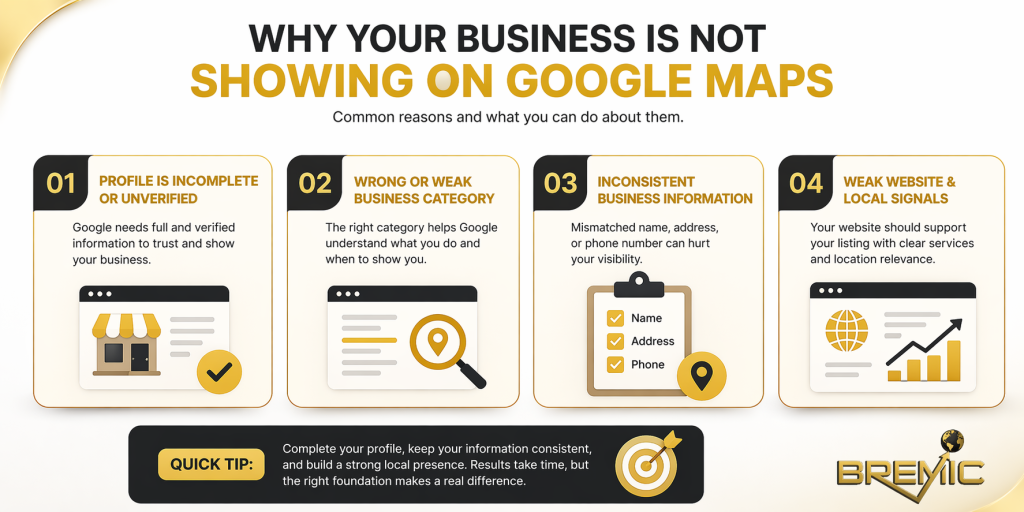
Your Google Business Profile is incomplete or unverified
This is one of the most common reasons. If your Google Business Profile is not verified, suspended, or only partially completed, your visibility may be severely limited.
An incomplete listing often lacks the signals Google uses to assess relevance and legitimacy, such as:
- primary and secondary categories
- business description
- hours
- photos
- services
- website link
- accurate contact details
Verification is not just an admin step. It is part of Google’s trust process. If that process is incomplete, your business may not be eligible to appear consistently.
Your business category is weak or inaccurate
Google relies heavily on your primary category to decide which searches your business should appear for. If you choose a category that is too broad, too narrow, or simply wrong, you may disappear for the terms that matter most.
For example, a business that should be categorized as a family law attorney but is listed more generally as a legal service may struggle in competitive local results.
Category selection is not a small detail. It directly affects relevance.
Your location signals are inconsistent
Google wants consistent business information across the web. If your business name, address, phone number, or service area varies across directories, social profiles, your website, and your Google Business Profile, that creates friction.
This is especially common after:
- rebranding
- moving offices
- changing phone numbers
- merging listings
- using tracking numbers carelessly
Inconsistent data does not always remove you from Maps completely, but it can weaken trust and limit visibility.
Your website does not support local relevance
A Google Business Profile alone is rarely enough in competitive markets. Google also uses website signals to confirm what your business offers and where it is relevant.
If your website has weak local landing pages, unclear service descriptions, poor metadata, or little geographic relevance, Google has less supporting evidence for your listing.
This is where Local SEO becomes broader than profile management. Your site architecture, internal linking, service pages, and location signals all matter.
A business with a strong listing and a weak website often underperforms a competitor with a better-connected local presence.
You are in a competitive area and not strong enough yet
Sometimes the real answer to why your business is not showing on Google Maps is simple: Google is showing other businesses instead.
Map results are limited. In many searches, only a few businesses receive primary visibility. If competitors have more complete profiles, stronger reviews, clearer category targeting, more authoritative websites, and better engagement, they may consistently outrank you.
That is not necessarily a penalty or technical error. It may just mean your local signals are not strong enough yet.
Your listing has duplicate, filtered, or conflicting entries
Duplicate listings can confuse Google’s systems. In some cases, one listing becomes dominant while another is suppressed. In others, neither performs well.
There is also a separate issue known informally as local filtering. A business can exist in Google Maps but appear inconsistently because nearby competitors share similar categories or addresses, or because Google groups similar businesses and shows only some of them more prominently.
This is particularly common in shared office environments, service businesses, and dense urban locations.
Your service area setup is unclear
For service area businesses, local visibility can be more complicated than for storefronts. If your business serves customers across a region but does not have a clearly eligible physical presence, your visibility may depend heavily on how your service area, categories, and website content are configured.
Many businesses assume that adding multiple cities to a profile means they will rank in all of them. That is rarely how it works.
Google still needs evidence that your business is relevant in those areas.
How to Diagnose the Problem Properly
If you want to fix map visibility, start with diagnosis rather than random edits.
Check your Google Business Profile status
Make sure the profile is:
- verified
- not suspended
- connected to the correct business information
- using the most accurate primary category
- fully completed
Also confirm there are no old or duplicate versions of the listing.
Review your core business data everywhere
Check whether your business name, address, phone number, website URL, and operating details are consistent across:
- your website
- Google Business Profile
- key directories
- social profiles
- industry listings
Small inconsistencies add up. Local SEO works best when your data is stable and uniform.
Evaluate your website’s local signals
Ask whether your website clearly supports your map listing.
Your site should make it obvious:
- what you do
- where you are located
- which areas you serve
- why your business is relevant for those services
This usually means having strong service pages, location context where appropriate, clear contact details, and internal links between related local content.
Compare your listing with top competitors
Do not analyze your business in isolation. Search your main target terms and compare your presence with the businesses that consistently appear.
Look at:
- category choices
- review profile
- photos
- business description
- website quality
- location relevance
- overall completeness
This often reveals whether the issue is eligibility, trust, or simple competitive weakness.
Common Mistakes Businesses Make
A lot of local visibility problems get worse because the response is reactive.
Constantly changing the profile without a strategy
Frequent edits to categories, business names, service areas, or addresses can create instability. Not every update is harmful, but repeated changes made without a clear reason can delay trust and confuse the signal set.
Stuffing keywords into the business name
This is a common tactic, and sometimes businesses do it because they see competitors doing the same. But it is not a sound long-term strategy. It can create compliance issues and puts your listing at risk if the name does not reflect your real-world branding.
Relying only on the listing and ignoring the website
Google Business Profile optimization matters, but it should not be treated as a standalone tactic. Local rankings are stronger when your listing and website support each other.
Expecting instant results after setup
A corrected profile does not always lead to immediate visibility improvements. Local SEO often requires Google to recrawl, process trust signals, and reassess relevance over time.
Practical Guidance for Improving Google Maps Visibility
A realistic approach is usually more effective than trying ten tactics at once.
Start by fixing foundational issues first:
- verify and complete the Google Business Profile
- confirm the best primary category
- clean up inconsistent business data
- remove or resolve duplicates
- strengthen local relevance on the website
- improve review quality and profile completeness over time
Then support that work with a proper content structure. A good local SEO setup is not just a listing and a homepage. It often includes supporting content around services, locations, reputation, citations, and Google Business Profile optimization.
That is how cluster-based site architecture can help. It gives Google clearer topical context and gives users more relevant pathways through your site.
Timing and Expectations
Local SEO is not instant, especially in competitive markets.
If the issue is basic, such as missing verification or incorrect category targeting, improvements can happen relatively quickly once corrected. If the problem is broader, such as weak authority, poor local relevance, or stronger competitors, progress usually takes longer.
The key is to think in stages:
- first, fix eligibility and trust
- second, strengthen relevance
- third, build competitive authority
That is a more realistic model than expecting Google Maps visibility to improve just because the profile exists.
Conclusion
If your business is not showing on Google Maps, the answer is usually structural rather than mysterious. Google needs clear, consistent, trustworthy signals before it will surface a business confidently in local results.
That is why Local SEO matters. It is not just about claiming a profile. It is about building a connected local presence that supports relevance, trust, and visibility.
A serious fix starts with diagnosis, not guesswork. Review your Google Business Profile, your website, your business data, and your competitors with a strategic eye. Once those pieces are aligned, Google Maps visibility becomes far easier to improve and far easier to sustain.