If your website is not ranking on Google, the problem is rarely one single issue. In most cases, poor visibility comes from a combination of weak relevance, low authority, technical friction, and content that does not fully satisfy search intent.
That is why this topic matters. Many site owners assume rankings are mainly about publishing more pages or adding keywords to a title tag. In reality, Search Engine Optimization (SEO) is a system. Google evaluates whether a page is relevant to the query, useful to the user, technically accessible, and credible compared with competing results.
This article explains why your website is not ranking on Google, what SEO actually involves, and how to diagnose the issue in a practical, strategic way. The goal is not to offer quick fixes. It is to help you understand what Google is looking for and how to improve your site in a way that supports long-term performance.
What is Search Engine Optimization (SEO)
Search Engine Optimization (SEO) is the process of improving a website so that search engines can understand it, trust it, and rank it for relevant queries.
In practical terms, SEO is not just about keywords. It includes how your site is structured, how well your pages match search intent, how strong your internal linking is, how technically accessible the site is, and whether your content demonstrates real expertise.
A well-optimized page does three things clearly:
- It tells Google what the page is about.
- It gives users a better answer than competing pages.
- It fits into a larger site structure that signals topical depth and authority.
This is where many websites fall short. They may have decent content, but the page is isolated, the intent is unclear, or the site has not built enough trust around the topic.
Why SEO matters for rankings and website performance
When a website is not ranking on Google, the immediate concern is usually traffic. But rankings affect more than visits.
Strong SEO improves qualified visibility. That means appearing in front of users who are already searching for what you offer or what you know. This often leads to stronger engagement, more trust, better lead quality, and higher conversion potential than traffic from less targeted channels.
SEO also shapes how Google interprets your business. A site with clear topical coverage, helpful content, and a logical internal structure is easier for search engines to evaluate. Over time, that improves indexation, strengthens authority signals, and gives individual pages a better chance to rank.
Poor SEO has the opposite effect. Even strong products or services can remain invisible if the site sends weak or mixed signals.
How Google decides whether to rank your website
Google does not rank websites simply because they exist, or because they are well designed. It ranks pages that appear to be the best fit for a given search.
Relevance to the search query
Your page needs to match what the user is actually looking for. If someone searches for why your website is not ranking on Google, they expect diagnosis, causes, and practical next steps. They do not want a broad sales pitch about digital marketing.
If your content targets the wrong angle, it may never become competitive, even if it is technically sound.
Search intent alignment
Intent is one of the most common ranking gaps. A page can include the right keyword and still fail because it does not meet the dominant intent in the search results.
For informational searches, Google usually favors pages that explain, compare, clarify, or guide. If your page is overly commercial, too thin, or too generic, it may not align with what Google sees users preferring.
Content quality and depth
Google is better than many site owners assume at distinguishing between surface-level content and genuinely useful information.
Thin pages often fail because they restate obvious points without explaining why they matter. Stronger content shows understanding. It breaks down causes, trade-offs, mistakes, and realistic expectations. It answers the next question a serious reader is likely to ask.
Authority and trust signals
If your site is new, lightly linked, or covers topics with little depth, Google may not yet see it as a reliable source.
This does not mean only large brands can rank. It means smaller sites need clearer topical focus, stronger content quality, and better internal structure to compete. Trust is built over time through consistency, accuracy, usability, and signals that show the site is maintained and credible.
Technical accessibility
A page cannot rank properly if Google struggles to crawl, index, or interpret it.
Common technical issues include blocked pages, poor internal linking, duplicate content, slow load times, broken canonicals, weak mobile performance, and JavaScript-heavy pages that are not rendered well. Technical SEO does not replace content quality, but it can absolutely limit rankings when basic issues are ignored.
The main reasons your website is not ranking on Google
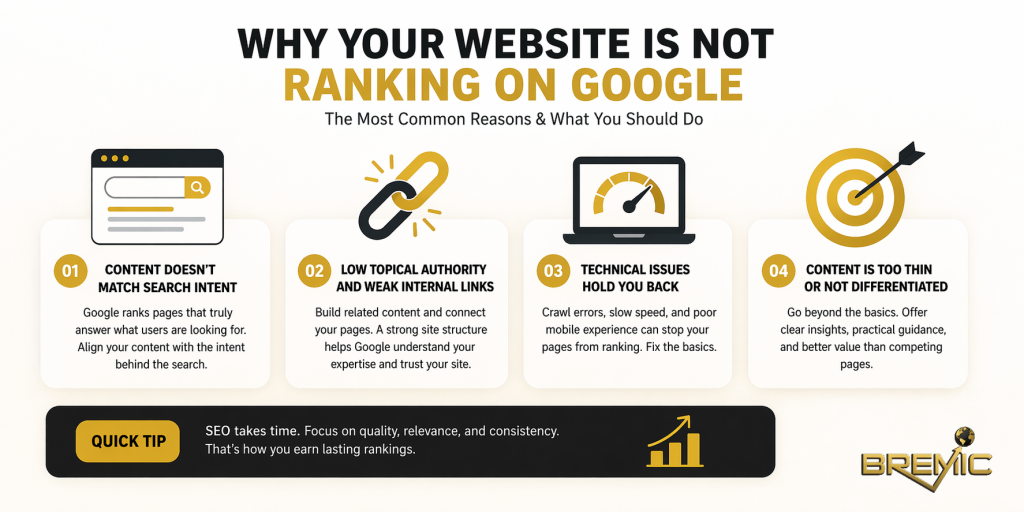
Your content is targeting keywords, not topics
A page built around a single phrase without proper topical context often looks incomplete. Google increasingly evaluates whether a page belongs to a broader, coherent subject area.
If your site publishes isolated articles with no cluster strategy, weak supporting content, and little internal linking, it is harder to establish authority. One article alone rarely proves expertise.
Your page does not satisfy search intent
This is one of the most frequent reasons a website is not ranking on Google. You may be trying to rank a homepage for an informational query, or a blog post for a transactional keyword, or a short article for a topic that clearly requires deeper explanation.
The search results usually reveal the dominant format. If most top-ranking pages are detailed guides and your page is a brief overview, that mismatch matters.
Your site has not earned enough authority yet
Newer websites often expect rankings too early. Even with solid on-page work, a site may struggle until it builds a stronger footprint in its niche.
Authority is influenced by factors such as topical consistency, backlinks, brand mentions, publishing quality, and overall site trust. You do not need an aggressive link campaign to improve, but you do need signals that your site deserves to be taken seriously.
Your technical SEO is getting in the way
Sometimes the issue is not content at all. Pages may not be indexed, internal links may be too weak, or the site architecture may bury important pages too deeply.
A technically messy site makes it harder for Google to understand what matters. This is especially damaging when multiple pages compete for similar terms or when key pages are not well connected from the rest of the site.
Your site architecture is too flat or too fragmented
Topical authority is difficult to build when pages are disconnected.
A strong pillar-and-cluster structure helps Google understand relationships between pages. A pillar page can cover a broader subject, while focused cluster pages address specific questions and link back into the broader topic. This supports crawling, clarifies relevance, and strengthens the perceived depth of the site.
If your content exists as separate articles with no strategic relationship, you lose much of that benefit.
Important subtopics that affect rankings
Internal linking
Internal linking is not just for navigation. It helps distribute authority, guide crawlers, and reinforce topic relationships.
When relevant pages link to each other naturally, Google gets clearer signals about which pages are most important and how your content ecosystem is organized.
Weak internal linking often leaves good pages under-supported.
Indexation and crawlability
Some pages do not rank because they are not properly indexed in the first place. Others are indexed but treated as low value because they look duplicative, orphaned, or thin.
This is why a ranking review should always include crawl status, indexation status, and how important pages are surfaced within the site.
Content differentiation
If your article says the same thing as dozens of competing pages, there is little reason for Google to prefer it.
Differentiation does not require a dramatic opinion. It requires sharper framing, clearer insight, stronger examples, better structure, or more practical guidance than what is already ranking.
Common mistakes that keep websites from ranking
Many websites underperform because they repeat familiar SEO mistakes:
- publishing content without first validating search intent
- targeting broad keywords with weak domain authority
- creating multiple pages around overlapping topics
- relying on AI-generated copy without editorial expertise
- ignoring internal links and site structure
- treating technical SEO as separate from content strategy
- expecting rankings before the site has built enough trust
These mistakes matter because SEO problems compound. A page with average content might still rank if the site has strong authority and internal support. But when content, structure, and technical quality are all only average, rankings tend to stall.
Practical guidance for improving rankings
Start with diagnosis, not assumptions. If your website is not ranking on Google, review the issue in layers.
First, check whether the page is indexed and crawlable. Then compare it directly with the current top results. Look at content depth, intent match, structure, and quality. After that, review whether the page is properly supported by internal links and whether the topic is covered elsewhere on the site.
From a strategy perspective, focus on these priorities:
Build topical depth
Do not rely on one page to rank for an entire subject. Create supporting cluster content that addresses adjacent questions, subtopics, and decision points. This strengthens the whole topic, not just the target page.
Improve intent match
Study the existing search results and align with what users clearly want. That may mean changing the page type, expanding the scope, narrowing the angle, or removing commercial language from an informational article.
Strengthen internal architecture
Link related pages with purpose. Help Google understand which page is the core resource and which pages support it. Good internal linking is one of the most overlooked improvements in Search Engine Optimization (SEO).
Upgrade weak content, do not just expand it
Longer is not automatically better. The goal is not word count. The goal is completeness, clarity, usefulness, and trust. Improve substance before adding volume.
Timing and realistic expectations
SEO usually takes time because rankings depend on trust, competition, and consistency.
A technical fix may lead to faster improvement if crawl or indexation was the main problem. But content and authority gains typically take longer. For newer sites or competitive topics, meaningful movement can take several months.
This is normal. SEO is cumulative. Stronger site structure, better content, improved internal linking, and clearer topical focus tend to build momentum over time rather than produce instant results.
That is why realistic expectations matter. Good SEO is not about quick ranking spikes. It is about building a site that deserves sustained visibility.
Conclusion
If your website is not ranking on Google, the answer is usually not that Google is ignoring you. It is that your site has not yet given Google enough strong, consistent signals to justify better visibility.
Search Engine Optimization (SEO) works when relevance, intent, quality, technical health, and authority support each other. When even one of those areas is weak, rankings can suffer. When several are weak at once, performance often stalls completely.
The most effective response is strategic, not reactive. Diagnose the real issue, improve the page in context of the wider site, and build topical authority with patience and structure. That approach is slower than chasing shortcuts, but it is also how durable rankings are earned.