Choosing a domain name is one of those decisions that feels simple at first and expensive to fix later.
A good domain supports your brand, makes your business easier to remember, and gives your website a stronger foundation for long-term marketing. A poor one creates friction from day one. It can confuse users, weaken trust, complicate branding, and make future growth harder than it needs to be.
That is why how to choose the right domain name for your business is not just a naming exercise. It is a strategic business decision that affects branding, SEO, usability, and even conversion performance.
This guide breaks down the decision in practical terms. You will learn what Domain Registration actually involves, what matters from an SEO perspective, where business owners often go wrong, and how to choose a domain that works now without limiting you later.
What is Domain Registration
Domain Registration is the process of securing the web address your business will use, such as yourbusiness.com.
In practical terms, it means you register the right to use a specific domain name through a registrar for a defined period, usually one or more years. Once registered, that domain becomes the primary address people use to find your website, and it often becomes part of your email identity as well.
The registration itself is administrative. The more important question is whether the domain you register is actually the right one for your business.
That is where many companies make the wrong assumption. They focus on what is available instead of what is strategically suitable. Availability matters, but the better question is this:
Will this domain still make sense as the business grows?
A domain name should be easy to understand, aligned with your brand, commercially credible, and durable enough to support future expansion.
Why It Matters
A domain name is not a major ranking factor in the way many people assume, but it still matters for SEO in several indirect and meaningful ways.
First, it affects trust. Users make fast judgments about whether a website looks legitimate. A clear, professional domain is easier to trust than one that feels spammy, awkward, or overloaded with keywords.
Second, it affects memorability. If people cannot recall your domain, they are less likely to return directly, recommend you, or search for your brand later. Brand recall is not a minor issue. It influences repeat traffic, referrals, and branded search demand over time.
Third, it affects click behavior. In search results, email campaigns, and social shares, the domain is visible. A clean and relevant domain can improve perceived credibility before a user even lands on the page.
Fourth, it affects site architecture and long-term authority building. If you are investing in a pillar-and-cluster content model, your domain becomes the home of that authority. A strong domain gives you room to build out service pages, educational content, location pages, and supporting clusters without looking narrow or outdated.
So while the domain itself will not guarantee rankings, the wrong domain can still weaken performance across branding, trust, and marketing efficiency.
How to Choose the Right Domain Name for Your Business
The best way to approach this decision is to think beyond the launch phase.
Start with brand clarity
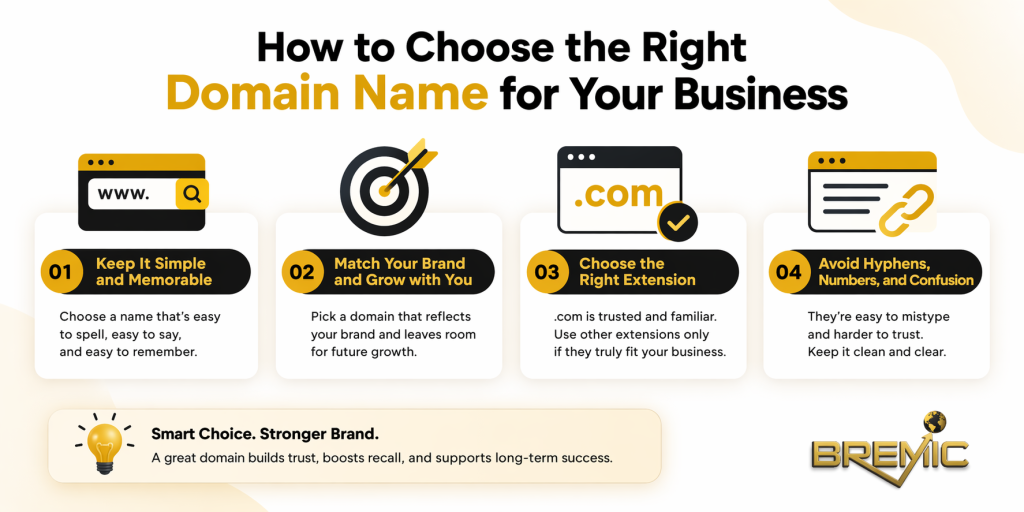
Your domain should reflect how you want the business to be known, not just what keyword you want to rank for.
If your business name is already established, the strongest option is usually a domain that matches it closely. Consistency across your business name, domain, email, and social profiles reduces confusion and strengthens brand recognition.
If you are still naming the business, prioritize a name that is:
- easy to pronounce
- easy to spell
- easy to remember
- distinct enough to stand out
- broad enough to grow with the business
A domain that sounds good when spoken aloud is often stronger than one that only looks good on paper. That matters more than many people realize, especially for word-of-mouth referrals and branded search.
Keep it simple
Shorter is usually better, but clarity matters more than absolute length.
A concise domain is easier to type, remember, and share. That said, a slightly longer domain that is clear and brandable is usually better than a short domain that is vague or confusing.
Try to avoid:
- hyphens
- unnecessary numbers
- unusual spellings
- doubled letters that are easy to mistype
- awkward abbreviations that only make sense internally
Complexity creates leakage. Every extra point of friction increases the chance that someone types the wrong address, forgets the name, or mistrusts the brand.
Choose a domain that fits long-term positioning
One of the most common mistakes in Domain Registration is choosing a name that locks the business into its current offer.
For example, a company that starts with logo design may later expand into broader branding or digital strategy. A domain built around one narrow service can become restrictive once the business grows.
This does not mean every domain should be abstract. It means the domain should support the business you are building, not just the service you are selling this quarter.
Think about future expansion in terms of:
- additional services
- new locations
- broader audiences
- product lines
- brand repositioning
A domain should leave room for growth without forcing a rebrand too early.
Should You Include Keywords in the Domain?
This is where nuance matters.
Including a relevant keyword in a domain can still help with clarity and user understanding, especially for local businesses or highly specialized brands. A domain that signals what the business does can sometimes make immediate sense to users.
But that does not mean you should force exact-match keywords into the domain.
Domains like best-cheap-seo-services-online.com do not create credibility. They often do the opposite. They look low quality, over-optimized, and difficult to build into a serious brand.
A keyword in the domain is acceptable when it feels natural and brandable. It becomes a problem when it makes the domain look generic, manipulative, or forgettable.
For most businesses, the better priority order is:
- brand fit
- clarity
- memorability
- scalability
- keyword relevance, where natural
That is a more durable framework than chasing an SEO benefit that is often overstated.
Choosing the Right Domain Extension
The extension is the part after the dot, such as .com, .co, .net, or a country-code extension like .uk.
Is .com still the best choice?
In many cases, yes.
.com is still the most familiar and broadly trusted extension for commercial businesses. It is usually the safest default because users recognize it immediately and often assume it by instinct.
If the .com version of your brand is available and reasonable to secure, it is often the strongest option.
When other extensions make sense
Alternative extensions can work, but they should be chosen carefully.
A country-specific extension can make sense for businesses serving one market exclusively. A niche extension can sometimes work for startups or specialist brands, but it may still introduce friction if users are unfamiliar with it.
Before choosing a non-.com extension, ask whether it improves the brand enough to justify the extra confusion risk.
In many cases, it does not.
Important Subtopics to Consider Before Registering
Check trademark and legal risk
A domain can be available and still create legal problems.
Before registering, check whether the name conflicts with an existing trademark, especially in your category or region. This is basic risk management. Rebuilding a site and brand because of a naming conflict is avoidable if you do the diligence early.
Review search results for the name
Search the business name and domain concept before committing.
Look for existing companies, confusingly similar competitors, negative associations, or unrelated meanings that could complicate brand perception. You are not just buying a domain. You are stepping into a wider search environment.
Make sure matching channels are realistic
You do not need every social handle to match perfectly, but major brand signals should be reasonably consistent.
If your domain, business name, and key platform handles are all dramatically different, the brand becomes harder to remember and trust.
Protect related versions where sensible
If budget allows, it can be worth registering common variations, common misspellings, or regional versions that matter to your business. This is not always essential, but it can reduce brand confusion and protect your traffic over time.
Common Mistakes
Choosing based only on keywords
This is one of the oldest mistakes in SEO.
A keyword-heavy domain may feel strategic, but if it weakens the brand, reduces trust, or sounds generic, it usually creates more long-term problems than benefits.
Picking a name that is too narrow
Businesses evolve. Domains should allow for that.
A domain tied too tightly to one service, one product type, or one location can become outdated surprisingly fast.
Ignoring usability
A domain may look clever in a brainstorming document and still perform badly in the real world.
If users have to ask how to spell it, whether it includes a hyphen, or whether the ending is .com or something else, that is a sign the domain is doing unnecessary damage.
Registering without a brand strategy
Domain Registration should not happen in isolation. It should connect to your brand name, market positioning, content strategy, and growth plans.
A rushed registration often leads to a later correction. That correction is usually more expensive than making the right choice up front.
Practical Guidance
If you want a realistic process for how to choose the right domain name for your business, use this sequence:
Start with a shortlist of names that fit the brand and are easy to say and spell. Remove anything overly clever, overly long, or dependent on explanation.
Then test each option against five questions:
- Does it sound credible?
- Is it easy to remember?
- Can someone type it correctly after hearing it once?
- Will it still fit if the business expands?
- Does it avoid legal or brand confusion?
Once you narrow the list, evaluate extension options, branding consistency, and search result context before moving into Domain Registration.
This is also the point where related internal topics become relevant for your website strategy. A strong domain choice works best when it supports broader decisions around brand positioning, website structure, service page planning, and long-term content clusters.
Timing and Expectations
Choosing the domain should happen early, but not impulsively.
It is worth spending extra time at the front of the process because changing domains later can create avoidable complications. Rebrands, migrations, redirect mapping, email changes, citation cleanup, and brand confusion all add cost.
That does not mean you should get stuck in endless naming debates. It means the decision deserves structured thinking.
For most businesses, the right domain is not the most creative option or the most keyword-rich option. It is the one that best balances brand strength, usability, and future flexibility.
Conclusion
The right domain name does more than give your website an address. It supports trust, brand recognition, usability, and long-term marketing efficiency.
If you are deciding how to choose the right domain name for your business, the smartest approach is to think beyond immediate availability and short-term SEO assumptions. Focus on clarity, brand fit, scalability, and credibility. Use Domain Registration as the final step in a strategic process, not the first.
A good domain will not build authority on its own. But it gives your business a cleaner foundation for everything that comes after: content, rankings, brand growth, and customer trust.