A domain name is one of the earliest decisions in a website’s lifecycle, but it often gets treated like a small branding task rather than a strategic business asset. That is where problems start. The wrong choice can create friction for users, weaken brand recall, complicate SEO, and force an expensive change later.
Many businesses focus heavily on design, content, and promotion while giving too little attention to domain registration. In practice, the domain influences how credible a site appears, how easy it is to remember, and how cleanly a brand can grow over time. It does not determine rankings on its own, but it can absolutely affect the conditions that support long-term search performance.
This article breaks down the most important domain name mistakes to avoid, explains why they matter, and shows how to approach domain registration with a more strategic mindset. The goal is not to find a “perfect” domain in theory. It is to choose a domain that is practical, defensible, brand-safe, and fit for long-term growth.
What Is Domain Registration?
Domain registration is the process of securing the web address your business will use online, such as yourbrand.com. A registered domain gives you the legal right to use that address for a specific period, typically renewed annually through a domain registrar.
In practical terms, domain registration is not just a technical formality. It is the point where naming, branding, website architecture, legal risk, and future marketing all intersect. Once a domain is live and connected to your site, email, and brand assets, changing it later becomes much more disruptive.
A strong domain should do a few things well:
- represent the brand clearly
- be easy to remember and type
- avoid confusion with competitors
- support long-term credibility
- create as little friction as possible for users
That is why domain name mistakes to avoid are not only branding mistakes. They are strategic mistakes.
Why It Matters
It affects trust before users read a single page
Before a visitor evaluates your content, products, or expertise, they see your domain. If it looks spammy, hard to read, or oddly constructed, trust drops immediately. That matters for click-through, direct traffic, branded search behavior, and conversion rates.
A clean, professional domain helps reduce hesitation. That is especially important for businesses in competitive or high-trust sectors such as finance, legal, healthcare, SaaS, and consulting.
It shapes long-term brand equity
A domain is part of how the market remembers you. If people cannot recall it easily, spell it correctly, or say it aloud without confusion, the brand pays a tax every time it is mentioned.
Good domain registration supports brand consistency across search, social, email, and offline marketing. A poor choice creates unnecessary leakage.
It can create SEO friction
Google does not reward a site simply for having keywords in its domain. That era is long gone. But domain decisions still influence SEO in indirect yet meaningful ways.
For example, a confusing or low-trust domain can reduce click confidence. A domain that is too narrow can make content expansion awkward. A domain with prior spam history can introduce risk. A domain change later can also trigger migration challenges, including traffic loss, redirect issues, and diluted link equity if not handled properly.
So while a domain is not a ranking shortcut, it is very much part of the SEO foundation.
How It Works and How to Apply It
Start with business fit, not keyword obsession
One of the most common domain name mistakes to avoid is choosing a domain mainly because it contains a target keyword. Exact-match logic used to be more attractive than it is now, and many businesses still overvalue it.
A keyword in the domain can be helpful in limited cases, especially for clarity in local or niche markets, but it should not come at the expense of brand quality. If the name sounds generic, awkward, or disposable, it usually creates more problems than it solves.
A better approach is to choose a domain that is:
- brandable
- easy to pronounce
- easy to spell
- broad enough to support future expansion
- credible in your industry
Think about the domain in real-world use
A domain has to work in more contexts than a browser bar. It has to work in conversation, presentations, podcast mentions, email signatures, sales calls, ads, and referrals.
A practical test is simple: say the domain out loud to someone once. If they are likely to misspell it, misunderstand it, or ask you to repeat it, that is a warning sign.
Check ownership history before you commit
Domain registration should include due diligence. Not every available domain is a clean asset. Some have been used before, and that history matters.
A previously owned domain may come with backlinks, index history, or brand mentions, but it may also carry baggage from spam, low-quality content, penalties, or irrelevant associations. Before committing, review the domain’s past use, backlink profile, and brand footprint.
This step is often skipped, and it is one of the more expensive domain name mistakes to avoid because the problem may not become obvious until after launch.
Important Subtopics
Choosing the Right Top-Level Domain
The extension matters more for trust and positioning than for direct SEO value.
For most businesses, .com remains the strongest default because it is familiar, credible, and easiest for users to remember. That does not mean every business must use it, but it usually remains the safest choice when available.
Country-code domains can be appropriate for region-specific businesses. Industry-specific extensions may work in some cases, but they should be evaluated carefully. If the extension looks unfamiliar or promotional, users may hesitate.
The main question is not whether the extension is technically valid. It is whether it supports confidence.
Brandability versus descriptiveness
Some domains are highly descriptive but weak as brands. Others are distinctive but too vague. The right balance depends on the business model, competition, and growth plans.
A service business targeting a narrow local market may benefit from more descriptive naming. A company planning to expand products, markets, or content themes usually needs more brand flexibility.
A domain should help people recognize what you are about without trapping the business in a narrow category.
Legal and competitive risk
Another major issue in domain registration is trademark conflict. A name that sounds close to an established brand can create legal exposure and market confusion, even if the domain itself is technically available.
This is not just a legal concern. It is a visibility concern. If your brand name overlaps with stronger brands, search demand can become messy. Branded search becomes harder to own, and identity signals become diluted.
Common Mistakes
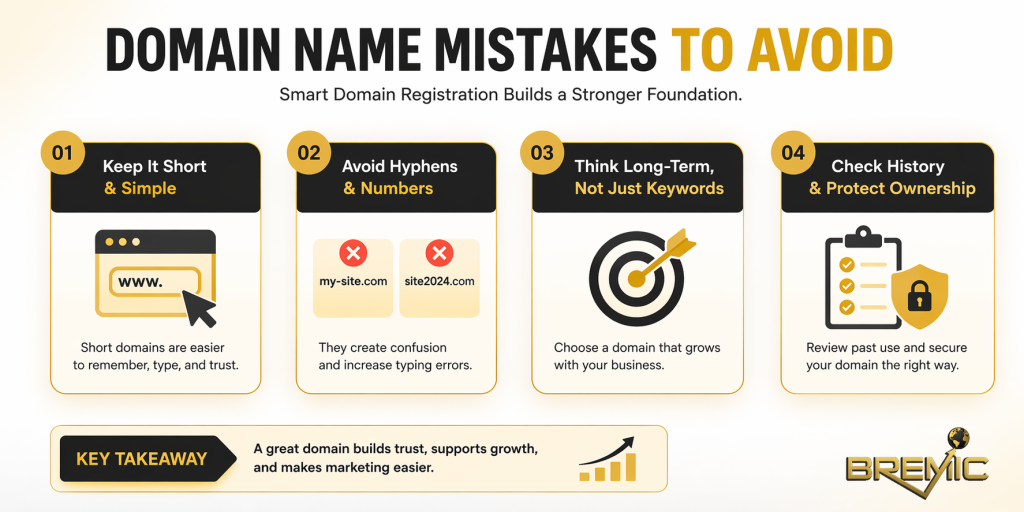
Choosing a domain that is too long
Long domains are harder to remember, type, share, and trust. They also tend to look weaker in marketing materials.
A short domain is not always possible, but clarity matters more than length alone. If a domain contains unnecessary words, modifiers, or location terms that do not need to be there, simplify it.
Using hyphens or numbers
Hyphens and numbers create friction. They force explanation and increase typing errors. If your domain must constantly be clarified as “with a hyphen” or “the number 4, not the word four,” it is working against you.
This is one of the clearest domain name mistakes to avoid unless there is a very specific and defensible reason.
Over-optimizing with keywords
Domains stuffed with search terms often look low quality. They can also age badly if the business expands beyond that narrow topic.
What seems “SEO-friendly” at launch can later become a branding liability.
Ignoring future scalability
A domain built around one product, one city, or one narrow service may become restrictive. If the business grows, the domain can start to feel misaligned with the actual offering.
Good domain registration should reflect where the business is going, not just where it is today.
Skipping the history check
An available domain is not automatically a safe domain. Prior ownership, backlink history, spam signals, and brand associations should all be reviewed.
This is particularly important when buying expired domains or premium resale domains.
Registering through the wrong account or owner
Operational mistakes matter too. Businesses sometimes register domains under a freelancer’s account, a former employee’s email, or an agency login with poor documentation. That creates avoidable risk.
Control, billing access, renewal visibility, and ownership records should be handled professionally from day one.
Practical Guidance
A strong domain decision is usually the result of disciplined filtering, not inspiration alone. In most cases, the best process looks like this:
1. Define the strategic role of the domain
Decide whether the site is being built around a brand, a local service identity, a niche content property, or a broader commercial platform. That context should shape naming decisions.
2. Create a shortlist based on usability
Remove names that are awkward, overly long, hard to pronounce, or easy to confuse with competitors.
3. Validate the business risks
Check trademark issues, social handle availability, prior domain use, and reputational concerns.
4. Prioritize clarity over forced SEO signals
If a name sounds credible and memorable, that usually creates more long-term value than squeezing keywords into the domain.
5. Secure the domain properly
Use a trusted registrar, enable auto-renewal, turn on domain lock where available, and make sure ownership sits with the business, not an external vendor.
Timing and Expectations
A good domain choice does not produce instant ranking gains, and it should not be evaluated that way. Its value shows up over time through stronger brand recognition, cleaner marketing execution, lower confusion, and fewer structural problems.
If the wrong domain is chosen, the consequences also tend to appear later rather than immediately. That is why this decision deserves more attention early on.
If a business already has an imperfect domain, that does not automatically mean it should rebrand. In many cases, the cost of changing domains outweighs the benefit. The right move depends on the severity of the issue, the strength of the current brand, and how much future growth is being constrained.
The key is to treat domain registration as a long-term infrastructure decision, not a quick setup task.
Conclusion
The most important domain name mistakes to avoid are rarely just technical mistakes. They are strategic errors that affect trust, usability, brand development, and future SEO stability.
A good domain will not guarantee success, but it makes everything else easier. It supports credibility, reduces friction, and gives the business a stronger foundation to build on. A poor domain does the opposite. It creates confusion, limits growth, and often becomes far more expensive to fix later.
Approach domain registration with the same seriousness you would apply to brand positioning or site architecture. The best choice is usually not the most clever or keyword-heavy option. It is the one that is clear, credible, easy to use, and built to last.