Keyword clustering for SEO matters because rankings rarely come from targeting isolated terms. Search engines evaluate topical relevance, content depth, internal relationships between pages, and whether a site appears to cover a subject with genuine authority. If your content strategy is built around one keyword per page with no clear structure, you often end up with overlap, weak internal linking, and pages that compete against each other.
That is where keyword clustering becomes strategically useful. It helps you organize search demand into logical topic groups, assign intent correctly, and decide which pages should exist as pillar pages, cluster articles, or supporting resources. Done well, it improves site architecture, clarifies content priorities, and gives your SEO work a stronger long-term foundation.
This article explains what keyword clustering for SEO is, how it connects to Keyword Research, why it matters for rankings and topical authority, how to apply it in practice, and what mistakes to avoid if you want a content system that can scale.
What Is Keyword Research?
Keyword Research is the process of identifying the terms, questions, modifiers, and topics your audience uses when searching. In practice, it is not just about finding high-volume phrases. It is about understanding search intent, the language real users use, the stages of the buyer journey, and the topics search engines already associate with a subject.
On its own, keyword research gives you raw material. It tells you what people search for. It does not automatically tell you how to structure your site, which queries belong on the same page, or where one topic ends and another begins.
That is where keyword clustering for SEO becomes essential.
Keyword clustering is the step that organizes research into meaningful groups. Instead of treating each keyword as a separate content opportunity, you evaluate which terms share the same intent, which belong together on one page, and which deserve their own dedicated asset. In other words, Keyword Research finds the demand. Keyword clustering turns that demand into an architecture.
Why Keyword Clustering for SEO Matters
A keyword list is not a content strategy. Without clustering, teams often publish too many thin articles, create multiple pages for near-identical intent, or fail to build clear relationships between topics. That weakens both usability and SEO performance.
Keyword clustering helps because it improves several core parts of SEO at once.
First, it supports clearer search intent targeting. When related terms are grouped properly, you can create pages that satisfy the full intent behind a topic instead of narrowly optimizing for one phrase.
Second, it reduces keyword cannibalization. If five pages all target slightly different versions of the same query, search engines may struggle to understand which page is the best result. Clustering helps prevent that by defining one primary page per intent group.
Third, it strengthens internal linking and topical authority. A well-clustered site naturally supports a pillar-and-cluster model, where broader pages link to more specific supporting pages and vice versa. That creates stronger contextual relevance across the site.
Fourth, it improves content production efficiency. Instead of producing content reactively, you can plan an editorial structure based on priority topics, supporting subtopics, and realistic expansion paths.
For serious SEO programs, keyword clustering is not a nice extra after research. It is the bridge between research and execution.
How Keyword Clustering for SEO Works
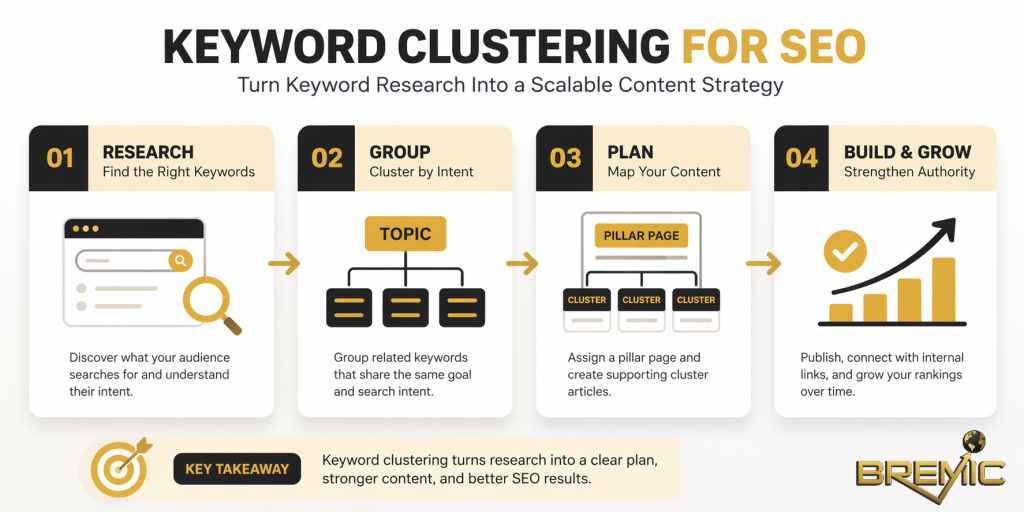
At a practical level, keyword clustering for SEO is the process of grouping keywords by shared meaning, shared intent, and likely SERP overlap. The goal is to determine which terms can be targeted on one page and which need their own page.
Start with Topic-Level Keyword Research
Clustering only works if the input is good. Begin with a broad keyword set around one core topic, including primary terms, long-tail variations, question-based queries, commercial modifiers, and informational subtopics.
Do not focus only on search volume. You also need to look at intent signals. For example, a query that suggests a beginner wants a definition is different from a query that suggests they want a process, a comparison, or a tool recommendation. Those distinctions shape clusters more than volume alone.
Group Keywords by Intent, Not Just Similar Wording
This is where many SEO teams go wrong. Similar words do not always mean the same page. Different words can reflect the same need, and nearly identical phrases can still deserve separate pages if the user expectation differs.
A useful clustering approach usually considers three questions:
- Would the same page satisfy these keywords?
- Do the top-ranking results overlap significantly?
- Is the underlying user need the same?
If the answer is yes across those questions, the terms likely belong in one cluster. If not, they may need separate pages.
Assign a Primary Keyword and Supporting Terms
Each cluster should have one clear primary keyword and a set of supporting variations. The primary keyword shapes the page’s main focus, title direction, and core optimization. Supporting terms help define subtopics, related entities, FAQs, and semantic coverage.
This prevents the common mistake of trying to target ten equal “main keywords” on one page. A page needs a dominant topic. Supporting terms should reinforce it, not fragment it.
Map Clusters to Page Types
Once clusters are formed, map them to the right content format.
A broad, high-level cluster may belong on a pillar page. A narrower, intent-specific cluster may work better as a cluster article. A highly focused question may fit a supporting article that links into the main cluster.
This mapping stage is where keyword clustering becomes site architecture, not just spreadsheet work.
Important Subtopics That Influence Clustering Quality
Search Intent Comes First
The best keyword clusters are intent-led. Informational, commercial, navigational, and transactional keywords should not be blended carelessly. Even within informational search, intent can vary. A user searching for “what is keyword clustering” has different expectations than a user searching for “how to do keyword clustering for SEO.”
If the expected content format, depth, or outcome differs, the cluster may need to split.
SERP Analysis Validates the Cluster
Keyword tools are useful, but they are not enough on their own. You need to review search results to confirm whether Google treats terms as equivalent or distinct.
When the same pages rank repeatedly across a group of keywords, that is a strong sign they belong together. When the result sets differ significantly, it usually means the keywords should be separated.
SERP analysis is especially important for borderline cases where wording is close but intent is not identical.
Site Architecture Should Guide Cluster Decisions
Clustering is not just about what keywords belong together. It is also about how your site should present expertise. A strong cluster model usually includes:
- a core pillar page covering the broader topic
- supporting cluster pages focused on specific subtopics
- related supporting articles that address adjacent questions or use cases
For example, keyword clustering for SEO may naturally connect to supporting topics such as search intent analysis, content mapping, internal linking strategy, topic clusters, and on-page optimization. Those relationships create a more coherent topical framework than isolated blog posts ever could.
Common Mistakes
One common mistake is clustering by tool output alone. Automated grouping can save time, but it should not replace judgment. Tools often miss nuance, especially when search intent is mixed or when topics overlap only superficially.
Another mistake is creating a separate page for every keyword variation. That usually leads to thin content, duplication, and cannibalization rather than greater visibility.
The opposite mistake also happens: combining too many distinct intents into one page. This creates unfocused content that ranks poorly because it tries to answer several different queries at once.
A more strategic mistake is failing to connect clustering with internal linking and site hierarchy. Even good keyword groups lose value if they are not translated into a coherent page structure.
Finally, many teams cluster once and never revisit the model. As a site grows, new content, changing SERPs, and shifts in business priorities can require cluster refinement.
Practical Guidance for Applying Keyword Clustering Correctly
Start with one topic area, not your entire website. Build a focused keyword set, review intent patterns, analyze the SERPs, and define a realistic page map.
From there, work through the process in order:
1. Build the Keyword Universe
Gather core terms, variants, questions, and related phrases around the topic. Include both obvious and supporting searches.
2. Identify Intent Patterns
Separate informational queries from commercial or mixed-intent queries. Then distinguish broad educational topics from specific tactical searches.
3. Review SERP Overlap
Check whether the same types of pages rank for the terms you are grouping. Use this to validate or split clusters.
4. Create the Cluster Map
Assign one primary keyword per cluster, list supporting terms, and decide what type of page should target that group.
5. Connect It to the Site Structure
Define which page should act as the pillar, which articles support it, and how the internal linking should flow between them.
6. Brief Content Strategically
A content brief should not just include target keywords. It should explain the cluster purpose, search intent, related subtopics, internal linking opportunities, and what the page should uniquely contribute within the broader topic model.
This is where many SEO strategies improve dramatically. Better clustering usually leads to better briefs, and better briefs usually lead to better content.
Timing and Expectations
Keyword clustering can improve SEO outcomes, but it is not a shortcut. It helps you make better structural decisions, avoid wasted content, and create pages that are better aligned with search behavior. That is valuable immediately from a strategic perspective, but ranking results still depend on execution quality, competition, site strength, crawlability, content depth, and links.
In practice, the benefits of clustering often show up over time rather than all at once. Early gains may come from reducing cannibalization and improving internal linking. Longer-term gains usually come from building a cleaner topical footprint that supports authority across a subject area.
That is why keyword clustering should be treated as part of an ongoing SEO system, not a one-time task.
Conclusion
Keyword clustering for SEO is the process that turns Keyword Research into a usable content strategy. It helps you group search demand by intent, map topics to the right pages, support internal linking, and build a site architecture that reflects real expertise instead of disconnected keyword targets.
For websites using a pillar-and-cluster model, clustering is foundational. It defines what each page is supposed to do, how pages support each other, and where topical authority can realistically grow over time.
The strategic takeaway is simple: do not stop at collecting keywords. Organize them into intent-led clusters, validate them with SERP analysis, and use them to build a site structure that can scale. That is how keyword research becomes SEO strategy rather than just a list of terms.