Most SEO traffic is not equally valuable. A page can rank, attract visitors, and still produce little business impact if it targets the wrong searches. That is why learning how to find buying intent keywords matters. These are the queries people use when they are close to making a decision, comparing options, or actively looking for a solution.
For businesses that want SEO to support leads, sales, or qualified pipeline, buying intent keywords deserve special attention. They help bridge the gap between visibility and commercial outcomes. They also force a more disciplined approach to Keyword Research, because the goal is no longer just to find volume. The goal is to find intent that aligns with revenue.
This article explains how to identify buying intent keywords in a practical way, how to separate them from purely informational terms, and how to use them strategically within a broader SEO content structure.
What Is Keyword Research
Keyword Research is the process of identifying the search terms people use, understanding the intent behind those searches, and selecting the topics your site should target.
In practice, good Keyword Research is not just a list-building exercise. It is a decision-making framework. It helps you understand what your audience wants, how they think, what stage of the journey they are in, and which pages your site needs in order to meet that demand effectively.
When the goal is commercial SEO performance, Keyword Research should go beyond broad traffic opportunities. It should also identify terms that signal comparison, evaluation, and readiness to act. That is where buying intent keywords come in.
Why Buying Intent Keywords Matter
Buying intent keywords matter because they are closer to business outcomes than general awareness queries.
A top-of-funnel keyword like “what is CRM software” may bring visitors who are learning. A keyword like “best CRM software for small business” is different. The searcher is no longer just exploring the category. They are evaluating options. The commercial value is usually much higher, even if the search volume is lower.
From an SEO perspective, these keywords matter for several reasons.
First, they often map to pages that can influence conversion directly. That might be a service page, a category page, a comparison article, or a product-focused cluster page.
Second, they improve the quality of traffic. Not all organic sessions are equal. Traffic that arrives with a problem, budget, and decision timeline is more useful than traffic with vague curiosity.
Third, they support topical authority in a more commercially meaningful way. A strong content cluster should not consist only of educational articles. It should also include pages that target search intent, product comparisons, solution-based terms, and bottom-funnel questions.
How Buying Intent Keywords Work
Buying intent keywords usually appear when a searcher has moved beyond basic education and into evaluation or action.
That does not always mean they are ready to purchase immediately. In B2B especially, a user may still need approval, internal discussion, or vendor review. But the search language changes in recognizable ways. The query becomes more specific, more solution-oriented, and more tied to outcomes.
Common buying intent patterns include modifiers such as:
- best
- top
- review
- pricing
- cost
- software
- services
- agency
- consultant
- near me
- compare
- versus
- alternative
- for [specific use case]
These modifiers are useful signals, but they are not enough on their own. A keyword only has real value when the intent, SERP landscape, and page type all align.
How to Find Buying Intent Keywords
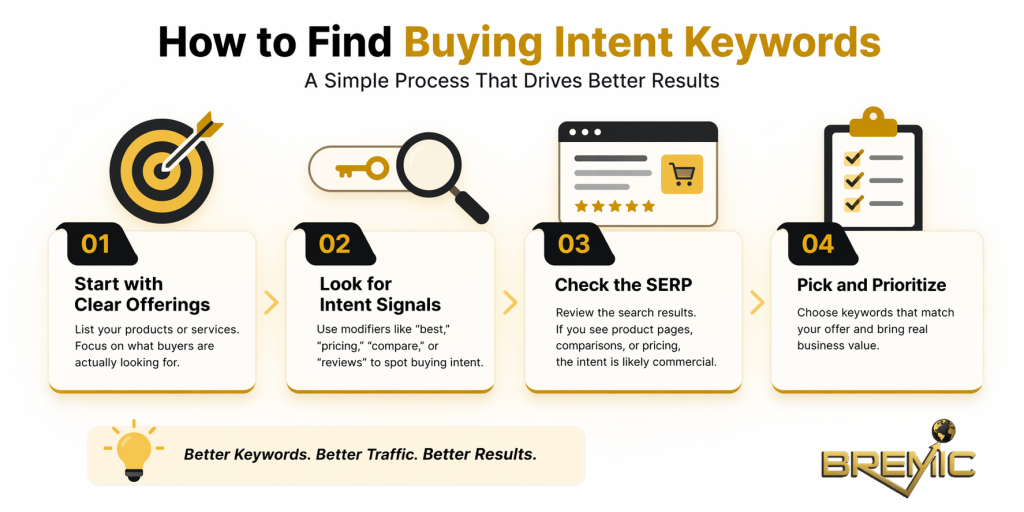
Start with clear commercial categories
The cleanest way to find buying intent keywords is to begin with the commercial side of the market.
Ask simple questions first:
- What does the business actually sell?
- What category are buyers shopping in?
- What alternatives are they likely to compare?
- What problems lead them to look for a solution?
This helps you build seed terms around products, services, software categories, solution types, and specific business outcomes. Starting from commercial reality is more reliable than starting from a generic keyword tool export.
For example, if a company sells SEO services, “SEO tips” may be relevant for authority building, but “enterprise SEO agency,” “SEO consultant for SaaS,” and “technical SEO services pricing” are much closer to buyer intent.
Look for high-intent modifiers
Once you have core categories, expand them with modifiers that suggest evaluation or purchase behavior.
Examples include:
- best CRM for startups
- email marketing software pricing
- local SEO agency for dentists
- Shopify SEO consultant
- project management software comparison
These terms often reveal the difference between interest and intent. Someone searching “email marketing” may want definitions, examples, or templates. Someone searching “email marketing software for ecommerce” is much closer to selecting a tool.
This is where Keyword Research becomes strategic rather than mechanical. You are not just collecting related phrases. You are identifying language patterns that reflect buyer behavior.
Study the SERP, not just the keyword
A keyword can look commercial in a tool and still behave differently in the search results.
Always inspect the SERP manually. Look at what Google is rewarding. If the results are mostly product pages, service pages, comparison articles, and review-style content, that usually confirms commercial or transactional intent. If the results are mostly beginner guides and dictionary-style pages, the keyword may be more informational than it first appears.
This matters because intent mismatch is one of the most common reasons content underperforms. If the SERP expects comparison content and you publish a general explainer, rankings will be harder to win and conversions will usually be weaker.
Use comparison and alternative keywords
Comparison terms are some of the clearest buying signals in SEO.
Queries with “vs,” “alternative,” “top,” and “best” often indicate that the searcher already understands the market and is narrowing options. These keywords may have lower volume than broad head terms, but they can be exceptionally valuable because the searcher is further along in the decision process.
Useful examples include:
- Ahrefs vs Semrush
- best payroll software for small business
- HubSpot alternative for startups
- best SEO agency for ecommerce brands
These terms also work well within a cluster structure because they naturally connect to adjacent pages about pricing, implementation, use cases, and vendor selection.
Mine sales and customer language
One of the most overlooked ways to find buying intent keywords is to listen to how prospects actually speak.
Sales calls, demo requests, proposal questions, and customer emails often contain the exact language people use before they buy. Those phrases can reveal pain points, objections, budget concerns, and category terms that traditional tools do not emphasize clearly.
For example, a business may optimize for “ERP software,” while prospects consistently ask about “inventory management system for manufacturers.” The second phrase may reflect stronger practical intent because it is tied to a real purchasing problem.
This is where experience matters. Strong SEO strategy is not built only from tools. It is built from the overlap between search behavior and commercial reality.
Segment keywords by funnel stage
Not every valuable keyword is bottom-of-funnel, but every keyword should be mapped to a clear stage.
A healthy content strategy usually includes:
Informational intent
These are educational searches such as definitions, processes, and how-to content. They build reach and authority.
Commercial investigation intent
These are often the true buying intent keywords. The searcher is comparing, evaluating, reviewing, or estimating cost.
Transactional intent
These are direct action terms, often tied to product, service, booking, signup, or purchase pages.
When you know the stage, you can create the right page type and connect it to the rest of the site. That is how clusters become commercially useful, not just structurally neat.
Important Subtopics to Understand
Search intent matters more than volume
A keyword with moderate volume and strong commercial intent is often more valuable than a high-volume keyword with weak conversion potential.
This is especially true for service businesses and B2B websites, where one qualified lead may be worth far more than thousands of low-intent visits.
Page type must match the keyword
Buying intent keywords do not always belong on blog posts.
Sometimes the correct destination is a service page, product page, category page, or comparison landing page. If you force every target keyword into a blog format, you weaken both relevance and conversion potential.
Internal linking should support decision-stage content
Buying intent pages should not sit isolated on the site. They should be supported by internal links from broader educational content and connect back to stronger hub pages such as your content cluster strategy guide or your pillar resource on commercial SEO strategy.
That internal linking model helps distribute authority and guides users from education toward evaluation.
Common Mistakes
One common mistake is treating all relevant keywords as equally valuable. Relevance alone is not enough. A keyword can be relevant to your industry but still be a poor commercial target.
Another mistake is relying too heavily on keyword tools without checking the SERP. Tools can suggest patterns, but they cannot replace judgment.
A third mistake is targeting buying intent keywords with vague educational content. If the query suggests comparison, pricing, or solution evaluation, the page needs to address those needs directly.
Finally, many sites ignore lower-volume commercial keywords because they appear small on paper. In reality, these are often the terms that contribute most clearly to pipeline and revenue.
Practical Guidance for Using Buying Intent Keywords
Start by building a separate keyword list for commercial terms instead of mixing them into a broad research sheet. Group them by product, service, audience, and use case. Then review the SERPs and assign each keyword to the page type that best fits the intent.
From there, prioritize based on business value, not just difficulty or volume. A difficult keyword may still deserve investment if it aligns tightly with your offer and sits near conversion.
Keep the content focused. If the page is about how to find buying intent keywords, it should not drift into a generic beginner guide to all of SEO. That kind of dilution weakens clarity and makes internal architecture less effective.
Timing and Expectations
Buying intent keywords can produce meaningful results faster than broad informational targets, but they still require patience.
SEO performance depends on competition, site authority, content quality, and how well the page aligns with the SERP. On a strong site, commercially aligned pages may begin gaining traction within a few months. On newer or weaker domains, the timeline is usually longer.
It is also important to judge success properly. Rankings matter, but so do qualified visits, assisted conversions, demo requests, and lead quality. The real test is whether the keyword strategy supports business outcomes, not just visibility.
Conclusion
Understanding how to find buying intent keywords is one of the most important parts of commercially effective SEO. It shifts Keyword Research from traffic chasing to strategic demand capture.
The best opportunities usually come from clear commercial categories, strong modifier patterns, careful SERP analysis, and real customer language. When those insights are mapped to the right page types and supported by internal linking, SEO becomes more than a publishing exercise. It becomes a structured way to attract the right audience at the right stage of decision-making.
That is the long-term advantage. Not just more rankings, but more relevant visibility built on intent, structure, and strategic fit.