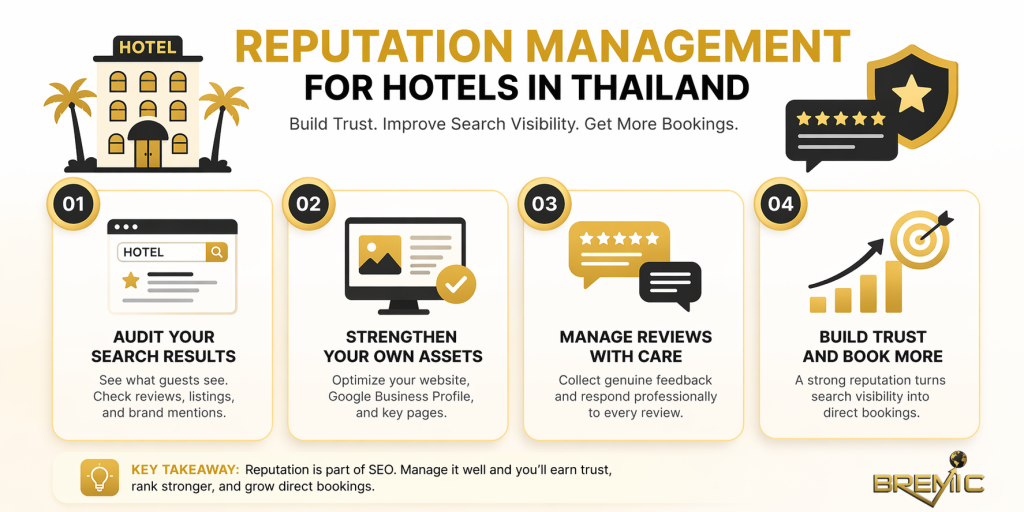
Reputation management for hotels in Thailand is no longer a brand exercise handled separately from SEO. For hotels, resorts, and hospitality groups, search visibility and reputation are closely connected. When a potential guest searches for a property name, a location-based query, or a comparison such as “best beachfront hotel in Phuket,” they are not just evaluating prices and amenities. They are evaluating trust.
That trust is shaped by what appears in search results: review profiles, third-party travel sites, local listings, editorial mentions, forum discussions, news coverage, and the hotel’s own website content. If those signals are weak, inconsistent, or negative, rankings alone will not solve the problem. Traffic may still fail to convert.
This is where Search Engine Reputation Management (SERM) becomes important. For hotels in Thailand, SERM is not about hiding criticism or trying to manipulate perception. It is about building a search presence that reflects the real quality of the property, responds professionally to public feedback, and gives prospective guests enough confidence to book.
This article explains what SERM means in practical terms, why it matters for hotel SEO, how to apply it properly, and what hotel operators often get wrong.
What is Search Engine Reputation Management (SERM)
Search Engine Reputation Management (SERM) is the process of influencing how a brand appears in search results by improving the visibility of trustworthy, relevant, and positive content while reducing the impact of outdated, misleading, or harmful search results.
In practical terms, SERM for hotels involves three connected areas:
- Owned assets such as the hotel website, location pages, blog content, press pages, and Google Business Profile
- Earned signals such as guest reviews, travel platform ratings, media mentions, local citations, and backlinks
- Response and correction work such as replying to reviews, updating inaccurate listings, resolving recurring complaints, and publishing content that addresses brand-related concerns
For hotels in Thailand, SERM often sits at the intersection of SEO, local search, customer experience, and conversion optimization. A hotel may rank well for branded searches but still lose bookings if review sentiment is poor or if search results are dominated by third-party pages with complaints, outdated information, or inconsistent descriptions.
SERM is therefore not separate from search performance. It is part of how search performance turns into revenue.
Why it matters
Search visibility is only part of the booking decision
Guests researching hotels rarely make decisions based on a single page. They compare multiple sources before they trust a property. Even when users land on the hotel’s website, many will search the brand name again to validate what they saw.
If that branded search returns mixed reviews, weak review management, old press coverage, or low-quality directory listings, it creates friction. That friction reduces direct bookings and increases dependence on third-party platforms.
Reputation affects conversion as much as ranking
Hotels often focus heavily on ranking for non-branded keywords such as “luxury hotel in Chiang Mai” or “family resort in Krabi.” Those keywords matter, but brand credibility becomes decisive later in the journey. A strong reputation profile helps close the gap between discovery and booking.
This is especially important for hotels in Thailand, where many properties compete within the same destination and price range. In competitive markets, reputation signals often become the deciding factor once a property is already visible.
SERM supports E-E-A-T and brand authority
From an SEO perspective, a strong reputation profile supports the credibility of the business behind the website. Consistent brand signals, high-quality mentions, review activity, accurate local listings, and authoritative branded content all reinforce trust.
A hotel site that demonstrates operational transparency, current information, and responsive management is more likely to earn user trust than one that looks polished but disconnected from real guest experience.
How reputation management for hotels in Thailand works
Start with a branded search audit
The first step is to understand what users actually see. Search the hotel name, hotel name plus location, hotel name plus “reviews,” and hotel name plus common modifiers such as “family,” “spa,” or “beachfront.”
Review the first two pages of results and identify:
- Which pages dominate branded search
- Whether the hotel website ranks strongly
- Which review platforms appear most often
- Whether any negative or outdated content ranks prominently
- Whether business details are consistent across platforms
This audit gives you a realistic picture of your search reputation, not just your website performance.
Improve the strength of owned search assets
A hotel should not rely entirely on third-party platforms to define its reputation. Its own digital assets need to rank well and answer common trust questions clearly.
That typically includes strengthening:
- The homepage and branded landing pages
- Location-specific pages
- FAQ content about policies, amenities, transport, and nearby attractions
- Press or media pages
- Guest experience content such as service standards, sustainability practices, or renovation updates
For internal linking, this topic usually works well alongside content on hotel SEO, local SEO for hospitality businesses, Google Business Profile optimization, and direct booking strategy. That helps the site build a stronger topical cluster around visibility and trust.
Manage review ecosystems strategically
Review management is one of the most visible parts of SERM, but it needs discipline. Hotels should monitor major review sources consistently and treat them as search assets, not just feedback channels.
The goal is not to chase volume blindly. It is to improve quality, recency, and response standards.
A sound review process usually includes:
- Encouraging genuine post-stay feedback from recent guests
- Responding to both positive and negative reviews professionally
- Escalating recurring complaints to operations, not just marketing
- Identifying patterns by room type, season, service area, or guest segment
A reply to a negative review does not erase the complaint, but it changes how future guests interpret it. Calm, specific, accountable responses often matter more than defensive ones.
Correct inaccuracies across the web
Hotels in Thailand often face inconsistency across listings, travel platforms, map profiles, social pages, and older directories. That inconsistency damages trust and can weaken local search performance.
Check for outdated room descriptions, incorrect contact details, old photography, inaccurate map pins, closed facilities still being advertised, or conflicting policy information. These issues create avoidable doubt.
SERM is partly about perception, but it is also about accuracy. Accurate listings reduce confusion and reduce the chance that negative feedback comes from mismatched expectations.
Important subtopics
Branded content strategy
Hotels should publish brand-supporting content that deserves to rank for branded and semi-branded searches. This does not mean writing self-promotional blog posts. It means creating useful pages that answer the questions guests already have.
Examples include content around:
- Airport transfer options
- Family-friendly facilities
- Wedding or event venue details
- Long-stay accommodation information
- Accessibility features
- Seasonal travel guidance for the destination
This kind of content strengthens branded search and reduces dependence on third-party pages for critical pre-booking information.
Local SEO and destination relevance
Reputation management for hotels in Thailand also depends on local relevance. Searchers may discover a hotel through broader destination searches before they ever search the brand directly.
That is why SERM should connect with local SEO efforts such as optimized location pages, accurate business listings, local attraction content, and destination-specific internal linking. A good reputation profile becomes more powerful when the hotel is visible earlier in the search journey.
Complaint analysis as a content and operations input
Negative reviews should not be treated as isolated PR issues. They are often signals of repeated expectation gaps.
If guests regularly mention weak Wi-Fi, misleading room photos, noisy surroundings, or poor breakfast quality, those patterns matter. Some should be fixed operationally. Others should be addressed through better on-site content so expectations are set correctly before booking.
That is one of the most practical forms of SERM: reducing the mismatch between what searchers expect and what the property actually delivers.
Common mistakes
Treating reputation management as damage control only
Many hotels start working on reputation only after a visible negative event. That is too late. SERM works best as an ongoing system, not a reactive campaign.
Focusing only on review responses
Review replies matter, but they are only one part of the search landscape. If the website is weak, branded content is thin, and listings are inconsistent, the reputation problem remains only partially addressed.
Ignoring third-party search results
Hotels cannot control every result, but they can influence the balance of what ranks. Ignoring travel platforms, local directories, editorial mentions, and forum discussions leaves too much of the brand narrative unmanaged.
Using templated or defensive responses
Guests and future searchers can spot generic replies immediately. A poor response can make a bad review more damaging because it signals a lack of accountability.
Trying to suppress legitimate criticism instead of fixing root causes
The strongest long-term approach is operational improvement paired with transparent communication. Attempts to push down criticism without addressing the cause usually fail.
Practical guidance
A hotel that wants to improve its search reputation should approach the work in layers.
First, secure the basics: branded search visibility, accurate listings, and a strong Google Business Profile. Then improve review collection and response standards. After that, strengthen supporting content that answers trust-based questions and gives the hotel more control over branded search results.
From a content architecture perspective, this article should connect naturally to supporting pages such as:
- hotel SEO strategy
- Google Business Profile optimization for hotels
- local SEO for hotels in Thailand
- review management best practices
- direct booking conversion optimization
That internal structure helps search engines understand that reputation is part of a broader hospitality SEO system, not a standalone tactic.
Timing and expectations
Reputation management for hotels in Thailand is not instant. Some changes, such as updating listings or improving review response quality, can have visible effects relatively quickly. Stronger search result improvements usually take longer because they depend on content performance, review recency, crawl cycles, and brand signal consolidation.
In most cases, hotels should expect SERM to be an ongoing process measured over months, not days. The timeline depends on the current state of the brand, the competitiveness of the market, the severity of any negative search results, and the consistency of execution.
The important point is that reputation gains are cumulative. A hotel that steadily improves guest experience, listing accuracy, content quality, and public responsiveness will usually build a stronger search presence over time.
Conclusion
Reputation management for hotels in Thailand is not just about protecting brand image. It is about improving what potential guests see when they research a property and making sure that search visibility leads to trust, not hesitation.
Search Engine Reputation Management (SERM) works best when it combines SEO, review management, operational feedback, and strong branded content. Hotels that treat it as a long-term discipline are in a better position to improve direct bookings, reduce avoidable trust barriers, and build a search presence that reflects the real value of the property.
For hospitality brands, that is the strategic goal: not to control every conversation, but to earn a search reputation that is accurate, credible, and commercially useful.