Negative Google reviews are not just a customer service issue. They affect how potential customers judge your business before they ever visit your website, call your team, or request a quote. For many companies, a poor review profile becomes a conversion problem long before it becomes an SEO problem.
That is why knowing how to respond to bad Google reviews matters. A strong response can reduce reputational damage, show professionalism in public, and help future customers see that one unhappy experience does not define the business. A weak response can do the opposite. Defensive, vague, or careless replies often make the review more damaging than the original complaint.
This article explains how to handle negative Google reviews strategically. It also places the topic in the wider context of Search Engine Reputation Management (SERM), so you can see how review responses fit into a broader reputation and visibility strategy.
What is Search Engine Reputation Management (SERM)
Search Engine Reputation Management, usually shortened to SERM, is the practice of influencing how a brand appears in search results. The goal is not simply to remove negative content or make a business look perfect. It is to build a credible, accurate, and trust-building search presence.
In practical terms, SERM includes work such as:
- managing review profiles
- improving branded search results
- publishing useful brand-owned content
- strengthening third-party trust signals
- responding to customer feedback in public spaces
Google reviews are one of the clearest SERM touchpoints because they appear where buying decisions happen. For local businesses especially, reviews are often visible before a user even reaches the website. That means the way you respond is part of your public brand narrative.
A bad review is rarely just one isolated comment. It can influence click-through rate, trust, lead quality, and how people interpret everything else they find about your business. That is why review management belongs inside a broader reputation strategy, not just inside customer support.
Why It Matters
Reviews shape trust before rankings do
In many cases, users do not compare ten websites in depth. They scan search results, map listings, star ratings, and recent reviews. A business with thoughtful responses often appears more credible than one with silence or hostility, even if both have similar ratings.
Review responses support conversion quality
A review response will not automatically push a page to the top of Google. But it can influence whether someone clicks, calls, or fills out a form. That makes it commercially significant. When prospects see a business handling criticism calmly and specifically, it reduces perceived risk.
It strengthens your brand’s search footprint
Bad reviews are part of what people find when they search your company name. If your branded search results include review platforms, map listings, and local pack visibility, then review management becomes part of your organic brand defense.
It signals operational maturity
A business that responds well to criticism shows that it listens, investigates, and takes accountability seriously. That matters for users and for anyone evaluating your company’s authority in the market.
How to Respond to Bad Google Reviews
The best responses follow a disciplined structure. They are not emotional reactions. They are controlled public statements written for two audiences at once: the reviewer and everyone else reading later.
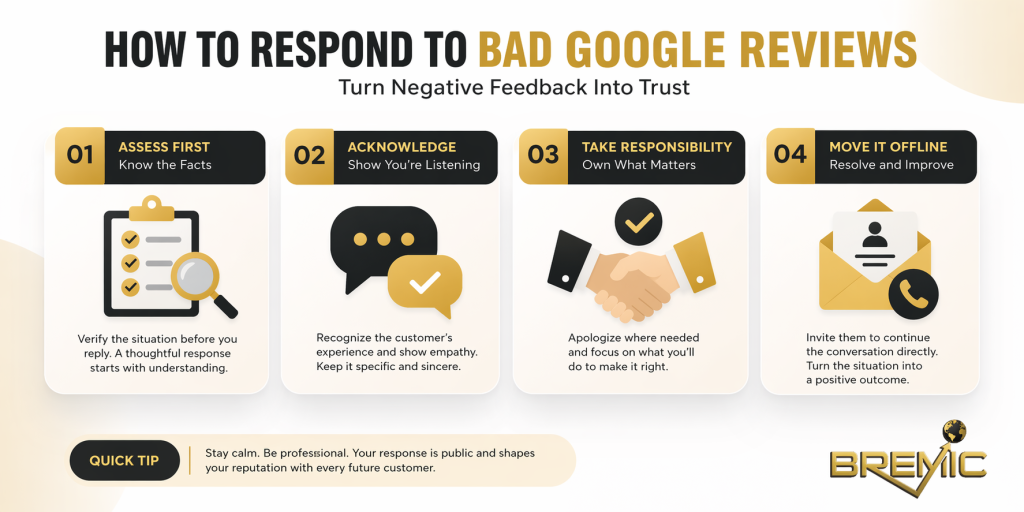
Start by assessing whether the complaint is real
Before replying, verify the situation internally. Check whether the reviewer was a real customer, whether the event happened as described, and whether there is context your team needs to understand first.
This step matters because the right response depends on the type of review:
- a legitimate complaint from a real customer
- a misunderstanding
- a review aimed at the wrong business
- a fake, spam, or malicious review
Do not rush into a public reply before you know which category you are dealing with.
Respond promptly, but not impulsively
A fast response is usually better than a delayed one, especially when the complaint looks credible. It shows the business is active and paying attention. But speed should not come at the cost of judgment.
A rushed reply often sounds defensive or dismissive. A strong response is calm, specific, and measured.
Acknowledge the experience
The first job of the response is to show that you understand the issue being raised. That does not mean admitting fault automatically. It means recognizing the customer’s dissatisfaction in plain language.
For example, if the issue concerns delays, poor communication, or a disappointing service experience, acknowledge that directly. Avoid generic lines that sound copied and pasted. People can usually tell when a business is using a template with no real engagement.
Take responsibility where appropriate
If the complaint is valid, own the relevant part of the problem. Do not overcompensate, but do not hide behind vague wording either.
A response that says, “We’re sorry you felt this way,” often sounds evasive. A response that says, “We’re sorry our communication around your appointment was not clear,” is more credible because it addresses the real issue.
Specific accountability builds trust. Overly polished corporate language weakens it.
Move the resolution offline
The public response should acknowledge the issue and open a path to resolution, but it should not turn into a long public argument. Invite the reviewer to continue the conversation through email, phone, or direct contact with a named team or department.
This shows initiative while preventing a public back-and-forth that usually helps no one.
Keep the tone professional at all times
This is where many businesses fail. They reply as if they are trying to win an argument. That is almost always a mistake.
Even when the reviewer is unfair, the business has more to lose. Future customers are judging your tone, self-control, and judgment. A sarcastic or combative response can make a single negative review look like evidence of a broader problem.
Important Subtopics That Affect the Quality of Your Response
When the review is legitimate
A legitimate complaint deserves a serious response. In these cases, the aim is not damage control alone. It is to show that the business understands what went wrong and is willing to address it.
The strongest replies usually include three elements:
- recognition of the issue
- concise accountability
- a clear next step for resolution
You do not need to explain every internal detail. In fact, long explanations often sound defensive. What matters is clarity, professionalism, and a credible effort to resolve the issue.
When the review is fake or malicious
Not every negative review should be treated as valid feedback. If the review appears fabricated, abusive, or clearly unrelated to a real transaction, document what you can and report it through Google’s review process.
You may still choose to post a brief public response while the review is being reviewed. The tone should remain neutral. State that you cannot identify the interaction and invite the reviewer to contact the business directly with details. That communicates professionalism without validating false claims.
When the issue involves sensitive details
Do not reveal personal information, order details, medical details, payment disputes, or internal records in a public response. Even if the reviewer shares too much, the business should remain careful.
Public replies should protect privacy and keep the focus on resolution rather than exposure.
When there are repeated complaints about the same issue
If multiple reviews mention the same problem, this is no longer just a reputation issue. It is an operational signal. Repeated complaints about delays, billing confusion, rude service, or poor follow-up usually point to a process weakness.
In SERM terms, recurring themes in reviews shape brand perception at scale. In business terms, they often indicate a fixable system problem. Smart businesses use reviews as feedback data, not just public relations problems.
Common Mistakes
Replying emotionally
The most obvious mistake is writing from frustration. Even if the review is exaggerated or unfair, anger is visible in tone. Once published, that tone becomes part of your brand.
Using generic templates for every reply
Templates can help with consistency, but they should not replace judgment. When every negative review receives the same bland wording, the responses stop looking sincere.
Arguing point by point in public
Detailed rebuttals usually make the business look defensive. They also prolong the visibility of the complaint. A concise, composed response is almost always stronger than a public dispute.
Ignoring reviews entirely
Silence sends a message too. If a business never responds to criticism, potential customers may assume complaints go unanswered offline as well.
Treating review responses as separate from SEO and reputation strategy
Review management is often siloed inside support or operations. That is understandable, but incomplete. Reviews influence branded search, local visibility, and user trust. They should be connected to your wider Search Engine Reputation Management strategy and your broader local SEO approach.
Practical Guidance for Writing Better Responses
A good working framework is simple:
Acknowledge the issue.
Address the concern directly.
Offer a real next step.
Stay concise and professional.
That sounds straightforward, but execution matters. Your response should feel like it came from a competent business leader, not from a script generator.
For example, a strong reply usually does the following:
- names the issue in plain language
- avoids legalistic or defensive phrasing
- shows willingness to investigate or resolve
- invites direct contact through a clear channel
- reflects the tone you want associated with your brand
It is also worth creating internal review response guidelines. Not a rigid script, but a documented standard for tone, escalation, approval, and handling fake reviews. This becomes especially important if multiple team members can reply on behalf of the business.
If your business is building a stronger review profile overall, this topic should also connect with related content such as how to ask customers for Google reviews and how to handle fake business reviews. Those supporting pages strengthen the cluster while helping teams manage the full review lifecycle.
Timing and Expectations
A good response can improve perception quickly, but reputation improvement is usually cumulative. One reply does not fix a weak review profile, and it does not erase a pattern of poor service.
In the short term, a strong response can reduce the impact of an individual complaint by showing professionalism. In the medium term, consistent review management supports better trust signals, stronger branded search perception, and healthier conversion performance. In the long term, the real gains come when review insights are fed back into operations, customer experience, and content strategy.
That is the realistic view. Review responses are valuable, but they work best when paired with actual business improvements and a structured SERM program.
Conclusion
Knowing how to respond to bad Google reviews is not about saying the perfect thing. It is about protecting trust in a public setting and showing that your business handles criticism with maturity.
The most effective responses are calm, specific, accountable, and focused on resolution. They do not argue, deflect, or perform for the sake of appearance. They reinforce the kind of business you want prospects to believe they are dealing with.
From an SEO and reputation standpoint, negative review responses should be treated as part of a larger Search Engine Reputation Management system. They influence how users interpret your brand in search, how confidently they convert, and how resilient your reputation is over time.
Businesses that handle bad reviews well do not just manage optics. They build credibility where it matters most: in public, under pressure, and in full view of future customers.