Managing reputation online is no longer just a PR concern. For many businesses, the first real impression happens in search results long before someone visits the website, fills out a form, or speaks to sales. When a prospect searches your brand name, leadership team, product, or reviews, what they find shapes trust immediately.
That is why learning how to manage your online reputation needs to be approached as both a brand and SEO discipline. Reputation is not only about responding to criticism or collecting reviews. It is also about influencing what search engines understand, index, and rank when people look you up.
This article explains the search-focused side of reputation management, often called Search Engine Reputation Management (SERM). It covers what SERM is, why it matters, how it works in practice, and what businesses often get wrong when trying to improve branded search visibility.
What is Search Engine Reputation Management (SERM)
Search Engine Reputation Management (SERM) is the process of improving how a person, brand, or company appears in search engine results. In practical terms, it means shaping the pages, profiles, articles, reviews, and brand assets that users are most likely to see when they search for you.
A lot of people confuse online reputation management with general social media monitoring or review response workflows. Those can be part of it, but SERM is more specific. It focuses on search visibility and search perception.
That includes questions such as:
- What ranks when someone searches your brand name
- Whether your own website controls the first page for branded queries
- How reviews, third-party listings, press mentions, and directories influence trust
- Whether outdated, negative, or misleading pages dominate branded search results
- How Google interprets your entity, authority, and relevance
At its core, SERM is about increasing the visibility of credible, accurate, and brand-supportive content while reducing the prominence of weak, outdated, or harmful search results over time.
Why it matters
When people search for a business by name, they are usually not at the beginning of the journey. They are validating what they have already heard. That makes branded search one of the most trust-sensitive stages in the funnel.
If search results are strong, consistent, and well-controlled, they reinforce confidence. If they are fragmented, outdated, or dominated by poor reviews and irrelevant third-party pages, they create friction.
It affects conversions, not just perception
A good reputation in search supports conversion because it reduces doubt. Searchers want to confirm that the business is legitimate, active, credible, and worth engaging with. Branded results that include a strong homepage, helpful about page, accurate business profiles, review platforms, expert content, and positive media mentions make that easier.
Weak branded results do the opposite. They introduce hesitation.
It strengthens brand authority
From an SEO perspective, authority is not built only through non-branded rankings. Branded search matters because it reflects how well your entity is established online. Search engines look for consistency across your website and third-party sources. Strong brand signals help reinforce trust and relevance.
It protects demand you already earned
Paid campaigns, referrals, podcast appearances, social content, and outreach often lead people back to Google. If you drive attention to your brand but do not manage what appears in search, you leave an important part of the customer journey unmanaged.
How to manage your online reputation through search
If you want to understand how to manage your online reputation effectively, start by treating it as an ongoing search visibility program rather than a one-time cleanup project.
Audit your branded search results first
Before improving anything, you need a realistic view of what people currently see.
Search for:
- Your brand name
- Brand name plus reviews
- Brand name plus scam, complaints, pricing, founder, or location
- Key staff names
- Product or service names
- Common misspellings
The goal is not just to find obvious negatives. You are looking for the full search landscape. Which domains rank? Which pages are outdated? Which assets are missing? Which third-party sites appear more authoritative than your own content?
This audit gives you the baseline for a proper SERM strategy.
Look beyond the first result
Many businesses only care whether the homepage ranks first. That is too narrow. Reputation is influenced by the full branded result set: sitelinks, reviews, local listings, knowledge panels, social profiles, review sites, media coverage, directory pages, and discussion threads.
A reputation issue can exist even when the homepage ranks first.
Build pages you can control
One of the most effective ways to improve branded search is to publish and strengthen assets you own.
That typically includes:
- A clear homepage
- An accurate about page
- Leadership or team profile pages
- Service and product pages
- Press or media pages
- Customer story or case study content
- FAQ content for branded concerns
- Contact and location pages
- Review or testimonial frameworks where appropriate and compliant
This is where SEO and reputation strategy overlap directly. Search engines cannot rank pages that do not exist, and they cannot favor pages that are weak, thin, or ambiguous.
If your branded SERP is dominated by third-party platforms, the answer is often not to chase every mention individually. It is to create stronger, more useful first-party content that deserves to rank.
Strengthen your entity signals
Search engines try to understand who you are, what you do, and whether trusted sources confirm that identity. That is why consistency matters.
Make sure your brand name, business description, contact details, social profiles, founder information, and core positioning are aligned across your site and major external platforms. Inconsistency creates confusion for both users and search engines.
This also connects naturally to related topics such as local SEO, brand SERP optimization, business listings, and structured data. Those supporting areas often reinforce Search Engine Reputation Management (SERM) more than people expect.
Improve the quality of third-party signals
You do not control third-party platforms in the same way you control your site, but you can influence them.
That includes:
- Claiming and optimizing business profiles
- Encouraging satisfied customers to leave honest reviews
- Responding professionally to negative feedback
- Correcting inaccurate listings
- Earning credible media mentions
- Maintaining active, accurate social profiles
The key is credibility. Trying to manufacture reputation signals usually backfires. Search engines and users are both good at spotting patterns that feel manipulated.
A strong SERM approach improves the quality and consistency of third-party evidence rather than trying to game it.
Address negative or outdated results strategically
Not every negative result can or should be removed. Some content is legitimate. Some cannot realistically be taken down. Some should be answered rather than suppressed.
That is where nuance matters.
In practice, the strategic options are usually:
Correct inaccurate content
If a listing, article, or profile is wrong, request an update with evidence. This is the cleanest path when the issue is factual rather than reputational.
Respond where response is appropriate
For reviews or public complaints, a calm, factual, professional response can reduce damage. The goal is not to win an argument. It is to show future searchers that the business is responsive and credible.
Outrank weak negative pages
Sometimes the best route is to publish stronger, more relevant content that pushes low-authority negative pages lower in results over time. This is often slow, but it is usually more sustainable than aggressive removal efforts.
Important supporting concepts
Reputation management is not separate from content strategy
A site with weak topical depth often struggles to control branded search beyond the homepage. A site with a strong pillar-and-cluster structure has more opportunities to rank for branded informational queries, support entity clarity, and demonstrate expertise.
That is why related internal content matters. Supporting articles around reviews, trust signals, branded search optimization, crisis communications, local listings, and customer feedback can all strengthen the broader reputation layer of the site.
Trust is shaped by consistency
A business does not look trustworthy just because it says the right things on its homepage. Trust emerges when the same story is reinforced across multiple touchpoints. Your website, reviews, profiles, media mentions, author pages, and business details should all point in the same direction.
Common mistakes
One common mistake is treating reputation management as a purely reactive task. Businesses wait until a negative review or bad article appears, then try to solve everything at once. By that stage, they are often working from a weak foundation.
Another mistake is focusing only on removals. In many cases, the bigger opportunity is not taking content down. It is building stronger assets that deserve to rank higher.
Some businesses also overuse reputation language on-page in a way that feels defensive or unnatural. Pages written only to counter negative perceptions often fail because they are thin, obvious, and not genuinely useful.
A final mistake is expecting SEO to work like emergency PR. Search takes time. Reputation improvements in search usually come from sustained publication quality, better entity signals, stronger brand assets, and better third-party reinforcement.
Practical guidance for doing it well
Start with your branded search audit and document what actually ranks. Then prioritize the gaps.
If your website lacks strong brand-controlled pages, fix that first. If third-party listings are inaccurate, correct them. If reviews are weak or outdated, improve the customer feedback process rather than trying to paper over the issue.
Keep the strategy grounded in reality. The goal is not to make criticism disappear. It is to make sure search results present a fair, accurate, and trust-supportive picture of the business.
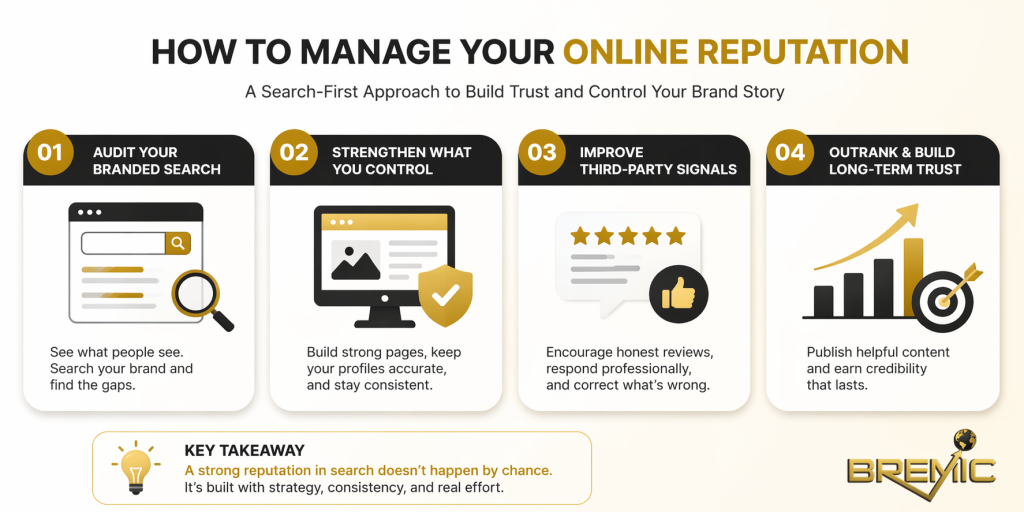
A good working order is:
- Audit branded search results
- Strengthen core pages on your website
- Improve business profiles and third-party consistency
- Build supporting content around brand trust and expertise
- Monitor branded query changes over time
That process is more effective than chasing isolated issues without a clear search strategy.
Timing and expectations
If you are wondering how to manage your online reputation quickly, the honest answer is that some parts move faster than others.
Profile updates, review responses, and listing corrections can improve perception relatively quickly. Organic ranking changes usually take longer. If you are trying to improve what ranks for branded queries, results may take weeks or months depending on the authority of the competing pages, the strength of your site, and how established the unwanted results are.
That does not mean progress is impossible. It means SERM should be treated as a medium-term SEO and brand investment, not a short-term patch.
Conclusion
Understanding how to manage your online reputation means understanding how search shapes trust. Search Engine Reputation Management (SERM) is not just about damage control. It is about building a stronger, more credible search presence around your brand before problems become expensive.
The businesses that do this well are usually the ones that think long term. They publish content they can stand behind, maintain accurate profiles, earn credible mentions, respond professionally to criticism, and build a site architecture that supports authority.
That is what makes online reputation durable. Not spin, not shortcuts, and not last-minute cleanup. A reputation that performs well in search is usually the result of consistent, strategic work backed by real expertise and visible trust signals.