For a small business, marketing rarely fails because of a lack of effort. It usually fails because the effort is scattered. One week goes into social posts, the next into a brochure, then a few blog articles appear with no clear purpose or follow-up. That kind of activity may keep a brand visible, but it does not build momentum.
That is where content marketing becomes useful.
If you are asking what is content marketing for small businesses, the simplest answer is this: it is the process of creating useful, relevant content that helps potential customers find you, trust you, and eventually choose your business. In practice, it is much more strategic than just “posting content.” Done well, it supports search visibility, customer education, brand authority, lead generation, and long-term growth.
For small businesses in particular, content marketing matters because it can keep working after the initial investment. A strong article, service guide, case study, or FAQ page can continue attracting search traffic and assisting sales conversations long after it is published.
This article explains what Content Marketing means in practical terms, why it matters, how it works, and how a small business can approach it realistically without wasting time on low-value content.
What Is Content Marketing?
Content marketing is the strategic creation and distribution of content designed to attract, inform, and influence a specific audience.
That content can take many forms, including blog posts, landing pages, guides, email newsletters, videos, case studies, service pages, comparison articles, and educational resources. The format matters less than the function. The goal is to publish content that helps a potential customer move closer to a decision.
For small businesses, content marketing is not about publishing for the sake of consistency. It is about answering real questions, solving real problems, and demonstrating expertise in a way that builds commercial trust.
Content marketing in practical terms
A local accountant might publish articles explaining tax deadlines, deductible expenses, and how to prepare for year-end filing.
A web design agency might create content about website redesign planning, conversion-focused page structure, and common mistakes that hurt lead generation.
A home services business might publish guides on pricing, maintenance, and how to choose the right provider.
In each case, the content serves a business purpose. It helps the customer understand the problem, evaluate options, and see the company as a credible solution.
That is the real answer to what is content marketing for small businesses: it is not content as decoration. It is content as a business asset.
Why It Matters
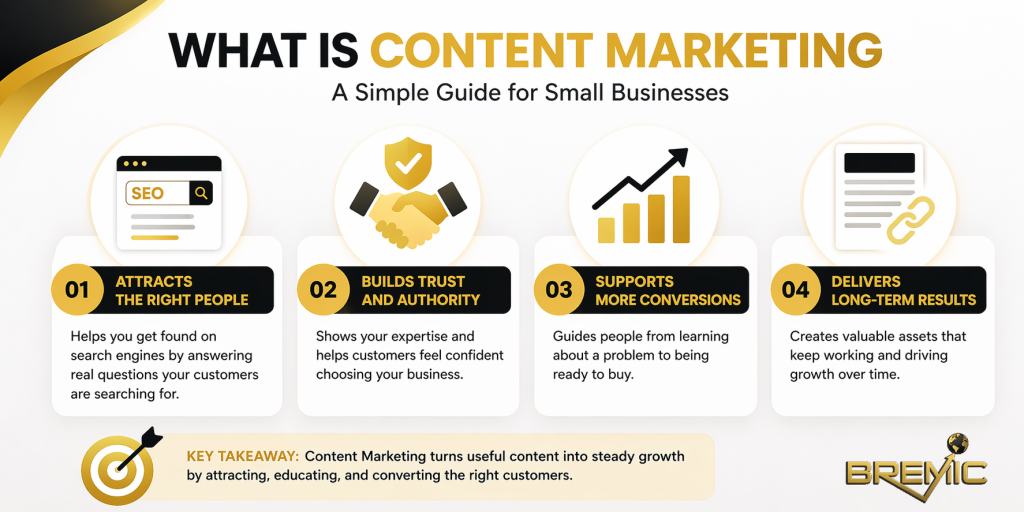
Small businesses usually do not have the luxury of broad brand awareness, large paid media budgets, or a long list of marketing specialists. They need marketing activities that are efficient, compounding, and aligned with buyer intent. Content marketing can do that when it is planned properly.
It improves search visibility
Search engines reward helpful, relevant, well-structured content. When a small business publishes content that addresses specific topics its audience is actively searching for, it creates more opportunities to rank for informational and commercial queries.
This is where Content Marketing and SEO overlap. Content gives a website topic depth. SEO helps that content become discoverable.
A single homepage cannot rank for every relevant question your audience has. But a content cluster can. A pillar page supported by focused articles allows a site to cover a topic in more depth, build internal relevance, and match different stages of search intent.
It builds trust before contact
Most buyers are not ready to contact a business the first time they visit a website. They want evidence that the company understands their needs, communicates clearly, and can solve the problem.
Useful content reduces uncertainty. It shows how you think, how you explain, and whether you understand the real concerns behind a purchase. That is especially important for small businesses competing against larger brands with more visibility or stronger name recognition.
It supports conversions, not just traffic
Traffic alone is not the point. Good content helps users move from awareness to action.
An educational article can lead into a service page. A comparison guide can support a sales conversation. A case study can reinforce credibility near the decision stage. A pricing explainer can qualify leads before they enquire.
When content is aligned with the customer journey, it contributes to business performance rather than acting as a disconnected publishing exercise.
How It Works
Content marketing works by matching useful content to audience needs at the right stage of the buying process.
Step 1: Start with audience problems, not topics alone
A common mistake is starting with a keyword list and treating every query as equal. A better approach is to begin with customer problems, objections, and decision points.
What does the buyer need to understand before they are ready to buy? What questions do they ask during calls? What concerns delay decisions? What misconceptions create friction?
Those are usually your strongest content opportunities.
Step 2: Map content to intent
Not every visitor wants the same thing. Some want a definition. Some want a comparison. Some want proof. Some want pricing.
For that reason, small businesses should create content across a few clear intent categories:
- Informational content for education and early-stage discovery
- Consideration content for evaluating options
- Transactional or service content for conversion
The target keyword here, what is content marketing for small businesses, is informational. That means the page should educate clearly and strategically. It should not turn into a hard sales pitch.
Step 3: Build topic clusters
A strong site architecture usually includes a broader pillar topic supported by more specific cluster pages.
For example, a business focused on Content Marketing might have a pillar page about content marketing strategy, supported by related articles on keyword research, content calendars, blog SEO, internal linking, content audits, and measuring performance.
This helps in three ways. It improves crawlability, strengthens topical relevance, and creates natural internal linking opportunities between related pages.
Step 4: Distribute and reuse content
Publishing is only part of the process. Small businesses get more value when content is repurposed across channels.
A detailed article can support email campaigns, sales follow-ups, social posts, FAQs, and video scripts. That makes content marketing more efficient and reduces the pressure to create everything from scratch.
Important Subtopics Small Businesses Should Understand
Content strategy matters more than output volume
A small business does not need to publish constantly. It needs to publish intentionally.
Five well-planned pieces built around high-value topics are usually more useful than fifty generic posts with no strategic role. Quality, relevance, and alignment matter more than raw publishing frequency.
Distribution is part of the strategy
Even strong content can underperform if nobody sees it. Small businesses should think about where content will be discovered and reused.
That may include organic search, email lists, LinkedIn, direct sales outreach, customer onboarding, and referral conversations. Content should support the channels that actually matter to the business.
Measurement should be tied to business goals
Not every piece of content should be judged by traffic alone.
Some pages are designed to attract search demand. Others are meant to support conversions, answer objections, or improve lead quality. Metrics should reflect that purpose. Depending on the page, useful indicators may include rankings, organic visits, enquiry quality, assisted conversions, time on page, or internal click-through to service pages.
Common Mistakes
Many small businesses say they have tried content marketing and found that it “did not work.” In most cases, the issue is not the channel itself. It is the execution.
Publishing without a clear audience
Content that tries to speak to everyone usually speaks to no one. Small businesses need content built around a defined buyer, a clear problem, and a specific stage of intent.
Treating content like a branding exercise only
Brand voice matters, but content should also answer search demand and support business goals. If every piece is vague, inspirational, or self-promotional, it will struggle to perform.
Chasing volume over usefulness
Publishing frequently is not a strategy. Content that adds no real value will not build authority, even if it is technically optimized.
Ignoring internal linking
If articles are published in isolation, they do little to strengthen the wider site. Internal links help users navigate related topics and help search engines understand content relationships across the cluster.
Expecting immediate results
Content marketing is usually cumulative. It rarely produces meaningful outcomes from one article alone. The gains tend to come from consistency, relevance, and compounding authority over time.
Practical Guidance for Small Businesses
A realistic content marketing approach should fit the business model, available resources, and sales cycle.
Start with commercial relevance
Begin with topics closest to revenue. That usually means content tied to services, customer concerns, buying decisions, and common objections.
Before creating broad educational content, make sure the core commercial pages are strong and supported by useful supporting articles.
Build around a small number of priority themes
Most small businesses do not need a huge editorial operation. They need focus.
Choose a few themes that align with your services and customer demand. Then build depth around those themes through connected articles rather than publishing random standalone posts.
Use expertise already inside the business
Strong content often comes from real operational knowledge. Sales calls, customer support questions, project experience, and recurring objections are all valuable inputs.
That is where E-E-A-T becomes practical. Experience and expertise are not abstract concepts. They show up when content reflects real-world understanding instead of generic commentary.
Maintain and improve what you publish
Content marketing is not only about creation. It is also about refinement.
Review performance, update weak pages, improve internal links, strengthen introductions, expand thin sections, and align pages more clearly with search intent. Small improvements across existing content can create more value than constantly adding new pages.
Timing and Expectations
Content marketing for small businesses should be treated as a medium- to long-term growth channel.
Some content can generate engagement quickly, especially if distributed well or tied to a current need in the market. But organic search performance usually takes time. Search engines need to crawl, understand, evaluate, and compare your content against existing competitors.
For a newer or lower-authority site, it is normal for results to build gradually. That is why realistic expectations matter. Content marketing is not instant-response advertising. It is an asset-building model.
The businesses that see meaningful results are usually the ones that stay consistent, focus on relevance, and improve their content over time instead of abandoning the effort too early.
Conclusion
So, what is content marketing for small businesses?
It is a structured way to attract the right audience, demonstrate expertise, and support growth through useful content that serves both users and business goals.
At its best, Content Marketing helps a small business do more than publish articles. It helps the business build authority, improve organic visibility, support conversions, and create marketing assets that continue working over time.
The key is to approach it strategically. Focus on real customer needs, align content with search intent, build topic depth through a clear site structure, and measure success in terms that matter to the business.
Small businesses do not need the largest content library in their market. They need the most relevant one.