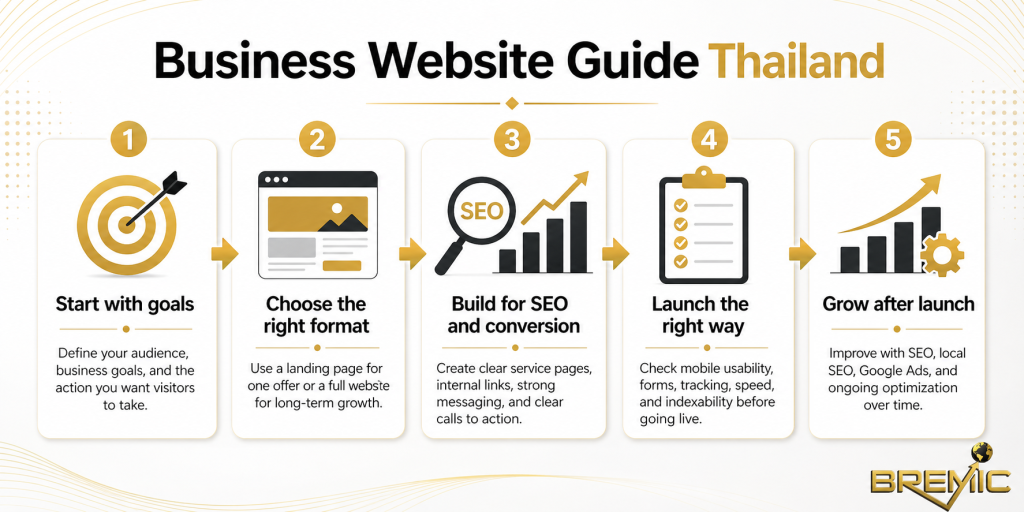
Business website guide Thailand: how to plan, build, launch, and grow a website that performs
A business website is not just a digital brochure. In practice, it is a sales asset, a credibility signal, a lead-generation system, and often the central point that connects SEO, Google Ads, local search, social traffic, and offline referrals.
That is why a proper business website guide for Thailand has to go beyond design preferences and platform choices. The real question is not whether your business needs a website. It is what the website needs to do, who it needs to persuade, how it should be structured, and how it will support growth after launch.
This pillar page explains how to approach a business website strategically in the Thai market. It covers planning, structure, content, SEO, local visibility, launch readiness, ongoing costs, and common mistakes. It is written for business owners and decision-makers who want a site that supports real business outcomes, not just a site that looks modern on day one.
What a business website in Thailand should actually do
A website should support a clear business objective. For some companies, that means generating inbound leads. For others, it means building trust before a sales call, helping prospects compare services, supporting local visibility, or giving paid traffic a place to convert.
In Thailand, that objective often has a few extra layers:
- audiences may search in English, Thai, or both
- mobile usability matters more than desktop assumptions
- trust signals are critical, especially for service businesses
- local relevance can strongly influence conversion and search performance
- businesses often rely on a mix of organic search, Google Ads, maps visibility, referrals, and messaging apps
A strong website accounts for those realities early. It does not treat SEO, copy, design, and conversion as separate tasks. It aligns them from the start.
If you are still at the planning stage, start with a more detailed breakdown of how to plan a business website in Thailand. That process will help you define goals, pages, audience needs, and success criteria before design begins.
Start with the right business goal, not the homepage layout
One of the most common weaknesses in website projects is starting from visuals instead of strategy. Businesses often begin by thinking about colors, inspiration sites, or whether they want something “simple and clean.” Those decisions matter, but they come later.
The foundation should be much more practical:
- What action should the website generate?
- Who is the ideal customer?
- What objections does that customer have?
- What services or products deserve dedicated landing pages?
- What information does a buyer need before they contact you?
- Will the site rely mainly on SEO, paid ads, referrals, or a combination?
These questions affect everything that follows, including site structure, page templates, content depth, conversion design, and whether the site needs a blog, case studies, location pages, or multilingual support.
A site built around a vague goal usually ends up vague in its messaging. A site built around a defined commercial objective is easier to write, easier to structure, and easier to optimize.
Decide whether you need a landing page or a full website
Not every business needs the same type of website.
A single-service business with one clear offer may do well with a tightly focused lead-generation setup. A company with multiple services, multiple customer segments, or long-term SEO goals usually needs a broader site architecture.
That is why the first structural decision is not “Which platform should we use?” It is “What kind of web presence matches the business model?”
If you are unsure, compare the practical differences between a landing page and a full website. A landing page can work for narrow campaigns or paid traffic, but it is usually too limited for businesses that want topical authority, long-term search visibility, and room to expand service content over time.
For most established small and mid-sized businesses in Thailand, a full website is the stronger long-term asset because it can support:
- multiple service pages
- educational content
- trust-building pages
- organic search growth
- local SEO signals
- expansion into new topics or locations later
Build a structure that supports SEO and conversion together
A well-structured business website helps users find what they need and helps search engines understand your expertise.
That usually means building around a sensible hierarchy:
- core business pages
- service or product pages
- trust pages such as About, FAQs, testimonials, or process pages
- location or area pages where appropriate
- supporting content that answers pre-purchase questions
The key is to avoid treating SEO pages and sales pages as separate things. A good service page should do both: rank for relevant intent and persuade the right visitor to take action.
For service businesses in Thailand, a typical site might include:
Home page
This is not the place to explain everything. The homepage should clarify what the business does, who it serves, what makes it credible, and where users should go next.
Core service pages
Each major service should usually have its own page. This improves relevance, makes internal linking easier, and gives you clearer SEO targets.
About page
This matters more than many businesses assume. Serious buyers often want to understand who they are dealing with, especially before submitting an inquiry.
Contact page
Your contact page should reduce friction, not create it. Address, phone number, inquiry form, and any relevant local details should be easy to find.
Supporting content
This is where the pillar-and-cluster model becomes powerful. Instead of overloading service pages with every possible detail, you create supporting resources around pricing, planning, SEO, maintenance, local visibility, and decision-making.
Content should answer buying questions, not just describe the company
Thin corporate copy is one of the fastest ways to weaken a website.
Many business websites still rely on generic wording such as “high-quality solutions,” “professional service,” or “tailored approach.” That language says almost nothing. It does not address real buying concerns, and it does not help search visibility either.
Better website content does three things at once:
- explains the offer clearly
- addresses practical concerns and objections
- creates useful topical depth around the customer journey
For example, a prospect considering a new website may also want to understand:
- what they should prepare before hiring a provider
- whether they need SEO from the start
- how launch should be handled
- what ongoing maintenance costs look like
- whether SEO or Google Ads is the better next investment
That is where supporting resources become valuable. Content such as what to prepare before hiring a web design agency helps prospects make better decisions while also strengthening your topical coverage.
This is the strategic difference between publishing random blog posts and building a real content cluster. In a strong cluster, each supporting article answers a specific question that buyers naturally have around the main service.
SEO should shape the website from the start
SEO is much easier to build into a website than to retrofit later.
When SEO is ignored during planning, businesses often end up with pages that are too thin, too broad, duplicated, or poorly targeted. That creates unnecessary rework after launch.
A practical SEO-driven website process should include:
- keyword and intent mapping before page creation
- clear page purpose for every major URL
- service pages built around real search demand and conversion intent
- internal linking between pillar and supporting pages
- metadata, headings, and on-page structure planned early
- technical basics such as crawlability, indexing, page speed, and mobile usability
If you want a more actionable starting point, use this SEO checklist for small businesses in Thailand. It is especially useful for making sure your site is not just visually complete, but actually prepared to compete in search.
A business website guide for Thailand should also acknowledge a basic reality: SEO is not only about rankings. It is about matching intent. If your pages attract the wrong traffic, rankings alone will not generate useful leads.
That is why keyword selection matters less than many people think, and page intent matters more.
Local SEO matters if your business serves a specific area
For many businesses in Thailand, local search visibility is a major driver of leads. This includes service businesses, consultants, clinics, showrooms, agencies, contractors, and any company that serves customers in a defined city or region.
A website supports local SEO in several ways:
- location signals in page content
- consistent business information
- localized service pages where justified
- internal linking to location-relevant resources
- alignment with your Google Business Profile
If local customers are important, review a proper local SEO checklist for Thailand. Local visibility is not just about being present on Google Maps. It depends on how your site, business profile, and local relevance work together.
That leads to another often-missed point: your website and your Google Business Profile should not be treated as separate channels. Your profile helps with discovery, but your website often does the heavier work of explaining services and converting visitors. If you need to improve maps and profile performance as part of the same strategy, this guide to Google Business Profile optimization in Thailand is a useful next step.
Website projects fail when the provider choice is handled casually
A website can underperform even when the design looks polished. Often the real issue is not visual quality but process quality.
The wrong provider may skip discovery, use generic templates without thinking through structure, write weak copy, ignore SEO intent, or deliver a site that is difficult to update later. That creates hidden costs after launch.
When evaluating who should build your site, the decision is not only about price. It is about capability, process, and fit for your goals.
Some businesses are better served by a structured agency process. Others are better matched with a capable independent specialist. The right choice depends on project scope, required expertise, communication style, and whether the site needs ongoing support after launch.
If you are comparing options, read the difference between a web design agency and a freelancer in Thailand. It is a more useful framing than simply asking who is “better.”
Launch is a process, not a handoff moment
Many businesses treat launch day as the finish line. In reality, launch is a transition point. It is when a website moves from development to live performance, and that means mistakes become public if the process is weak.
A proper launch should include checks for:
- indexability and noindex settings
- analytics and tracking setup
- form functionality
- mobile QA
- redirects if replacing an old site
- metadata and open graph basics
- image compression and page performance
- legal and contact information accuracy
- broken links
- crawl issues
This is where a practical website launch checklist for small business becomes useful. It helps prevent the common situation where a site is technically live but strategically unfinished.
A launch should also be followed by an early review period. Expect to refine copy, improve conversion points, and monitor how users interact with the site. Websites usually improve through iteration, not through one perfect version.
Understand the real cost beyond the build price
A business website in Thailand should be treated as an ongoing operating asset, not a one-time purchase.
The upfront build cost is only one part of the picture. Depending on your setup, you may also need to budget for:
- domain and hosting
- content creation
- SEO setup or ongoing SEO work
- copywriting
- photography or creative assets
- plugin or software licenses
- maintenance and updates
- tracking, reporting, and optimization
- paid traffic after launch
This is where many businesses get caught off guard. They compare build quotes without understanding what is included, what is missing, and what future costs are likely.
For budgeting context, it helps to understand SEO cost in Thailand, website maintenance cost in Thailand, and even Google Ads cost in Thailand. Those topics are connected. Website decisions are rarely isolated from traffic acquisition decisions.
Do not confuse website launch with website growth
A new website is not automatically a lead engine. It still needs traffic, trust, and refinement.
In practice, most businesses need a post-launch growth path. That may include SEO, Google Ads, local SEO, conversion improvements, content expansion, or all of the above.
The right mix depends on your timeline and business model.
When SEO makes sense
SEO is usually the stronger long-term channel when:
- search demand exists for your services
- buyers research before contacting
- you want compounding visibility over time
- you are willing to build supporting content and authority
When Google Ads makes sense
Google Ads can be effective when:
- you need faster lead generation
- the service is commercially clear
- your landing pages are conversion-focused
- you have the budget to test and optimize
Most businesses should not think in extremes. The better question is how the website supports both channels. A good site can serve as the foundation for organic growth while also converting paid traffic efficiently.
If you are weighing channels, compare SEO vs Google Ads in Thailand. The answer is rarely universal. It depends on competition, urgency, margin, and the quality of the site you are sending traffic to.
Common mistakes that weaken business websites
A strong business website guide for Thailand should be honest about what goes wrong most often.
Mistake 1: building around aesthetics alone
A modern-looking site can still fail if messaging, structure, and intent are weak.
Mistake 2: putting all services on one page
This often limits both SEO relevance and conversion clarity. Distinct services usually deserve distinct pages.
Mistake 3: using generic copy
Vague claims do not build trust. Buyers need specifics: scope, process, outcomes, fit, and next steps.
Mistake 4: ignoring internal linking
A cluster structure only works if pages support each other. Internal links help users navigate and help search engines understand topical relationships.
Mistake 5: treating SEO as a plugin
SEO is not something you “add later” through a settings panel. It starts with content strategy, page purpose, and site architecture.
Mistake 6: underestimating maintenance
Websites need updates, fixes, and periodic review. A neglected site becomes slower, less secure, and less reliable over time.
Mistake 7: no clear conversion path
If users cannot quickly understand what to do next, contact rates drop. Good conversion design is usually simple, not flashy.
A practical framework for building the right website
If you want a realistic approach, this sequence works well for most businesses:
1. Clarify the goal
Define the primary role of the website. Lead generation, trust building, local visibility, paid traffic support, or a combination.
2. Map the key pages
List core pages, service pages, and supporting content that aligns with real customer questions.
3. Choose the right site type
Decide whether you need a focused landing page setup or a broader website with room for SEO and content growth.
4. Align design with content
The layout should support the message, not compete with it. Content strategy should not be squeezed into leftover design space.
5. Build SEO and local visibility in early
Plan metadata, URL structure, internal links, and location relevance before launch.
6. Launch carefully
Use a real checklist, test important functions, and review indexability, tracking, and mobile performance.
7. Improve after launch
Monitor what pages attract traffic, where users drop off, and what content needs refinement or expansion.
This is also why the best website projects are usually not the cheapest or the fastest. They are the ones with clearer thinking behind them.
What to expect realistically
A website can improve credibility immediately if it is well written and professionally structured. That part can happen quickly after launch.
Search visibility takes longer. SEO performance depends on competition, content quality, topical depth, technical foundations, and how consistently the site is improved. Local SEO can sometimes move faster than broader organic visibility, but it still requires proper setup and alignment.
Conversion performance also evolves. The first version of a site is rarely the final version. Expect to learn from real user behavior and adjust calls to action, page copy, proof elements, and navigation over time.
That is the realistic view. A business website is not finished when it is published. It becomes valuable when it is maintained, measured, and improved.
Strategic takeaway
The best business website guide for Thailand is not a list of design trends or platform features. It is a framework for making better decisions.
A business website should be planned around clear goals, built with the right structure, written for real buying intent, optimized for search and local visibility, and supported after launch. It should help the business earn trust, attract qualified traffic, and convert that attention into inquiries or sales.
If you approach it that way, the website becomes more than an online presence. It becomes a durable growth asset.
And if you are building with a pillar-and-cluster model in mind, that asset becomes even stronger. Each supporting page improves relevance, answers real customer questions, and reinforces the authority of the broader site. That is what turns a website from a static project into a scalable digital foundation.