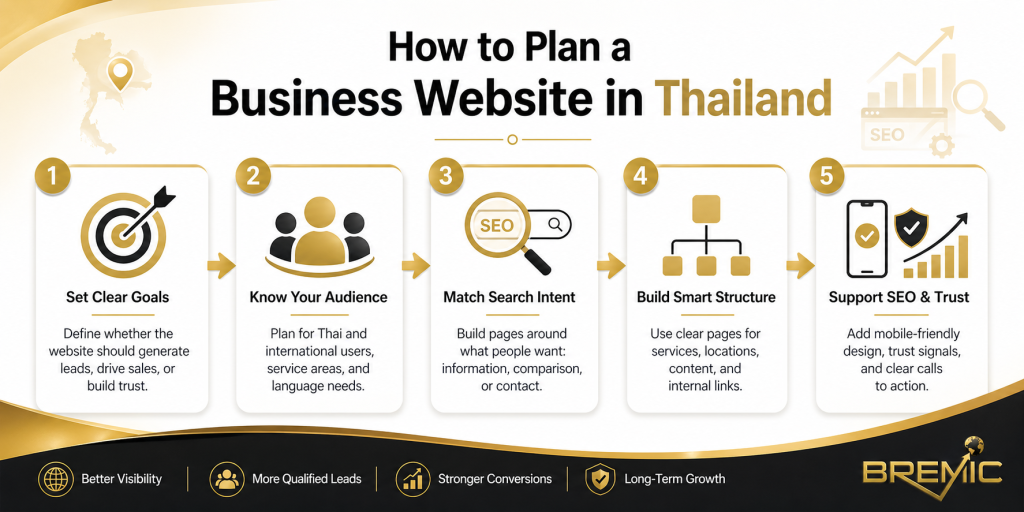
Planning a business website in Thailand is not the same as choosing a template and writing a few service pages. A good plan connects business goals, local market expectations, search visibility, trust signals, and the practical details that affect performance after launch. For many small and mid-sized companies, the website either becomes a steady source of qualified leads or an expensive brochure that does very little.
This website planning guide focuses on what matters before development starts. If you are planning a new company site, rebuilding an outdated one, or creating a more structured digital presence for a small business in Thailand, the goal is simple: make decisions early that support SEO, usability, and conversion instead of creating problems you have to fix later.
What business website planning actually means
Business website planning is the process of deciding what the website needs to do, who it needs to serve, what content it needs to publish, and how the site should be structured before design and development begin.
In practice, that means answering a few strategic questions first:
- Who is the site for: Thai customers, international buyers, or both?
- What actions should visitors take: call, submit a form, request a quote, book, or visit a location?
- What pages are necessary to support those actions?
- What information does Google need to understand the business clearly?
- What trust, legal, and operational details need to be in place from day one?
Without this stage, businesses often launch websites that look acceptable but have weak page targeting, unclear navigation, thin service content, and poor lead paths.
Start with the business objective, not the homepage
One of the most common mistakes in website planning is treating the homepage as the strategy. It is not. The homepage is only one page in a larger system.
Start by defining the primary business objective. For most businesses in Thailand, that usually falls into one of these categories:
- lead generation for services
- direct sales for products
- credibility and company validation
- local discovery and contact
- support for offline sales or B2B outreach
Once the goal is clear, the page structure becomes easier to plan. A service-led company might need focused service pages, location pages, case-related content, and quote forms. A manufacturer or exporter may need capability pages, industry pages, certification details, and bilingual content. A local small business website in Thailand may need strong contact, map, call, and messaging paths above all else.
This sounds obvious, but many websites fail because every page tries to do everything at once.
Define the audience before you define the structure
A business website in Thailand often serves mixed audiences. That changes planning decisions immediately.
For example, your site may need to serve:
- Thai-speaking local customers
- English-speaking expats or tourists
- overseas buyers researching suppliers in Thailand
- procurement teams comparing vendors
- people already familiar with your brand who only need contact and trust validation
These audiences do not search the same way, and they do not need the same information. That is why audience definition comes before sitemap planning.
If you need both Thai and English content, decide early whether both languages deserve full strategic treatment or whether one language will carry most of the commercial SEO effort. A bilingual site can work very well, but only when the content model is intentional. Copying a thin English version of a Thai site, or vice versa, usually creates weak pages in both languages.
Choose the right domain and platform decisions early
Domain planning is not a minor detail. It affects branding, trust, and in some cases local positioning.
If your business wants a Thai country-code domain, you need to check eligibility and registration rules in advance. THNIC publishes specific guidelines for .th registrations, including category-based third-level domains such as .co.th, rather than treating them like generic open-registration domains.
That does not mean a .com is wrong. In many cases, a .com is still the practical choice, especially for broader regional or international positioning. The key is to choose based on business scope, brand use, and long-term marketing, not on assumptions.
Platform choice matters too, but it should follow the content and operational needs. If the site needs strong content marketing, scalable landing pages, and ongoing SEO work, choose a platform your team can actually manage well. The best system is usually the one that lets you publish clean pages, edit metadata, manage redirects, improve internal linking, and update content without technical friction.
Plan the core page architecture before writing content
A strong site architecture helps users and search engines understand what the business offers. Google’s guidance is consistent on the basics: content should be crawlable, understandable, and built for people first, not just for ranking manipulation.
For most service businesses, the minimum viable structure usually includes:
Core commercial pages
These are the pages that explain what you do and generate enquiries. In many cases that means:
- homepage
- about page
- individual service pages
- industry or use-case pages where relevant
- contact page
Do not compress multiple services into one generic page if customers search for them separately. Separate pages create clearer targeting and better internal linking opportunities.
Support and trust pages
These pages often influence conversion more than businesses expect:
- company profile
- portfolio, projects, or examples
- FAQs
- testimonials or review-based proof where appropriate
- policy pages
- careers or team pages if credibility matters in the buying process
Resource or educational content
A business website planning guide should not ignore content strategy. Informational content often supports commercial performance indirectly by building topical relevance, answering early-stage questions, and creating internal links into service pages. If the site will publish educational content, it should sit inside a clear content hub. On this site, that naturally connects to the broader resources section.
Build SEO into the plan, not after launch
If SEO is treated as a finishing step, the site usually ends up with pages that are structurally hard to rank. Good SEO planning starts with page intent mapping.
For each important page, define:
- the target keyword theme
- the search intent behind it
- the primary conversion action
- the supporting internal links
- the evidence or trust elements that page needs
This prevents a common problem: publishing pages that have titles and headings but no real search purpose.
For example, if a page targets a service term, it should not read like a vague brochure. It should explain the offer, who it is for, what the process looks like, what the business covers, and what the next step is. If a page targets an informational query, it should teach clearly and then guide the reader naturally toward a related commercial next step.
Mobile performance must also be planned from the beginning. Google uses the mobile version of a site’s content for indexing and ranking, and it recommends equivalent content and metadata across mobile and desktop experiences. That matters in every market, but especially when your audience often first encounters the site on a phone.
Plan for trust, compliance, and conversion together
A business website in Thailand should not separate marketing decisions from compliance and trust decisions.
If the website collects personal data through forms, analytics, account features, or cookie-based tracking, privacy planning needs to happen before launch. Thailand’s PDPA environment is reflected in the official PDPC ecosystem and related government compliance resources, which cover areas such as consent management, privacy notices, cookie policy handling, records of processing activities, and breach-related processes.
For most businesses, that means planning for:
- a clear privacy policy
- a practical cookie notice where relevant
- form language that matches actual data use
- internal handling of enquiries and stored contact data
- accurate business identity and contact details
This is not just a legal issue. It is a conversion issue too. Businesses ask visitors to trust them with contact information, quotation requests, or commercial enquiries. That trust is easier to earn when the website feels complete, transparent, and professionally maintained.
Conversion planning should also be practical. Do not assume every visitor wants a long form. Depending on the business, you may need a mix of calls, short forms, map access, email, or a familiar messaging channel. The best conversion path is the one your sales process can respond to consistently.
Common mistakes when planning a small business website in Thailand
The weakest websites usually do not fail because of one big issue. They fail because of several small planning mistakes stacked together.
One is building navigation around internal company language instead of customer search language. Another is using one broad service page where separate services should have their own pages. A third is underestimating how much trust content buyers need before making contact.
Other common mistakes include:
- choosing design before content structure
- launching with thin page copy and planning to “fix SEO later”
- creating bilingual pages without a real language strategy
- hiding important commercial details behind sliders, tabs, or PDFs
- using generic stock wording that does not explain the actual offer
- forgetting policy, consent, and data-handling requirements
- treating blog content as isolated articles with no internal linking purpose
These issues are avoidable when website planning is handled as a business and SEO exercise, not just a design project.
A realistic planning process before development starts
A practical website planning guide should leave you with a sequence, not just theory.
A realistic process usually looks like this:
First, define the business goals, audience segments, and commercial priorities.
Next, map the website structure. Decide which pages are essential, which can wait, and how pages should connect.
Then, assign keyword themes and intent to each core page. This is where SEO planning becomes operational instead of abstract.
After that, prepare content requirements page by page. Not final copy yet, but clear content briefs: what each page needs to explain, prove, and convert.
Then confirm technical and operational decisions, including domain, CMS, forms, tracking, language handling, redirects, and privacy requirements.
Only after that should design and development move forward.
This order saves time because it reduces rework. More importantly, it produces a website that is easier to scale with content, easier to optimize, and easier to trust.
What to expect after launch
Even a well-planned site does not produce strong SEO results instantly. A new or rebuilt website still needs indexing, technical validation, content expansion, internal link development, and performance monitoring through tools such as Google Search Console. Google describes Search Console as a way for site owners to monitor, debug, and optimize how their sites perform in Google Search.
That is why planning should include the post-launch phase. Know which pages matter most, which metrics define success, and which content areas will expand over time. The launch is the start of the system, not the finish line.
Final takeaway
If you want to know how to plan a business website in Thailand properly, start by thinking beyond design. Good planning aligns business goals, audience needs, page architecture, SEO intent, trust signals, and local practical requirements before development begins.
That approach gives you a website that can rank, convert, and support long-term growth instead of becoming a costly rebuild six months later. For most businesses, the smartest move is not launching faster. It is planning more deliberately.