If you are evaluating SEO cost Thailand options, the main question is not just “What is the monthly fee?” It is “What level of work does this budget actually buy, and is that scope aligned with my business goals?” That is where many businesses get pricing wrong. They compare packages by price alone, even though one proposal may cover technical fixes, content, reporting, and authority building while another is little more than basic on-page edits and a monthly report.
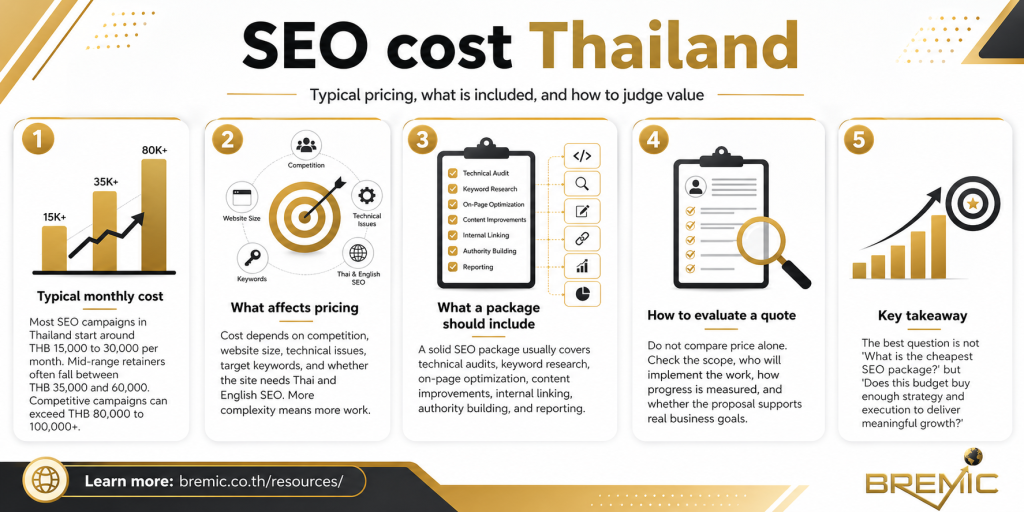
Public pricing pages in the Thailand market show that SEO usually starts around ฿15,000 to ฿20,000 per month at the lower end, with many mid-range retainers landing around ฿35,000 to ฿60,000 per month, and competitive campaigns often exceeding ฿100,000 per month. Those numbers are useful as market context, but they are not a universal rate card. The real cost depends on scope, competition, site quality, and how much content and authority-building work is needed.
What SEO pricing in Thailand usually includes
A serious SEO engagement is not a single task. Google’s own guidance describes SEO work as helping search engines understand content and helping users decide whether to visit a site, while its hiring guidance notes that SEO services commonly include site structure review, technical advice, content development, campaign support, keyword research, and market-specific expertise.
In practical terms, a solid SEO package cost usually covers a combination of:
- technical auditing and issue resolution
- keyword and search intent research
- on-page optimization
- content planning and content improvement
- internal linking and site structure work
- authority development, often including outreach or link acquisition
- analytics, tracking, and reporting
That mix matters because SEO results rarely come from one lever alone. A site can have good keywords and weak technical foundations, or strong pages and poor internal linking, or decent rankings but weak conversion paths. Good SEO pricing reflects the amount of coordinated work required to improve the full search performance of the site.
How much does SEO cost in Thailand by business type?
For a small local business with a relatively simple website and modest competition, a lower monthly retainer may be enough to cover local keyword targeting, on-page work, Google Business Profile support, service page improvements, and steady technical maintenance. Public Thailand pricing references commonly place entry-level SEO around the high four figures to low five figures per month, with many campaigns beginning around ฿15,000 to ฿30,000.
For established service businesses, multi-location brands, or companies targeting both Thai and English search demand, the budget usually needs to move higher. Once the campaign requires deeper content production, stronger reporting, more pages, or broader keyword coverage, the scope grows quickly. That is why mid-market SEO pricing in Thailand often lands in the ฿35,000 to ฿60,000 range.
For aggressive national campaigns, ecommerce, or highly competitive sectors such as medical, finance, real estate, or larger retail categories, SEO often becomes a much heavier operational program. More technical work, more content, stronger authority requirements, and tighter performance expectations push the cost up. In those cases, ฿80,000 to ฿100,000+ per month is not unusual.
Why SEO pricing varies so much
The biggest driver of SEO pricing Thailand is scope. A five-page service site targeting a narrow local market is not comparable to a large multilingual site trying to rank across multiple services, cities, or product categories. Agencies price accordingly because the work volume and strategic complexity are completely different.
Competition is another major factor. If your target terms are commercially valuable and crowded with established competitors, the campaign will usually need stronger content, better page quality, higher technical standards, and a more serious authority strategy. Cheap retainers tend to struggle in those environments because they do not fund enough work to move the needle.
Language and audience coverage also matter in Thailand. Many businesses are not targeting one audience only. They may need to reach Thai customers, expats, tourists, or international buyers, which changes keyword research, content planning, site architecture, and UX decisions. If the SEO scope covers Thai and English content properly, the cost should rise because the workload is larger, not because the agency is inflating the proposal.
The current condition of the website also affects price. If the site has poor crawlability, weak page structure, duplicate content, thin service pages, slow performance, or tracking gaps, the agency has to solve those problems before rankings are likely to improve consistently. Businesses often underestimate how much budget is absorbed by fixing the site before growth work can scale.
Common SEO pricing models in Thailand
The most common model is the monthly retainer. This is usually the right format when the goal is sustained growth rather than a one-off cleanup. SEO is iterative, so monthly retainers make sense when the agency is expected to audit, implement, publish, monitor, and refine over time. Public Thailand agency pages also present retainer pricing as the standard structure for ongoing SEO work.
A second model is the project-based engagement. This works for technical audits, migrations, architecture reviews, or cleanup projects where the scope is finite. It can be valuable, but it is not a substitute for an ongoing organic growth program. A one-time fix may improve the site, but it will not replace consistent content, tracking, and competitive response.
The third model is the low-cost fixed package. This is where caution matters. Low-cost SEO is not automatically bad, but very cheap packages often rely on shallow deliverables: a small batch of keywords, basic metadata edits, generic reporting, and little real strategic work. If the proposal is much cheaper than the market, check what is actually being done each month. Cheap SEO becomes expensive when it delays progress for six to twelve months.
How to evaluate whether an SEO quote is worth it
A strong proposal should explain the scope clearly. You should be able to see what is included in technical work, content work, on-page improvements, off-page activity, reporting, and implementation support. If the quote is vague, the risk is high. Ambiguity usually benefits the seller, not the client.
You should also check whether the proposal is tied to business goals rather than vanity metrics. Rankings matter, but rankings alone are not the outcome you are buying. A good SEO strategy should connect search visibility to qualified traffic, lead quality, revenue opportunity, or another commercial objective that matters to the business.
Another important filter is implementation ownership. Some agencies audit and recommend, but the client’s internal team has to execute. Others handle execution directly. That difference has a major effect on price and on timelines. Two quotes can look similar until you discover that one includes hands-on work and the other mostly delivers advice.
Mistakes businesses make when comparing SEO package cost
One common mistake is choosing the lowest quote without checking deliverables. A cheaper package can look efficient until you realize it excludes content production, technical work, internal linking, or real authority-building. At that point, the business is not buying SEO growth. It is buying activity.
Another mistake is expecting guaranteed rankings. Google explicitly states that there are no secrets that automatically rank a site first, and it warns that hiring an SEO can improve a site but can also damage the site and reputation if done irresponsibly. Any agency that sells certainty should be treated carefully.
A third mistake is expecting immediate returns. Google says some changes may be reflected in hours, while others can take several months, and it recommends waiting a few weeks to assess impact. SEO is not the right channel if the business needs instant lead volume next week. It is the right channel when the business wants to build a durable acquisition asset over time.
What a realistic SEO investment decision looks like
For most businesses, the right question is not “What is the cheapest SEO price in Thailand?” It is “What level of monthly investment is realistic for our goals, competition, and website condition?” A serious local campaign may be viable at the lower end of the market. A broader or more competitive campaign usually is not.
That is why the best buying decision is usually scope-first, price-second. Start with the commercial targets, the market you want to compete in, the state of the current website, and the content gap. Then assess whether the proposed budget can realistically fund the work required. If you want a broader view of SEO, content, and website strategy, the site’s resources section is the right place to continue reading.
Conclusion
The honest answer to how much does SEO cost in Thailand is that there is no single fixed number, but there is a clear market pattern. Entry-level retainers often start around ฿15,000 to ฿20,000, many serious business campaigns sit in the ฿35,000 to ฿60,000 range, and competitive sectors can move well beyond ฿100,000 per month. The right budget depends on how much work is required to earn visibility, not just how much an agency wants to charge.
A good SEO investment should buy strategy, execution, and realistic progress. If the proposal is clear, the scope matches the goal, and the expectations are grounded in how search actually works, cost becomes easier to judge. That is the real standard: not whether the package looks cheap, but whether it is capable of producing meaningful organic growth.