If you are planning paid search in Thailand, the first question is usually simple: how much will Google Ads cost? The honest answer is that there is no fixed Thailand price list. Google Ads pricing is auction-based, your actual cost per click is often lower than your max CPC bid, and daily budgets are managed at campaign level rather than as a flat monthly fee.
That matters because many businesses make the same mistake early: they look for one average number, set a budget around it, and assume the account will perform. In practice, Google Ads cost Thailand depends on your market, your search terms, your targeting, your account structure, and the quality of the experience from keyword to ad to landing page. A strong campaign can buy better traffic more efficiently than a weak one, even in the same niche. Google’s own documentation makes this clear: ad quality and landing page experience affect performance, and better ad quality generally supports lower costs and better ad positions.
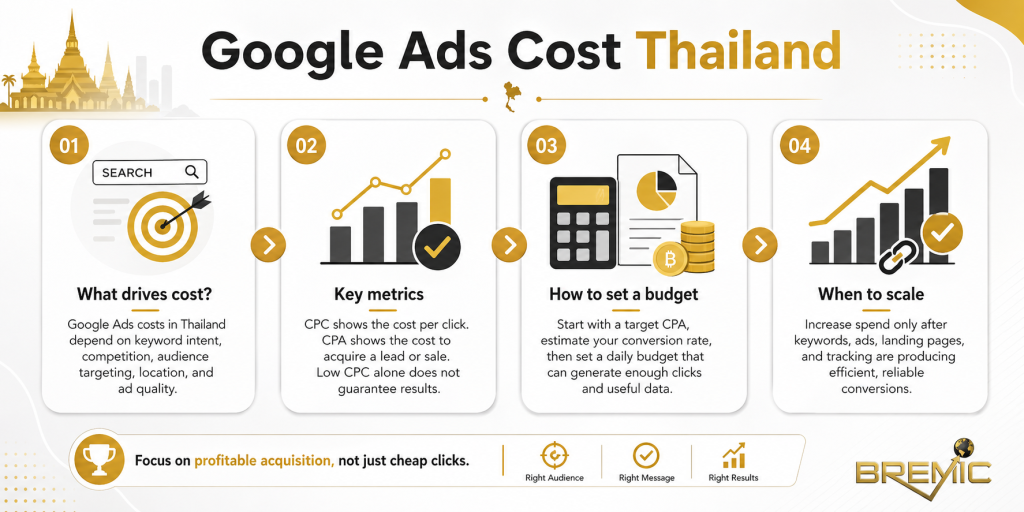
For businesses comparing options, the real goal is not to find the cheapest clicks. It is to build a budget that can produce enough qualified traffic to generate reliable conversion data, then scale what proves profitable.
What Google Ads cost means in practical terms
When people search for Google Ads budget Thailand, they are usually asking about one of three things:
- How much they need to start
- How much they should expect to pay per click
- How much monthly budget is required to generate leads or sales
Those are related, but they are not the same.
Google Ads charges for search traffic through an auction. Your actual CPC is the amount you pay for a click, not a fixed public rate. Your campaign budget is typically set as an average daily budget, and Google may spend more on higher-opportunity days while still working within the monthly spending limit. Google also states that a monthly estimate can be calculated by multiplying the daily budget by 30.4.
So when evaluating search ads cost Thailand, think in layers:
- CPC tells you the price of traffic
- Conversion rate tells you how efficiently traffic turns into leads or sales
- CPA or cost per acquisition tells you whether the campaign is commercially viable
A campaign with a low CPC but poor lead quality can be more expensive than a campaign with a higher CPC and strong conversion intent.
What drives PPC cost in Thailand
Keyword intent and competition
The biggest cost driver is usually keyword intent. Searches close to a transaction or inquiry tend to be more competitive than broad research terms. That is why commercial queries usually cost more than informational queries.
This is especially relevant in Thailand if you are advertising in sectors where one lead can be worth a significant amount. In those cases, competitors are often willing to bid aggressively because the downstream revenue justifies it.
Geography and language targeting
Thailand is not one uniform search market. Costs can shift depending on whether you target nationwide demand, a specific service area, or a more competitive metro market. Language setup also matters. Campaigns targeting English-speaking searchers, Thai-speaking searchers, or both often behave differently because the query patterns, ad relevance, and landing page expectations are not identical.
For that reason, it is rarely smart to combine all audiences into one generic campaign and hope Google sorts it out.
Campaign structure and bid strategy
Your PPC cost Thailand will also depend on how tightly the account is structured. Broad campaign groupings, weak keyword control, and loose intent matching usually waste budget. Clean segmentation tends to improve relevance and reporting, which makes optimization easier.
Bid strategy matters too, but not in the simplistic way many advertisers assume. Automated bidding can work well when the account has clean conversion data. Without enough signal quality, automation can spend budget inefficiently.
Ad quality and landing page alignment
Google treats Quality Score as a diagnostic measure at keyword level, not a success metric by itself. Still, it is useful because it reflects how competitive your ad quality is compared with other advertisers. Google also states that higher ad quality generally supports better positions and lower cost.
In practice, that means this: if your keyword, ad copy, and landing page do not line up, you usually pay more to get worse traffic.
For businesses trying to control Google Ads cost Thailand, this is one of the highest-leverage areas to fix.
How to calculate a realistic Google Ads budget in Thailand
The most reliable budgeting method is to work backward from commercial goals, not forward from a random spend number.
Start with your target CPA
First, define what one lead or sale is worth to the business. Then decide the maximum amount you can afford to pay to acquire it.
For example:
- If a qualified lead is worth ฿8,000 in expected gross profit
- And you want media acquisition cost to stay below 25%
- Then your target CPA is around ฿2,000
That gives you a real decision-making number.
Estimate the traffic you need
Next, estimate how many clicks you need to produce one conversion.
If your landing page converts at 5%, you need about 20 clicks for one lead. If it converts at 2%, you need about 50 clicks.
Now the math becomes usable:
- 20 clicks × ฿30 CPC = ฿600 per lead
- 20 clicks × ฿80 CPC = ฿1,600 per lead
- 50 clicks × ฿30 CPC = ฿1,500 per lead
- 50 clicks × ฿80 CPC = ฿4,000 per lead
That is why Google Ads budget Thailand should never be set without a view of conversion economics. CPC alone is not enough.
Give the campaign enough room to learn
A campaign also needs enough budget to generate statistically useful behavior. If the budget is so tight that you only buy a handful of clicks per day, performance data stays noisy and optimization takes longer.
As a working rule, the opening budget should be large enough to answer three questions within a reasonable period:
- Which search terms generate qualified traffic?
- Which ads produce the strongest click-through and conversion behavior?
- Which landing pages turn intent into leads or sales?
If the initial budget cannot answer those questions, it is often too small.
Convert daily budget into monthly spend properly
Because Google Ads budgets are set daily, many businesses underestimate real monthly spend. Google’s own guidance is to use average daily budget and multiply by 30.4 for a monthly estimate. A ฿1,000 daily budget, for example, is roughly a ฿30,400 monthly budget, not a neat 30-day figure.hould
One common mistake is chasing cheap clicks instead of commercial intent. Broad, low-cost traffic can look efficient in reports while producing very little revenue.
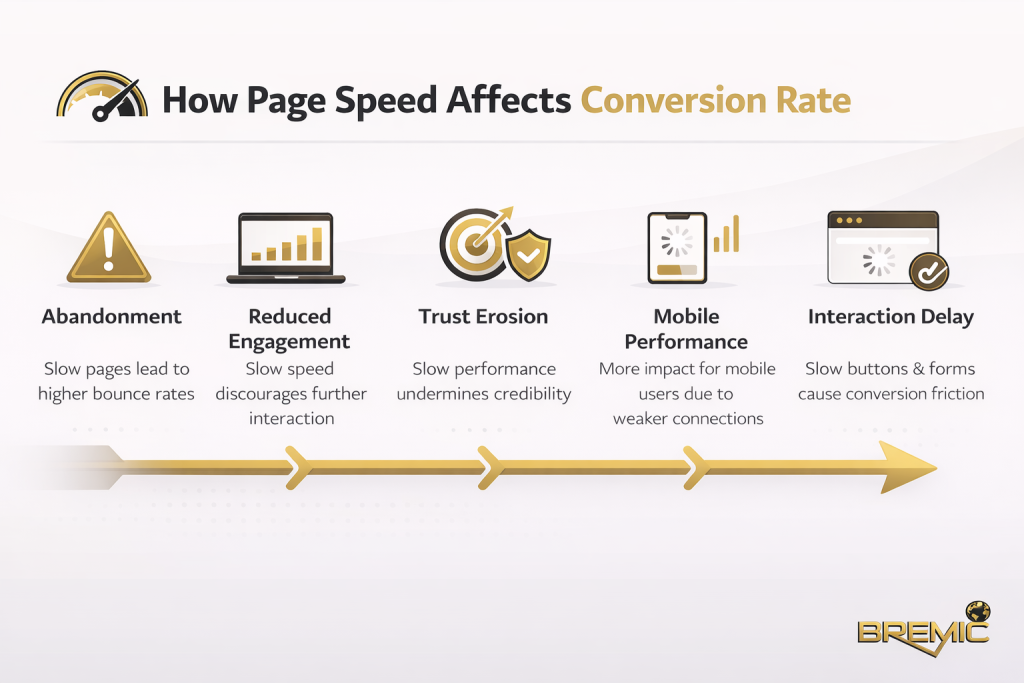
Another is launching with weak landing pages. If the page is slow, unclear, or poorly matched to the ad promise, conversion rates suffer. That pushes effective acquisition cost up even when the click price looks reasonable.
A third problem is poor keyword control. Businesses often overuse broad matching without a strong negative keyword strategy, which can inflate search ads cost Thailand without improving lead quality.
There is also the issue of premature judgment. A campaign should be reviewed critically, but cutting spend too early can prevent the account from gathering enough signal to identify what actually works. That is especially true when the campaign is targeting higher-value searches with lower volume.
A more strategic way to approach Google Ads cost in Thailand
If the objective is lead generation or revenue, the right question is not “What is the average PPC cost in Thailand?” The better question is:
What level of budget is required to generate enough qualified search traffic to validate profitable acquisition?
That shift changes how you build the account.
A practical approach looks like this:
- Start with a focused keyword set tied to one service, offer, or product category
- Separate campaigns by intent, geography, or language where that improves relevance
- Match ad copy tightly to the search theme
- Send traffic to landing pages built for the same intent
- Measure results at the CPA and lead-quality level, not just CPC
This is where many businesses waste money by overcomplicating too early. A smaller, tightly controlled launch usually produces better insight than a broad account with mixed intent.
If you want broader guidance on digital strategy, planning, and performance marketing decisions, the Bremic resources section is a sensible next stop.
When to increase budget and when to fix fundamentals first
Increase budget when the campaign is already showing healthy unit economics: qualified search terms, acceptable CPA, and conversion behavior you would be comfortable scaling.
Do not increase budget just because impression share is low or traffic volume feels disappointing. If core metrics are weak, adding spend usually increases waste faster than results.
Fix fundamentals first when you see patterns like:
- strong click volume but weak conversion rate
- high spend concentrated on poor search terms
- ad copy with weak relevance
- landing pages that do not match buyer intent
- unreliable or incomplete conversion tracking
In other words, scaling should follow validation, not replace it.
Conclusion
Google Ads cost Thailand is not a single market rate. It is the outcome of an auction system, your targeting choices, your account structure, and the quality of your offer presentation. Google confirms that actual CPC is auction-driven, budgets are managed as average daily budgets, and ad quality influences performance and cost efficiency.
For serious advertisers, the smartest path is to stop looking for a generic budget number and start building a commercial model. Define the value of a conversion, estimate the traffic required, set a budget large enough to generate learnings, and improve efficiency before you scale.
That is how you approach PPC cost Thailand realistically: not as a pricing mystery, but as a performance system that can be measured, improved, and made commercially accountable.