Hiring a web design agency usually goes wrong before the project even starts.
Not because the agency lacks technical skill, and not because the client has the wrong intentions, but because both sides begin with unclear inputs. A vague scope, an incomplete website project brief, or missing business requirements will almost always lead to rework, delays, budget drift, and a website that looks acceptable but performs poorly.
If you are researching how to hire a web design agency, the most useful thing you can do first is prepare the right information internally. Strong preparation helps you compare agencies more accurately, ask better questions, and avoid paying for avoidable discovery work. It also gives the agency a fair chance to recommend the right structure, features, and process from the beginning.
This guide explains what to prepare before hiring a web design agency, how to build a practical website project brief, and what should be included in a website requirements checklist before you ask for proposals.
Why preparation matters before you hire a web design agency
A website project is rarely just a design exercise.
In most cases, the site needs to support several business outcomes at once: visibility in search, lead generation, sales enablement, credibility, recruitment, customer support, or operational efficiency. If those priorities are not defined early, the project can become overly subjective. Discussions drift toward visual preferences while more important issues such as information architecture, conversion paths, content needs, and technical requirements remain unresolved.
Preparation matters because it helps answer the questions an agency needs before it can recommend the right solution:
- What is the site supposed to achieve?
- Who is it for?
- What content and functionality does it need?
- What constraints already exist?
- What would success look like after launch?
Without those answers, agencies are forced to estimate against assumptions. That makes proposals harder to compare and often creates hidden scope differences between vendors.
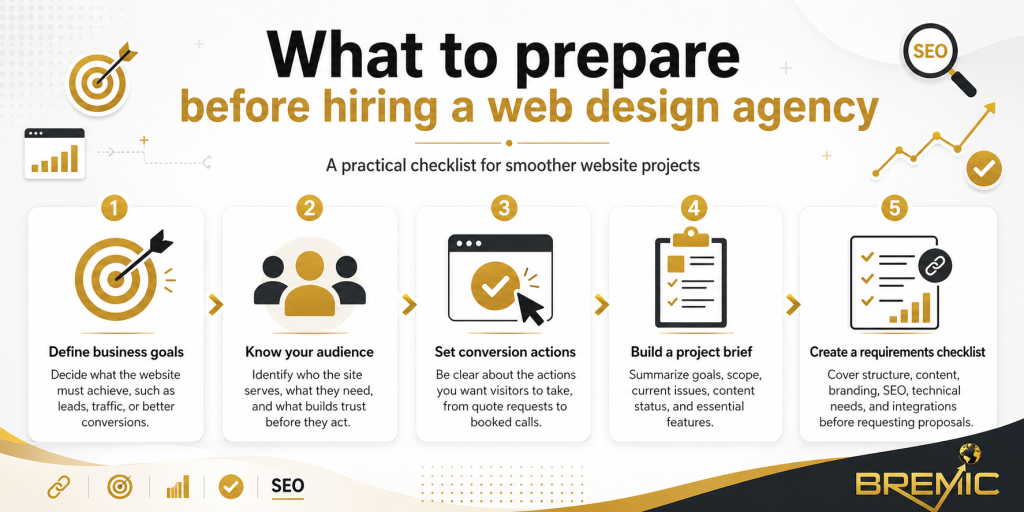
Start with business goals, not design preferences
Before you think about layouts, fonts, or examples of websites you like, define the job the website needs to do.
A serious agency will want to understand the business context behind the redesign or new build. That context shapes everything from page structure to CMS selection to SEO planning.
Clarify the following:
Primary business objective
Decide what the website is primarily meant to achieve over the next 12 to 24 months. Common examples include:
- generating qualified leads
- increasing organic traffic
- improving conversion rates
- supporting a sales team
- repositioning the brand
- consolidating multiple services into one clearer structure
- replacing an outdated platform that is hard to manage
A website can support multiple goals, but one of them should be primary. Otherwise priorities collide during planning.
Target audience and decision-makers
Define who the site needs to persuade. In many businesses, the website visitor is not the only stakeholder that matters. There may also be procurement teams, internal reviewers, technical evaluators, or senior decision-makers who influence conversions.
Document:
- your primary audience segments
- the problems they are trying to solve
- what information they need before taking action
- what objections or trust concerns they may have
This helps an agency design around user intent rather than assumptions.
Commercial model and conversion actions
Be clear about how the business makes money and what you want visitors to do.
For example, a B2B services site may prioritize consultation requests, while an ecommerce site may prioritize product discovery and checkout efficiency. A professional services site might need to generate fewer but higher-quality leads instead of maximizing raw form submissions.
Your preferred conversion actions should be explicit, such as:
- request a quote
- book a call
- submit an inquiry
- download a brochure
- purchase online
- visit a location
- call the business
Build a useful website project brief
A strong website project brief does not need to be long. It needs to be specific enough that an agency can understand the problem, the opportunity, and the constraints.
The best briefs are practical documents, not marketing decks.
What to include in your website project brief
Your website project brief should usually cover the following:
Business background
Explain what the company does, who it serves, and how the website fits into the wider business model.
Project goals
State what needs to improve and why the project is happening now. Be direct. For example, “Our current site does not support our service expansion and has weak organic visibility” is much more useful than “We want a modern website.”
Scope of work
Outline whether this is a full redesign, a new website build, a migration, a CMS rebuild, or a phased project. Mention the approximate number of templates or page types if you know them.
Current website issues
List the real problems with the existing site. These may include poor navigation, low-quality leads, weak mobile usability, slow performance, poor content structure, weak SEO foundations, or limited flexibility for internal teams.
Audience and user journeys
Explain who the users are and the main paths they should follow through the site.
Content status
Clarify whether content already exists, needs to be rewritten, or will be created from scratch. Content is often one of the biggest hidden delays in web projects.
Required functionality
List must-have features such as forms, booking tools, multilingual support, gated resources, CRM integration, ecommerce, user portals, or location pages.
Technical constraints
Mention your CMS preference, existing hosting setup, analytics tools, compliance requirements, integrations, or any internal IT restrictions.
Timeline and budget range
You do not need perfect numbers, but broad parameters help agencies recommend the right process and level of complexity.
A useful brief is often the difference between getting a strategic proposal and getting a generic package.
Create a website requirements checklist before requesting proposals
If your brief explains the project, your website requirements checklist defines the operational details that shape execution.
This is the part many businesses skip, and it is one of the main reasons projects expand unexpectedly after kickoff.
Strategy and structure requirements
Your checklist should cover structural questions such as:
- What core pages or sections are required?
- Will the site need a revised sitemap?
- Are there service, industry, or location pages that need a scalable template?
- Does the project require SEO input on site architecture, metadata, internal linking, and content hierarchy?
- Will there be a resource center, blog, or knowledge hub?
If you are still defining your content ecosystem, it helps to review related planning materials and strategic references in your resources section.
Content requirements
Content requirements often determine both timing and cost. Confirm:
- who will write, edit, or approve content
- whether existing content needs migration
- whether new photography, video, or illustrations are needed
- whether the agency must support messaging or information architecture
- how many pages need original copy versus light refinement
Design and brand requirements
This is where visual preferences belong, but only after business goals and requirements are clear.
Document:
- brand guidelines
- approved logos and assets
- examples of sites you like and why
- accessibility expectations
- mobile-first requirements
- any internal approval considerations related to branding
The “why” behind your preferences matters more than the examples themselves.
Technical and operational requirements
This part of the checklist should include:
- CMS requirements
- hosting and domain responsibilities
- analytics setup
- tracking and tag management
- CRM or marketing automation integrations
- form handling rules
- privacy or compliance requirements
- page speed expectations
- multilingual or multi-region requirements
- training needs for your internal team after launch
If these details surface late, they often trigger avoidable change requests.
What agencies evaluate when they review your project
Knowing how agencies assess opportunities can help you prepare better.
When you hire a web design agency, experienced teams are not only judging whether they can build the site. They are assessing whether the project has enough clarity to succeed.
Most agencies will look for:
- clarity of objectives
- decision-making structure on the client side
- realistic timeline expectations
- content readiness
- technical complexity
- whether SEO and conversion requirements have been considered early
- whether the budget aligns with the scope
This is one reason preparation improves outcomes. A well-prepared client tends to receive more thoughtful recommendations because the agency can focus on solutions instead of filling gaps.
Common mistakes clients make before hiring a web design agency
Some mistakes appear in almost every agency selection process.
Treating the project as purely visual
A visually polished site with poor structure, weak messaging, and unclear calls to action will not perform well. Design matters, but it should support usability, credibility, search visibility, and conversion goals.
Asking for quotes without a defined scope
If three agencies receive three different interpretations of the project, their proposals are not directly comparable. One may include discovery, SEO planning, and content structure work, while another may assume those items are out of scope.
Ignoring content until late in the process
Content is not a finishing step. It affects layout, user flow, page depth, metadata, internal linking, and launch timelines.
Failing to define internal ownership
Every website project needs clear ownership on the client side. If no one is responsible for approvals, content, feedback consolidation, and internal coordination, even strong agency work can stall.
Choosing on price alone
Low pricing is not always a bargain. It may reflect narrow scope assumptions, limited strategic input, or weak post-launch support. Value is not the same thing as cost.
How to prepare for agency conversations strategically
Before you start shortlisting vendors, organize your internal preparation into one working document set.
That does not need to be overly formal. It does need to be decision-ready.
A practical preparation pack should include:
- a concise website project brief
- a website requirements checklist
- your current sitemap if one exists
- examples of websites you like, with reasons
- a summary of current site problems
- your primary conversion goals
- any technical or compliance constraints
- an indicative timeline and budget range
When agencies receive this level of clarity, discovery conversations become far more useful. They can challenge assumptions, identify risks early, and recommend whether the project should be phased, simplified, or expanded.
What realistic expectations look like
Even well-run website projects take time because approvals, content, and technical decisions rarely move as quickly as expected.
For most professional website builds, realistic timelines depend on factors such as:
- the number of page templates
- content volume and readiness
- integration complexity
- stakeholder count
- whether SEO planning is included from the start
- whether migration or restructuring is required
The key point is this: the more preparation you do before hiring, the fewer surprises you will face once the project begins.
Good preparation does not eliminate iteration. It reduces avoidable iteration.
Final takeaway
If you are researching what to prepare before hiring a web design agency, the most important step is to define the project before you ask agencies to define it for you.
That means clarifying business goals, user needs, conversion priorities, content status, technical constraints, and scope. A practical website project brief and a detailed website requirements checklist make agency proposals more accurate, strategy conversations more productive, and final outcomes more aligned with business results.
The strongest agency relationships usually start the same way: with a client who has done enough internal thinking to frame the problem clearly, but is still open to expert challenge on the solution.