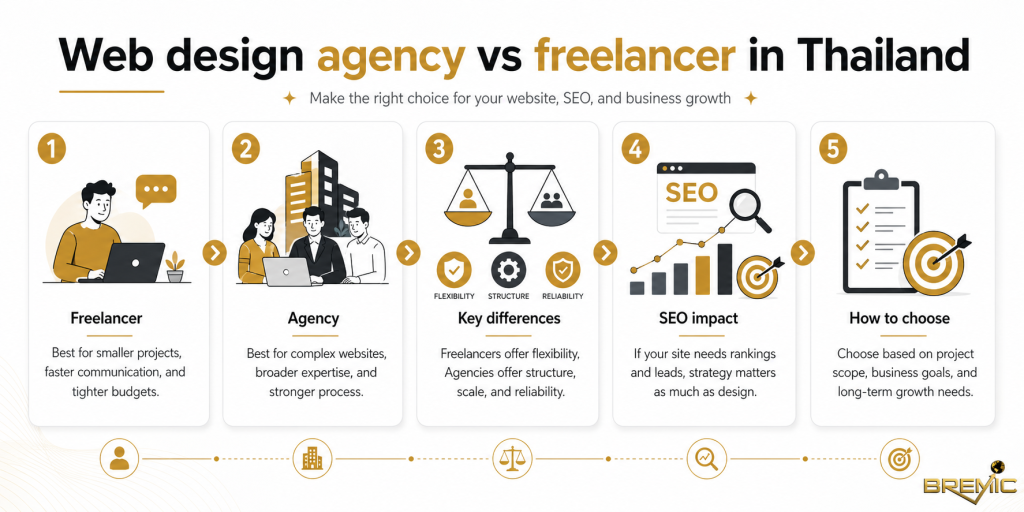
Choosing between a web design agency and a freelancer in Thailand is rarely just a budget decision. It affects how your website is planned, how smoothly the project runs, how well the final site supports marketing goals, and how easy it is to maintain after launch.
For some businesses, a skilled freelancer is the right fit. For others, an agency brings the structure, capacity, and cross-functional expertise needed for a more demanding project. The best choice depends on your scope, timeline, internal resources, and the role the website is expected to play in lead generation, brand positioning, and long-term growth.
This guide breaks down the real differences between the two models so you can make a practical decision based on business needs rather than assumptions.
What the choice really means
When comparing a web design agency vs freelancer in Thailand, most companies focus first on price. Cost matters, but the more important question is what kind of delivery model your project needs.
A freelancer is usually one person handling some or all of the work directly. Depending on their background, they may cover design, development, basic SEO, content integration, and launch support. In some cases, they work with a small network of specialists when needed.
A website agency in Thailand typically works as a team. That may include a project manager, designer, developer, strategist, SEO specialist, copywriter, or QA support. Even when the agency is small, the process is usually more structured and responsibilities are more clearly defined.
That difference affects more than communication. It changes how your site is scoped, how decisions are documented, how revisions are managed, and how quality is controlled.
When a freelancer makes sense
Hiring a freelancer can be a smart choice when the project is relatively straightforward and the business already has clear direction.
A freelancer is often a strong fit if you need:
- a brochure website with limited functionality
- design improvements to an existing site
- a landing page or small website refresh
- direct communication with the person doing the work
- a leaner budget and simpler approval process
In Thailand, many businesses hire freelancers for speed and flexibility. If the brief is clear and the website does not require a wide range of skills at the same time, a good freelancer can deliver strong work efficiently.
This approach works especially well when the business owner or marketing lead can provide fast feedback, organize content internally, and manage part of the process without needing heavy project support.
When an agency is the better choice
A web designer vs agency decision usually becomes clearer as complexity increases.
An agency is generally the better option when your website involves multiple moving parts, such as:
- custom UX planning
- SEO strategy built into site structure
- custom development or integrations
- multilingual content
- brand positioning work
- multiple stakeholder approvals
- long-term maintenance and support
An agency also makes sense when the website is expected to be a serious business asset rather than just an online presence. If the site needs to support paid traffic, organic search growth, conversion tracking, lead generation, or future content expansion, a team-based approach often reduces risk.
For these projects, the value of an agency is not just execution. It is coordination, process, quality control, and strategic consistency.
The biggest differences between a freelancer and an agency
Breadth of expertise
A freelancer may be excellent at design or development, but few individuals are equally strong across strategy, UX, technical SEO, content structure, performance optimization, and post-launch support.
An agency can usually cover those areas more consistently because different specialists handle different parts of the project. That does not guarantee better work, but it does create better conditions for complex projects.
If your site needs more than visual design, this matters. A good-looking website can still underperform if page structure, search intent mapping, conversion paths, or technical setup are weak.
Project management and reliability
Freelancers often offer a more personal working relationship. That can be a real advantage. Communication may feel faster and more direct, and decision-making can be simpler.
The trade-off is capacity. If the freelancer gets sick, takes on too many projects, or disappears mid-project, the business has limited backup.
Agencies usually bring more process and redundancy. There is often a defined workflow, scheduled checkpoints, shared documentation, and someone accountable for keeping the project moving. That can feel less informal, but it usually improves predictability.
Scalability
A freelancer may be ideal for a small project, but less suitable if your site later expands into new service pages, ongoing SEO content, conversion testing, or technical improvements.
An agency is usually better positioned to support that kind of growth. If your website is part of a broader digital strategy, scalability should be part of the decision from the start.
Cost structure
Freelancers are often more affordable upfront. Lower overhead usually means a lower project fee.
Agencies tend to cost more because you are paying for a broader service model, more defined process, and access to multiple skill sets.
That said, lower cost does not always mean lower total spend. If a cheap build has to be redesigned, rebuilt, or fixed later, the initial savings disappear quickly. The real question is whether the delivery model matches the complexity and commercial importance of the website.
How SEO changes the decision
This is where many businesses underestimate the difference between options.
If your site only needs to exist, either a freelancer or an agency may work. If your site needs to rank, attract qualified traffic, and support topical authority over time, the quality of planning matters much more.
A strong SEO-focused website requires more than clean design. It depends on:
- information architecture that supports search intent
- page structure that aligns with target keywords
- internal linking that reinforces topic relationships
- content planning that supports pillar and cluster growth
- technical fundamentals such as crawlability, speed, mobile usability, and indexation
Some freelancers can handle this well, especially if they specialize in SEO-friendly web design. But many web designers do not go deep on content architecture or on-page SEO. In those cases, the business gets a visually polished site that is harder to scale organically.
Agencies are often better equipped to align design, development, and SEO from the start. That makes a difference if your website is expected to drive long-term visibility rather than rely only on referrals or paid traffic.
If you are thinking beyond launch, it helps to review broader planning frameworks and practical website guidance in your resource library.
Common assumptions that lead to poor decisions
“A freelancer is always cheaper and faster”
Sometimes, but not always.
A freelancer may move quickly on a focused project with a strong brief. But if the project scope is unclear, content is not ready, or revisions expand, timelines can slip. One person can only handle so much at once.
“An agency is only for large companies”
Not true.
A small or mid-sized business may benefit more from an agency than a larger company with a strong internal team. If you need strategic input, project management, and cross-functional execution, agency support can be worthwhile even for a modest site.
“Design is the main thing that matters”
Design matters, but performance depends on far more than aesthetics. A website must also support usability, search visibility, page speed, mobile experience, trust signals, and conversion flow.
A visually impressive site that confuses users or buries important service pages is still a weak business asset.
How to evaluate either option properly
Whether you hire a freelancer or agency, the evaluation process should be the same in principle.
Look at how they think, not just how their portfolio looks.
Ask questions such as:
How do they handle discovery and scope?
A reliable partner should ask about business goals, audience, content, functionality, and future growth. If the conversation starts and ends with visual style, that is a warning sign.
Do they understand content structure?
A website is not just a collection of pages. The way pages are grouped, linked, and prioritized affects usability and SEO. This matters especially for service businesses that want to build authority over time.
What happens after launch?
Many projects go wrong after delivery, not during design. Clarify what happens with fixes, edits, maintenance, training, documentation, and future support.
How do they communicate?
Strong communication is often a better predictor of project success than technical language or polished sales presentations. Look for clarity, responsiveness, and realistic expectations.
A practical way to decide
If you are trying to decide whether to hire freelancer or agency support, use this simple framework.
Choose a freelancer when:
- the website is small or moderately scoped
- the goals are clear and limited
- you want direct collaboration with the person doing the work
- you have internal capacity to guide the project
- you are comfortable with a leaner process
Choose an agency when:
- the website has strategic importance for growth
- multiple skills are needed across design, development, SEO, and content
- the project involves complexity, integrations, or multiple decision-makers
- you need stronger process and accountability
- the site will likely expand after launch
The right answer is not based on company size alone. It is based on project risk, business priorities, and how much structure the work requires.
What businesses in Thailand should keep in mind
The local market adds another layer to the choice. In Thailand, businesses often compare providers across different pricing models, communication styles, and service depth. Some are very execution-focused. Others position themselves strategically but deliver mostly template-based work.
That means the label matters less than the actual operating model.
A freelancer may function like a mini-agency with strong systems and trusted collaborators. An agency may still be highly dependent on one or two people behind the scenes. Instead of focusing only on whether the provider is called a freelancer or agency, look at how they scope projects, solve problems, and support outcomes.
This is especially important if your website needs to serve international audiences, multiple locations, or a more competitive search environment.
Final takeaway
The decision between a web design agency vs freelancer in Thailand should come down to fit, not assumptions.
A freelancer can be the right choice for a focused project with clear requirements and limited complexity. An agency is usually the stronger option when the website needs deeper strategy, broader expertise, and a more reliable delivery process.
The best websites are not built by choosing the cheapest or most impressive-looking option. They are built by choosing the right level of expertise and structure for the job.
If the site will play a central role in visibility, lead generation, and long-term digital growth, treat the decision as a strategic investment rather than a purchasing shortcut.