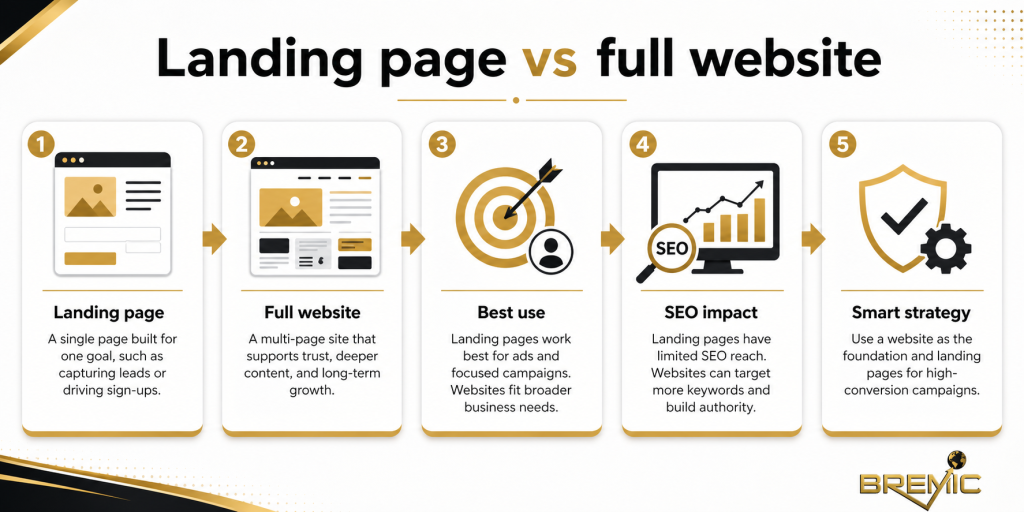
Choosing between a landing page and a full website is not just a design decision. It affects how you generate leads, how you build trust, how visible you are in search, and how well your digital presence can grow over time.
For many businesses, the real question is not simply landing page vs full website. It is whether you need a focused conversion asset, a scalable marketing foundation, or both.
A landing page can be highly effective when you want one audience to take one action. A full website gives you more room to educate, rank, expand your service pages, and support long-term organic growth. The right choice depends on your offer, traffic sources, sales process, and growth goals.
This guide explains the difference in practical terms, where each option works best, and how to decide based on lead generation, SEO, and business strategy.
What is the difference between a landing page and a website?
A landing page is a single page built around one objective. That objective is usually conversion-focused: fill out a form, request a quote, book a consultation, download a guide, or sign up for a demo. It removes distractions and keeps the visitor focused on one next step.
A website is a broader digital property made up of multiple pages. It usually includes a homepage, service pages, about page, contact page, blog or resources section, and supporting trust content such as case studies, FAQs, or testimonials.
In the debate around landing page or website, the core difference is focus versus breadth.
A landing page is narrow by design. A website supports deeper research and more varied user journeys.
This becomes especially relevant when comparing a single page website vs multi page website. A single page website can sometimes function like an extended landing page, but it still has limitations when it comes to content depth, topical structure, and organic search coverage. A multi-page website gives you more flexibility to target different search intents and support different stages of the buying journey.
When a landing page makes more sense
A landing page works best when you already know the audience, the offer, and the action you want them to take.
This is common in paid campaigns, local service promotions, product launches, event registrations, and lead magnet offers. If someone clicks an ad for a specific service, a tightly aligned landing page often converts better than sending them to a general website page with multiple navigation paths.
A strong landing page is especially useful when:
- you are running Google Ads or paid social campaigns
- you want to test one offer quickly
- your business has a short sales path
- one service drives most of your revenue
- you need a fast lead capture page before investing in a larger site
For a website for lead generation, landing pages are valuable because they reduce friction. They can match ad copy closely, address one pain point directly, and move the visitor toward a form submission without asking them to explore multiple pages first.
That said, a landing page is usually best as a campaign asset, not as a complete digital strategy.
When a full website is the better choice
A full website is the better choice when buyers need more information before they convert, or when your growth depends on being found through search over time.
This applies to most professional service businesses, B2B companies, agencies, consultancies, healthcare providers, legal services, SaaS brands, and any business with multiple services, locations, industries, or audience segments.
A full website gives you room to build a stronger trust framework. Visitors can review your services, understand your process, read your insights, compare solutions, and validate your credibility before contacting you.
From an SEO perspective, a full website is also the more scalable model. You can create:
- service pages for commercial intent
- location pages where relevant
- educational articles for informational intent
- comparison pages for mid-funnel research
- resource content that supports authority and internal linking
That structure matters. Search visibility usually does not grow from one page alone. It grows from a site architecture that covers a topic cluster well and signals expertise over time. A well-organized resources section can support this by answering related questions, building topical depth, and strengthening internal links across the site.
Landing page vs full website for SEO
If the goal is pure short-term conversion from paid traffic, a landing page may outperform a broader website page. If the goal includes long-term organic traffic, topic coverage, and authority building, a full website is usually the stronger option.
This is where many businesses make the wrong comparison.
They ask whether a landing page converts better than a website. The more useful question is whether the page format matches the traffic source and buyer intent.
Why landing pages are limited for SEO
A landing page can rank, but it has constraints.
Because it is focused on one action, it often has limited supporting content. It may not include strong internal linking, topical breadth, or enough context to compete well for broader or more competitive search queries. If it is built mainly for paid traffic, it may also avoid navigation and content depth that would help users explore further.
Landing pages can still be useful in SEO when they target a very specific commercial term with a clear offer. But they are not usually enough to build broad search visibility on their own.
Why websites support stronger organic growth
A multi-page website allows you to target different keyword themes and align pages with different intents. That makes it easier to rank for both direct service terms and supporting research queries.
For example, if someone searches a high-intent keyword, they may land on a service page. If they search a comparison query like landing page vs full website, they should find a focused educational article. If they are still early in research, they may discover a blog post or resource piece first.
That layered structure is how SEO supports lead generation in a sustainable way.
Lead generation: which one converts better?
There is no universal winner in landing page vs full website for conversion rate. Conversion performance depends on visitor intent, traffic source, offer clarity, and trust level.
A landing page often converts better for warm or paid traffic because it narrows attention to one outcome.
A full website often performs better for higher-consideration decisions because visitors can validate who you are before they commit.
Here is the practical rule:
- use a landing page when the campaign is specific and the visitor already has clear intent
- use a website when the buyer needs education, trust signals, and multiple paths before converting
- use both when you want short-term campaign performance and long-term organic growth
This is the approach many mature businesses adopt. Their website builds credibility and captures search demand over time, while dedicated landing pages support promotions, ads, and conversion-focused campaigns.
Single page website vs multi page website
The comparison between single page website vs multi page website often creates confusion because a single page website can look polished and feel simpler to launch.
That simplicity can be useful for very small businesses, early-stage offers, personal brands, or temporary campaigns. But it usually comes with tradeoffs.
A single page website may be enough if:
- you offer one very narrow service
- your audience already understands what you do
- most traffic comes from referrals or direct outreach
- you do not need to rank for many distinct search terms
A multi-page website is usually the better structure if:
- you offer multiple services
- your sales cycle involves comparison and research
- you want stronger SEO performance
- you need separate pages for different audiences or intents
- you plan to grow content over time
In most cases, a multi-page structure gives you a better foundation for both usability and organic search. It also makes internal linking more strategic, which is a core part of cluster-based SEO.
Common mistakes businesses make
One common mistake is treating a landing page as a replacement for a website when the business actually needs credibility, depth, and search visibility.
Another is building a full website but failing to create focused conversion paths. A site can have plenty of content and still generate weak lead volume if every page is too broad, too generic, or unclear about the next step.
Other frequent issues include:
Choosing based on budget alone
Cost matters, but it should not drive the entire decision. A cheaper build that does not support your acquisition strategy can become more expensive later when you need to rebuild.
Ignoring traffic source
A page should be designed around how people arrive there. Paid traffic, organic traffic, referral traffic, and outbound traffic behave differently.
Overvaluing simplicity
A simple site is not always a strategic site. Minimal structure can reduce friction, but it can also reduce discoverability, trust, and relevance.
Expecting one page to do everything
Trying to make one page rank broadly, explain every service, establish trust, and convert every user usually leads to a page that does none of those things particularly well.
How to choose the right option for your business
The right decision comes down to business model, marketing channel mix, and growth stage.
Choose a landing page first if your priority is validating an offer quickly, running paid campaigns, or capturing leads around one focused service.
Choose a full website first if your priority is long-term visibility, organic search growth, trust building, and supporting multiple services or customer questions.
Choose both if you want the strongest overall setup: a website as the core authority asset, and landing pages as focused conversion tools within that ecosystem.
For most established businesses, that combined approach is the most practical. The website builds the brand and search presence. The landing page sharpens specific campaigns.
Strategic takeaway
The best answer to landing page vs full website is rarely absolute.
A landing page is better when focus is the priority. A full website is better when growth, trust, and long-term SEO matter. For serious lead generation, the strongest strategy is often not choosing one over the other, but understanding what role each should play.
If your business relies on search visibility, authority, and content depth, a full website should be the foundation. If you need to drive action from a specific campaign, a dedicated landing page should sit on top of that foundation.
That is the difference between building a page and building a real acquisition system.