Google reviews are not just a reputation signal. They influence how potential customers judge your business before they ever visit your website, call your team, or walk through your door. For many local businesses, reviews sit at the intersection of trust, visibility, and conversion.
That is why business owners keep asking how to get more Google reviews for your business in a way that is effective, ethical, and sustainable. The short answer is that more reviews usually come from process, not luck. Businesses that consistently earn reviews tend to make the ask part of their customer journey, remove friction, and stay focused on service quality rather than shortcuts.
This matters even more in competitive local markets. A business with strong review volume, recent feedback, and thoughtful owner responses often looks more credible than a competitor with an outdated profile or only a handful of reviews. Reviews also support broader Local SEO performance by strengthening your Google Business Profile and improving the trust signals around your brand.
This article explains the strategic side of review generation, the practical steps that actually work, the mistakes to avoid, and what realistic expectations should look like.
What Is Local SEO?
Local SEO is the process of improving your visibility in location-based search results, especially when people search for services or businesses near them. That includes searches such as “dentist near me,” “best accountant in Manchester,” or “coffee shop open now.”
In practical terms, Local SEO is not only about your website. It also involves your Google Business Profile, business details across the web, local relevance, proximity, and the trust signals attached to your business. Reviews are one of those trust signals.
When someone searches locally, Google tries to show businesses that appear relevant, reputable, and useful. Reviews help support that decision. They can reinforce service quality, confirm real customer experiences, and provide fresh signals that your business is active and worth considering.
So while this article focuses on how to get more Google reviews for your business, the bigger context is that reviews are part of a wider local search strategy, not a standalone tactic.
Why Google Reviews Matter
Google reviews matter because they influence both click behavior and business credibility.
From a user perspective, reviews help reduce uncertainty. A potential customer wants evidence that your business delivers what it promises. They often look at the number of reviews, the quality of recent feedback, and whether the business owner responds in a professional way.
From an SEO perspective, reviews contribute to the overall strength of your local presence. They can support visibility in local search, improve engagement with your Google Business Profile, and increase the likelihood that searchers choose your listing over another option.
They also affect conversion after the click. Even if your website ranks well, poor or outdated reviews can weaken trust before a visitor takes action. In that sense, reviews are not just a traffic factor. They are a conversion asset.
How to Get More Google Reviews for Your Business
The most effective approach is to treat review generation as an operational system. If you only ask occasionally, results will stay inconsistent. If you build the ask into your process, reviews become more predictable.
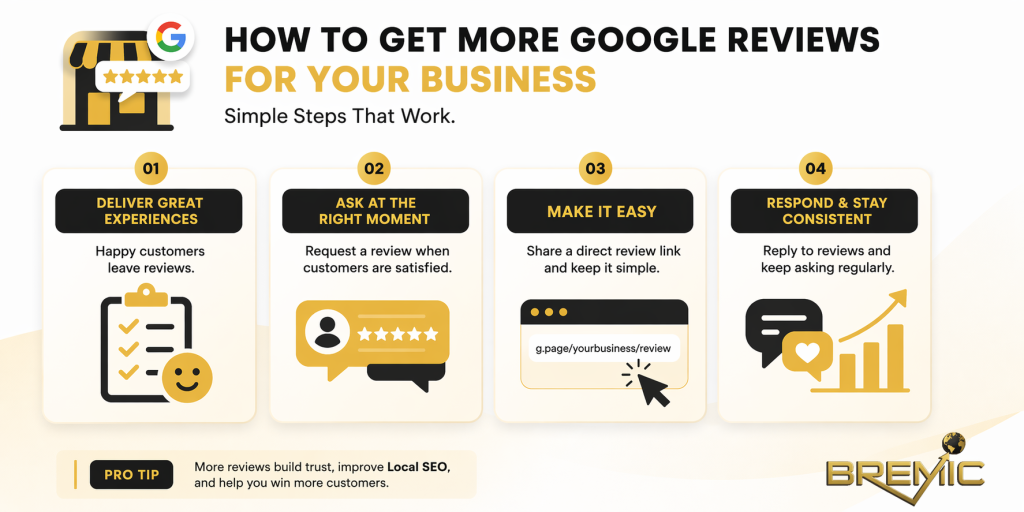
Start with the customer experience
No review strategy works for long if the underlying experience is weak. Customers leave positive reviews when expectations are met clearly, the process feels smooth, and the business solves the problem it promised to solve.
That does not mean you need a perfect operation. It means you need a reliable one. If you are getting complaints about communication, delays, billing confusion, or unclear expectations, fix those issues before pushing harder for reviews. Otherwise, you may simply increase the volume of negative feedback.
Ask at the right moment
Timing is one of the biggest variables in review generation. The best moment to ask is usually when the customer has just experienced value.
That might be:
- right after a successful service appointment
- after a product has been delivered and confirmed
- when a customer sends a thank-you message
- after a support issue has been resolved well
- at the end of a completed project when satisfaction is clear
The closer your request is to a positive outcome, the better your response rate tends to be. If you wait too long, enthusiasm fades and the customer moves on.
Make the process easy
A surprising number of businesses lose reviews because the path is too complicated. If a customer has to search for your profile manually, log in later, or figure out where to click, many will never finish.
You need a direct review link and a simple call to action. That link can be used in email follow-ups, text messages, invoices, thank-you pages, or post-service automation.
The language should stay natural and low-pressure. A direct message works better than a vague suggestion. For example, a simple request after a positive interaction often performs better than a long scripted paragraph.
Build review requests into your workflow
If you want to know how to get more Google reviews for your business consistently, this is where the real answer sits. Reviews should not depend on memory. They should be built into your standard process.
For example, a service business might trigger a review request after a job is marked complete. A clinic might send it after an appointment. A retail business might include it in a post-purchase email sequence. A B2B company might ask after onboarding or successful delivery milestones.
The channel matters less than the consistency. Email can work. SMS can work even better in some industries because it reduces friction. In-person requests can also perform well when staff are trained to ask naturally.
Train your team to ask properly
Frontline staff often influence review volume more than marketing teams do. They are the people interacting with customers at the key moment when satisfaction is highest.
The mistake is giving staff a generic instruction like “ask for reviews.” That usually leads to inconsistency. Instead, give them a simple framework:
- ask only after a positive outcome
- keep the request short
- explain that feedback helps other customers find the business
- point the customer to the direct review link when appropriate
This keeps the request professional without making it sound forced.
Important Subtopics That Influence Review Growth
Your Google Business Profile needs to be strong
Review generation works better when your profile already looks credible. If your Google Business Profile is incomplete, outdated, or thin, even willing customers may hesitate.
Make sure your profile has:
- accurate business information
- current business hours
- relevant categories
- quality photos
- a clear business description
- active owner responses to recent reviews
A strong profile supports the broader Local SEO picture and makes each new review more valuable.
Recency matters as much as volume
Many businesses focus only on getting to a certain number of reviews. That misses the bigger point. A business with steady recent reviews often looks healthier than one with a large total count but no recent activity.
Customers do not only ask, “How many reviews does this business have?” They also ask, “Are people still having good experiences here now?”
That is why a slow, steady review flow usually beats short bursts followed by silence.
Responding to reviews is part of the strategy
If you want more Google reviews, show customers that reviews are noticed. Responding professionally to both positive and negative feedback sends a clear signal that your business is active and accountable.
It also improves trust for future prospects reading your profile. A thoughtful response will not erase a poor review, but it can reduce the damage by showing maturity and responsiveness.
Common Mistakes
Asking everyone the same way
Not every customer relationship is the same. A high-trust client interaction deserves a more personal request than a generic automated message. Over-automation can make the ask feel transactional.
Offering incentives for positive reviews
This is a risky path. Incentivized or manipulated reviews can create compliance issues and damage trust. The goal is to earn authentic feedback, not engineer a false reputation.
Asking too early or too often
If you ask before value has clearly been delivered, the request feels premature. If you ask repeatedly, it can feel pushy. Review requests should be timely and respectful.
Ignoring negative feedback
Some businesses chase more reviews while failing to address the problems causing poor ones. That is a strategic mistake. A review strategy should also improve service quality, not just review count.
Treating reviews as a one-off campaign
This is one of the most common problems. Review generation is not a campaign you run once per year. It works best as an ongoing reputation process tied to your customer journey.
Practical Guidance for a Sustainable Review Strategy
A realistic approach starts with three priorities.
First, audit your current customer journey. Identify the moments when satisfaction is highest and where a review request fits naturally.
Second, create one clear review path. Use a direct Google review link and make sure your team knows when and how to share it.
Third, monitor response quality, not just quantity. If you are earning more reviews but recurring complaints keep appearing, the operational issue needs attention.
You should also connect this work to your broader local search strategy. Businesses that take Local SEO seriously usually pair review generation with Google Business Profile optimization, accurate local business information, location-focused service pages, and relevant local content. Reviews work better when the rest of the ecosystem is strong.
Timing and Expectations
Results rarely appear overnight unless you already have a strong customer base and simply were not asking before.
Some businesses see progress quickly once they introduce a clear review request system. Others need more time because customer volume is lower, the service cycle is longer, or internal follow-up is inconsistent.
The important point is to think in terms of momentum, not instant transformation. A steady stream of real reviews over the next few months is far more valuable than trying to force a spike in a single week.
You should also expect uneven results. Some requests will be ignored. Some satisfied customers will never leave a review. That is normal. The objective is not a perfect response rate. It is a reliable, repeatable process that increases review volume over time without compromising trust.
Conclusion
If you want to understand how to get more Google reviews for your business, the answer is not a trick or a shortcut. It is a combination of service quality, timing, process, and consistency.
Google reviews support trust, improve click decisions, and strengthen your Local SEO foundation, but only when they are earned naturally and managed strategically. The businesses that do this well usually make review requests part of their operations, keep the process simple, and respond professionally once feedback comes in.
That is the long-term advantage. Not just more reviews, but a stronger local reputation that supports visibility, credibility, and conversion over time.