Hotels in Hua Hin do not compete only on room quality, pricing, or amenities. They also compete in search results at the exact moment a traveler is deciding where to stay. That is why local SEO for hotels in Hua Hin matters. It helps a property appear when potential guests search for terms like “hotel in Hua Hin,” “beachfront hotel Hua Hin,” or “family resort near Cicada Market.”
For hotels, local visibility is not a side channel. It sits close to revenue. A strong local presence can improve visibility in Google Maps, strengthen trust before a click, and bring in direct traffic that might otherwise go to OTAs or larger hotel brands.
This article explains what Local SEO means in a hotel context, why it matters specifically in Hua Hin, how it works, and what hotel operators or marketers should focus on if they want a sustainable search strategy rather than short-term tactics.
What Is Local SEO?
Local SEO is the process of improving a business’s visibility in location-based search results. In practical terms, it helps a hotel appear when someone searches for accommodation in a specific area or near a specific landmark.
For a hotel, Local SEO usually involves three connected assets:
- The website
- The Google Business Profile
- Third-party location signals such as reviews, citations, and local mentions
When someone searches with local intent, Google evaluates relevance, prominence, and location context. For a hotel in Hua Hin, that means Google is trying to determine which property best matches the query and appears most credible for that destination.
Local SEO for hotels in Hua Hin is therefore not just about inserting the city name across a page. It is about building clear location relevance, strong trust signals, and useful content that matches how travelers search.
Why It Matters
Hotels often lose visibility to OTAs and aggregators
Search results for hotel-related terms are crowded. OTAs, travel directories, map listings, and large hotel chains often dominate the page. Without a deliberate Local SEO strategy, an independent hotel can struggle to appear in meaningful positions for commercial local searches.
That does not mean the opportunity is gone. It means the hotel needs a more precise strategy. Local SEO helps smaller properties compete by focusing on relevance, specificity, and trust rather than pure domain size.
Local intent is close to booking intent
Not every visitor who finds a hotel through search will book immediately, but many local hotel queries happen late in the decision process. Someone searching for “boutique hotel in Hua Hin near the beach” is not doing broad destination research. They are narrowing options.
That makes Local SEO especially valuable. It attracts users with clearer intent and gives the hotel a chance to win direct traffic before the booking happens elsewhere.
Strong local visibility supports brand authority
A hotel that appears consistently across local search results, Maps, reviews, and destination-based content tends to look more established. That matters even when users do not click the first result they see. Search visibility helps shape perceived trust.
For hotels in Hua Hin, this is particularly important because travelers often compare multiple properties in a short period. A credible local search presence reduces friction in that evaluation process.
How Local SEO for Hotels in Hua Hin Works
Google looks for clear relevance signals
A hotel website should make it obvious what the property is, where it is, and who it is for. That means the site needs more than a homepage with a booking widget and a few generic room descriptions.
Google needs to understand:
- that the business is a hotel
- that it is located in Hua Hin
- which part of Hua Hin it serves or sits near
- what type of stay it is relevant for
This is where page structure, title tags, on-page copy, internal links, and entity clarity all matter.
The Google Business Profile is a core local asset
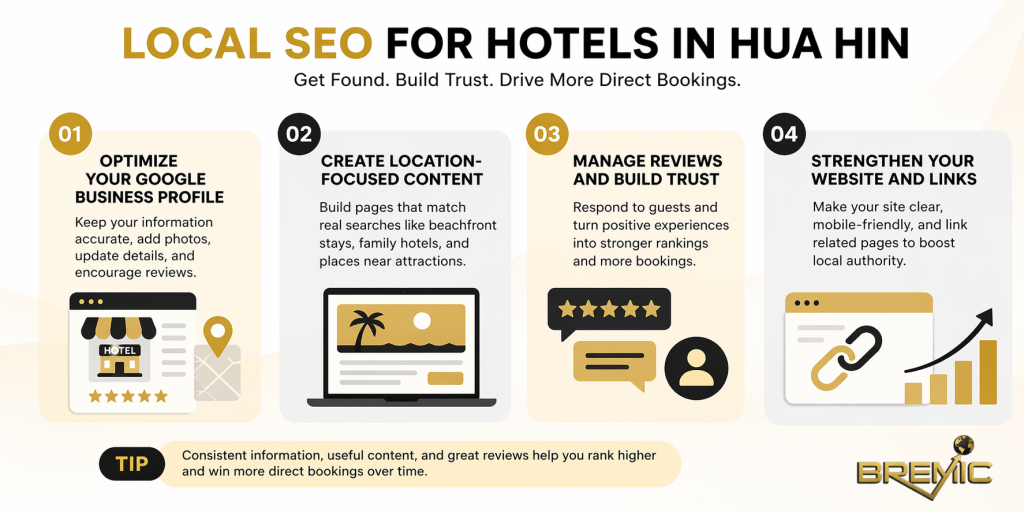
For most hotels, Google Business Profile plays a major role in local discovery. It influences map visibility, branded searches, and trust signals before users ever land on the website.
A well-managed profile should include accurate categories, business details, high-quality images, amenities, updated information, and consistent review activity. It should also align closely with the website. If the profile says one thing and the site says another, local relevance weakens.
Reviews shape both rankings and conversions
Reviews are not only a reputation factor. They also help Google understand how real guests describe the property. Reviews that naturally mention the hotel’s location, cleanliness, service, beach access, or suitability for families can strengthen topical and local relevance over time.
Just as importantly, reviews affect click behavior. A hotel may appear in local results, but weak ratings or outdated review patterns can limit the commercial value of that visibility.
Important Subtopics
Location Pages and Destination Relevance
A hotel site should not rely on one page to target every search variation. The homepage can support brand and broad local relevance, but supporting pages are often needed to match how people search.
Useful examples include pages about:
- staying near the beach
- hotels for families in Hua Hin
- accommodation near Hua Hin Night Market
- boutique stays or luxury stays in the area
- travel guidance for nearby attractions
These pages should not be thin landing pages created only for keywords. They need a distinct purpose. A page about staying near Khao Takiab, for example, should genuinely explain why that area matters, who it suits, and how the hotel relates to it.
On-Page SEO Must Reflect Real Search Behavior
Hotel marketers often optimize for broad phrases only. That is rarely enough. Search behavior is more layered.
Some users search by destination alone. Others search by feature, audience, or proximity. The content strategy should reflect that. A hotel in Hua Hin may need to serve queries around beachfront stays, pet-friendly accommodation, family travel, weekend breaks from Bangkok, or nearby golf access.
That does not mean creating a page for every possible variation. It means identifying recurring demand patterns and building content around real booking considerations.
Local Citations and Consistency Still Matter
Name, address, phone number, brand presentation, and business details should be consistent across major platforms. For hotels, this extends beyond traditional business directories. It includes travel sites, map platforms, booking portals, and tourism listings.
Consistency does not create authority on its own, but inconsistency can weaken trust. It also creates a poor user experience when guests find conflicting information about location, amenities, or contact details.
Internal Linking Supports Topical Authority
If the site follows a pillar-and-cluster model, internal linking should help search engines understand the relationship between pages.
For example, a broader local hospitality or destination page can link naturally to supporting content about beachfront stays, family-friendly accommodation, or hotel SEO considerations for specific areas in Hua Hin. In return, those cluster pages should link back to stronger parent pages using varied, natural anchor text.
This is how content stops being a collection of isolated pages and starts functioning as a topic cluster.
Common Mistakes
Treating Local SEO as only a Google Business Profile task
Many hotels update their profile and assume that is enough. It is not. The profile matters, but it works best when supported by a strong website and coherent local signals across the wider web.
Creating location pages with no real value
Pages built only to target keywords like “hotel Hua Hin center” or “best hotel in Hua Hin near beach” often fail because they offer no depth, no differentiation, and no useful context. Thin local pages are easy for search engines to discount.
Ignoring non-branded search intent
Hotels naturally focus on branded terms, but growth often comes from non-branded searches. If the site only performs for the hotel name, it is missing users who are still comparing options.
Overlooking review strategy
Reviews should not be treated as passive. Hotels need a process for encouraging feedback, responding professionally, and learning from recurring themes. A neglected review profile can weaken both trust and local performance.
Publishing generic destination content
A generic article about “things to do in Hua Hin” is unlikely to add much value unless it connects meaningfully to the hotel’s location, audience, or stay experience. Content should support the property’s positioning, not just fill the blog.
Practical Guidance
A sensible Local SEO strategy for a Hua Hin hotel usually starts with clarity, not scale.
First, make sure the website clearly communicates the property type, location, audience fit, and key differentiators. Then review the Google Business Profile and align it with the site. After that, strengthen supporting pages based on real traveler intent.
In most cases, the priority order looks like this:
Fix foundational local signals
Make the hotel’s core business information accurate and consistent across the website, Google Business Profile, and major third-party platforms.
Strengthen commercial location pages
Build or improve pages that connect the hotel to meaningful search themes, such as beachfront stays, family accommodation, or proximity to important Hua Hin landmarks.
Improve trust signals
Focus on reviews, photography, room detail pages, local context, and visible evidence that the property is legitimate and current.
Build supporting content around decision-stage questions
Content should help travelers choose, not just browse. Useful topics might include the best areas to stay in Hua Hin, what type of hotel suits different trip types, or how location affects the stay experience.
Timing and Expectations
Local SEO is not instant. A hotel can sometimes improve visibility fairly quickly by fixing obvious issues with its Google Business Profile or on-page signals, but stronger organic and local performance usually takes longer.
That is because search engines need time to recrawl pages, process changes, and evaluate signals such as reviews, relevance, and user engagement. Competition also matters. In a destination like Hua Hin, where travel intent is commercial and listings are crowded, improvement tends to be gradual rather than sudden.
A realistic expectation is steady progress rather than dramatic jumps. The hotels that perform best over time are usually the ones that maintain accuracy, publish useful location-focused content, and reinforce trust consistently.
Conclusion
Local SEO for hotels in Hua Hin works best when it is treated as a long-term visibility strategy, not a checklist. The goal is not simply to mention Hua Hin more often than competitors. The goal is to make it easy for search engines and potential guests to understand where the hotel is, who it serves, and why it is a credible option.
That requires a combination of solid technical foundations, strong local relevance, well-structured content, review management, and thoughtful internal linking.
For hotels that want more direct visibility in a market shaped by OTAs and comparison behavior, Local SEO is not optional. It is one of the clearest ways to build discoverability, trust, and compounding search value over time.