Restaurants in Hua Hin compete in a market where search intent is highly local and often immediate. People are not just browsing for ideas. They are looking for somewhere to eat now, later today, or during an upcoming trip. That makes local search one of the most commercially valuable channels available to restaurant owners.
Local SEO for restaurants in Hua Hin is not about chasing vanity rankings or stuffing a website with location keywords. It is about building strong local relevance across Google Business Profile, on-page content, reviews, citations, and user signals so your restaurant appears when people search for the type of food, dining experience, or location they want.
For restaurants, this matters because local visibility affects real-world actions: map clicks, calls, website visits, menu views, reservation requests, and foot traffic. A well-executed local SEO strategy helps your restaurant show up where local customers and tourists are actually making decisions.
This article explains what local SEO in Hua Hin means in practice, why it matters, how to apply it properly, and what mistakes to avoid.
What Is Local SEO Hua Hin?
Local SEO Hua Hin refers to the process of improving a business’s visibility in location-based search results within Hua Hin and surrounding areas. For restaurants, that typically means showing up in:
- Google Map results
- Google Business Profile listings
- local organic search results
- “near me” searches
- cuisine and location combinations such as “seafood restaurant Hua Hin” or “best brunch near Hua Hin Beach”
In practical terms, local SEO helps Google understand three things:
- What your restaurant offers
- Where it is located
- Why it is a relevant result for a nearby or location-specific search
For a restaurant, that relevance is shaped by more than a homepage and a few keywords. Google looks at business details, category selection, reviews, website content, local mentions, user engagement, and how clearly your restaurant is associated with Hua Hin as a place.
A restaurant that has accurate business information, a complete profile, clear menu and location content, and consistent signals across the web is easier for search engines to trust and rank locally.
Why It Matters
Local search drives high-intent traffic
Someone searching for a restaurant in Hua Hin usually has immediate or near-term intent. They may be deciding where to eat tonight, where to book a family dinner, or which cafe to visit during a weekend trip. That makes local SEO more commercially direct than many broader digital marketing channels.
Hua Hin has mixed local and visitor demand
Hua Hin is not a purely residential local market. Restaurants often depend on a mix of residents, domestic tourists, and international visitors. That changes the search landscape. People may search in English or Thai, search by cuisine, search by neighborhood, or search by experience such as beachfront dining, romantic dinner spots, or breakfast cafes.
A restaurant that only targets one narrow phrasing misses a large share of actual demand.
Visibility affects trust before the visit
People often decide whether a restaurant feels credible before ever visiting the website. They look at photos, opening hours, reviews, map placement, menu information, and recent activity. If those signals are incomplete or inconsistent, rankings can suffer and conversion rates usually suffer too.
Local SEO supports broader restaurant marketing
A strong local presence helps every other channel work better. Paid ads convert more efficiently when branded search results look strong. Social traffic performs better when users land on a well-optimized site. Repeat customers are more likely to find accurate details when they search again later.
How Local SEO for Restaurants in Hua Hin Works
Start with Google Business Profile
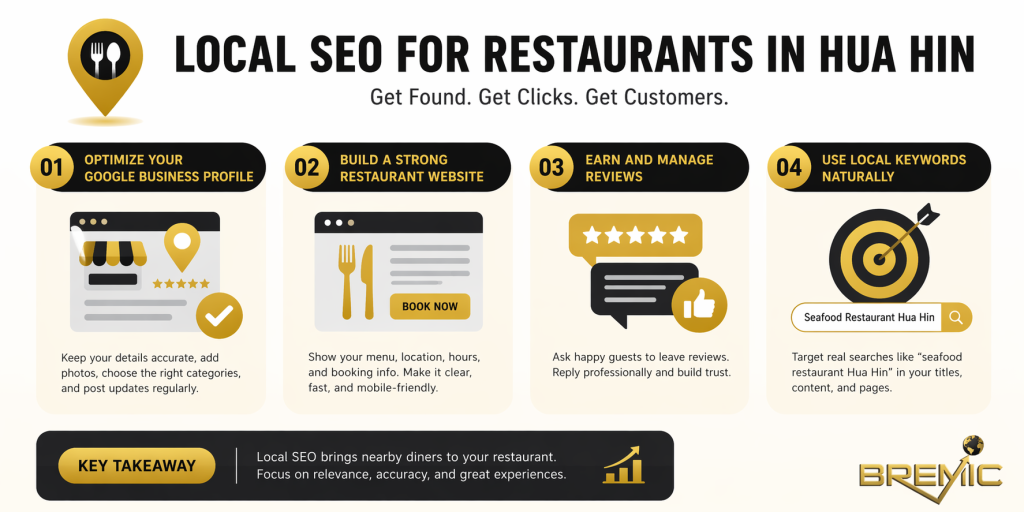
For most restaurants, Google Business Profile is the foundation of local SEO. In many cases, it influences visibility more directly than the website alone.
Your profile should include:
- the correct restaurant name
- accurate address and map pin
- current phone number
- opening hours
- primary and secondary categories
- menu information
- booking or ordering links where relevant
- recent, high-quality photos
- a clear business description
Category choice matters. A seafood restaurant, cafe, steakhouse, or rooftop bar should not default to a vague category if a more accurate option exists. Google uses these categories to match your listing to search intent.
For restaurants in Hua Hin, profile quality is especially important because users often search on mobile while already in town.
Make your website support local relevance
Your website should reinforce what Google Business Profile already says, not contradict it.
At minimum, your site should clearly show:
- your restaurant name
- full address
- service area relevance within Hua Hin
- contact details
- opening hours
- cuisine type
- menu or sample menu
- booking information
- directions or location context
A thin homepage with only branded messaging is not enough. Search engines and users both need practical information.
For local SEO Hua Hin, the strongest restaurant websites usually include dedicated content that helps both discovery and conversion. That might include a menu page, a contact or location page, cuisine-specific pages, or pages targeting real user intent such as family dining, beachfront dining, or private events if those offerings genuinely exist.
Align content with actual local search behavior
Not every restaurant should try to rank for broad terms like “best restaurant Hua Hin.” That is highly competitive and often too vague. A better approach is to build relevance around specific combinations of cuisine, location, and dining intent.
Examples of realistic search themes include:
- Italian restaurant in Hua Hin
- brunch cafe near Hua Hin beach
- family-friendly restaurant Hua Hin
- seafood restaurant with ocean view in Hua Hin
This does not mean creating low-quality doorway pages for every variation. It means structuring pages and on-page content so the restaurant is clearly associated with the searches it deserves to rank for.
Build consistent local business signals
Consistency still matters. Your restaurant name, address, and phone number should match across your website, Google Business Profile, social pages, directories, and major listing platforms.
Conflicting business details create uncertainty. That uncertainty weakens trust signals.
For a restaurant, consistency should also extend to details like hours, reservation links, and menu URLs. If one source says you are open and another says you are closed, it affects both user experience and search performance.
Reviews influence both rankings and conversion
Reviews are not a side factor. They are part of local SEO and part of sales.
A restaurant with strong, recent, authentic reviews is more likely to earn clicks and visits than a competitor with weak review signals. Reviews also help reinforce relevance when customers mention dishes, atmosphere, service, or location naturally in their own words.
The goal is not to manipulate reviews. It is to build a process that encourages satisfied guests to leave honest feedback regularly.
For restaurants in Hua Hin, multilingual reviews can also be valuable because they reflect the market reality of local and international demand.
Important Subtopics That Strengthen Local SEO
On-page optimization for restaurant pages
Your title tags, headings, and body copy should communicate location and offering clearly. A homepage title like “Welcome to Our Restaurant” is wasted SEO space. A clearer title that mentions the cuisine and Hua Hin gives search engines a meaningful signal.
On-page optimization should remain natural. Keyword stuffing “local SEO for restaurants in Hua Hin” across every section would weaken the page, not improve it.
Mobile experience matters more than many owners realize
A large share of restaurant discovery happens on mobile devices. Users want fast-loading pages, tap-friendly menus, clear directions, and immediate access to booking or contact information.
If the site is slow, hard to navigate, or poorly formatted on mobile, local traffic may still arrive but fail to convert.
Localized content should reflect real-world context
Restaurants in Hua Hin can benefit from content that reflects how people actually choose where to eat in the area. That may include references to neighborhoods, landmarks, beach areas, night market zones, hotel proximity, or dining occasions.
This kind of context helps search engines understand local relevance and helps users decide faster.
Structured data can help clarity
Restaurant schema and local business schema will not solve weak SEO on their own, but they help search engines interpret business details more accurately. For restaurants with menus, opening hours, pricing information, and reviews, structured data can strengthen clarity and reduce ambiguity.
Common Mistakes
Treating local SEO as only a Google Business Profile task
A profile alone is not enough. If the website is thin, the content is unclear, or business details are inconsistent, local rankings often plateau.
Targeting broad keywords without intent alignment
Trying to rank for generic phrases without a clear value proposition usually leads to weak visibility. A steakhouse, vegan cafe, and beachfront seafood restaurant should not all target the same vague language.
Creating repetitive location pages
Some businesses try to force rankings by publishing near-duplicate pages for every nearby area. For a restaurant with one physical location, that usually creates thin content rather than stronger authority.
Ignoring review quality and recency
Old reviews still matter, but local trust is shaped by fresh feedback. A restaurant with no recent reviews often looks less active and less reliable than competitors with ongoing review activity.
Neglecting operational accuracy
Incorrect hours, broken reservation links, outdated menus, or missing contact details damage both rankings and conversions. For restaurants, operational accuracy is part of SEO, not separate from it.
Practical Guidance
A sensible local SEO plan for a Hua Hin restaurant usually starts with the basics and then expands into stronger content and authority signals.
First, make sure the restaurant’s Google Business Profile and website say the same thing. Then improve the pages that users actually need: menu, location, reservations, and core service pages. After that, focus on review generation, local mentions, better photos, and content that reflects genuine dining intent.
Keep the strategy grounded in the restaurant’s real positioning. Do not try to optimize for every possible audience. A focused sushi restaurant should build authority around sushi, Japanese dining, and local relevance in Hua Hin, not dilute its SEO by chasing unrelated restaurant keywords.
The strongest local SEO strategies are coherent. The business model, the website, the profile, and the search targeting all support the same story.
Timing and Expectations
Local SEO is not instant, especially in a competitive hospitality market. Some improvements, such as better profile completion, cleaner business data, and improved page structure, can influence visibility relatively quickly. Broader gains from content, authority, and review growth usually take longer.
Restaurant owners should expect local SEO to work as a compounding channel. The goal is not a one-time ranking spike. The goal is to build durable local relevance that improves discovery over time and supports steady customer acquisition.
Results also depend on your starting point. A restaurant with no optimized profile, poor reviews, and a weak website has more room to improve, but also more work to do.
Conclusion
Local SEO for restaurants in Hua Hin works best when it is treated as an operational and strategic discipline, not a checklist. Search visibility improves when your restaurant sends clear, consistent, trustworthy signals about what you offer, where you are, and why you are relevant to local diners.
For most restaurants, that means strengthening Google Business Profile, improving website clarity, aligning content with real search intent, maintaining accurate business information, and earning authentic reviews over time.
The businesses that win local search are rarely the ones doing the most aggressive keyword targeting. They are usually the ones with the clearest relevance, the strongest trust signals, and the best alignment between search intent and real customer experience.