Health and wellness web design Thailand: what effective SEO-focused websites need
Health and wellness web design in Thailand is not just about appearance. For clinics, wellness brands, fitness providers, aesthetic practices, therapy services, and other health-focused businesses, the website has to do three jobs at once: build trust, explain services clearly, and support search visibility in a competitive local market.
That balance matters because people searching for health and wellness services tend to evaluate credibility before they act. They compare providers, look for signs of professionalism, scan for service details, and often visit from mobile devices. A site that looks polished but lacks structure will struggle to rank. A site that is technically optimized but confusing or generic will struggle to convert.
A strong approach to health and wellness web design Thailand therefore combines user experience, content strategy, technical SEO, and local relevance. It should support both search intent and decision-making, not treat them as separate problems.
For brands building an industry-specific web strategy, health and wellness deserves a tailored approach because the trust threshold is higher than in many other sectors.
What health and wellness web design means in practice
In practical terms, health and wellness web design is the process of structuring a website so that it reflects the seriousness of the service being offered, makes information easy to find, and helps search engines understand the business.
That usually means more than clean visuals. It includes:
- clear service architecture
- strong mobile usability
- trustworthy page layouts
- accurate, well-organized content
- local SEO foundations
- fast loading performance
- thoughtful calls to action
For a health and wellness business in Thailand, the website often serves multiple audiences at once. Some visitors are local Thai customers. Others may be English-speaking residents, international clients, or tourists researching services before they book. That makes clarity, language structure, and local search targeting especially important.
A good website in this space should reduce uncertainty. Visitors should quickly understand what the business offers, where it operates, who it serves, and how to take the next step.
Why web design and SEO are tightly connected in this sector
In health and wellness, design and SEO should not be treated as separate workstreams. Search visibility depends on structure, and structure directly affects user confidence.
A well-designed page helps SEO when it:
- uses clear heading hierarchy
- matches page content to a specific search intent
- organizes services into logical categories
- improves page speed and mobile experience
- supports internal linking between related topics
- reduces bounce caused by poor usability
At the same time, SEO improves design decisions by forcing clarity. If a page targets one service, one audience, and one core intent, the layout becomes easier to shape. The message becomes sharper. Navigation becomes more intuitive.
This matters even more in health and wellness because vague websites create friction. Users do not want to guess what a treatment includes, whether a service is suitable for them, or how to contact the provider. Google also has a harder time understanding pages that mix too many topics together.
A site that ranks and converts usually does not rely on broad messaging. It relies on focused pages, clear information design, and content that reflects how people actually search.
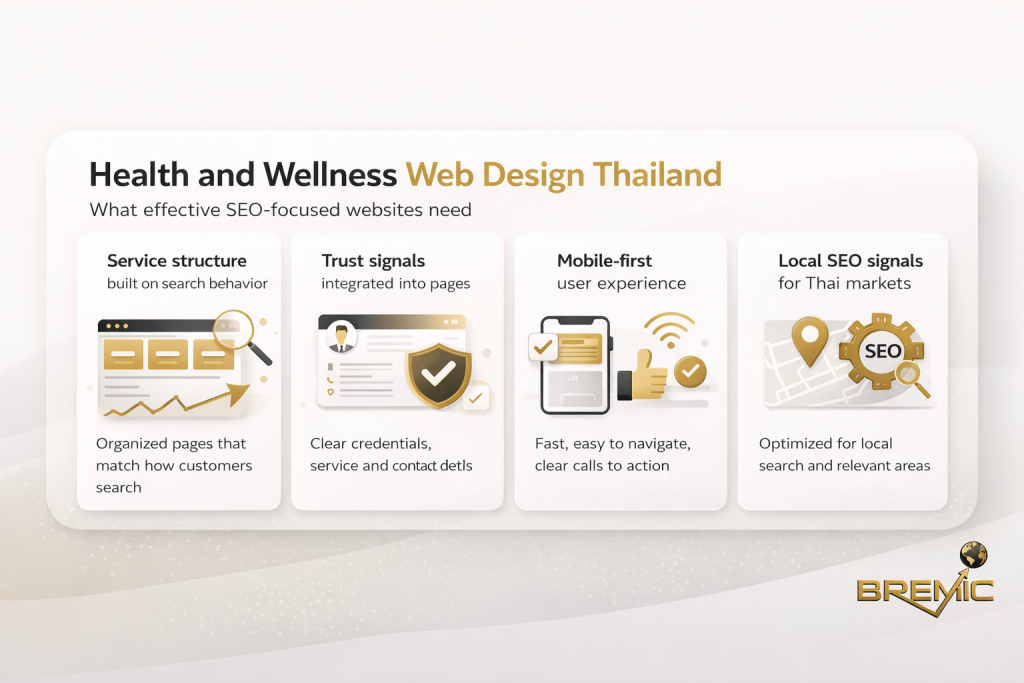
A service structure built around real search behavior
Many health and wellness websites fail because they are organized around internal business language rather than user intent.
A better structure starts with how people search. They usually look for a service, a problem, a location, or a combination of those factors. Examples include treatment-specific searches, wellness program searches, local service queries, and informational searches made before booking.
That means the website should separate core services into dedicated pages instead of forcing everything into one generic “services” page. Each important offering should have a page with a clear purpose, distinct copy, and a unique search target.
This also supports topical authority. When the site covers related services in a structured way, it becomes easier to create internal links, build supporting content, and strengthen relevance around the broader subject.
Trust signals that are built into the page, not added as decoration
In this sector, trust is part of the design system. It should not be treated as a cosmetic layer added near the footer.
Trust signals often include:
- clearly named services
- provider or team information where appropriate
- physical location details
- consistent contact information
- transparent service descriptions
- realistic language about outcomes
- accessible FAQs
- policy pages and business information
The goal is not to overload pages with claims. It is to remove ambiguity. In health and wellness, confident but restrained communication usually performs better than exaggerated copy. Visitors want professionalism, not hype.
Mobile-first UX for high-intent users
A large share of health and wellness searches in Thailand happen on mobile. People may be searching while commuting, during breaks, or when they are ready to contact a provider quickly.
That makes mobile usability a strategic priority, not a technical afterthought.
Core requirements include fast loading, readable text, tap-friendly buttons, short paths to contact options, and simple forms. Navigation must be easy to understand without forcing users through multiple layers. If a visitor cannot find services, pricing context, locations, or booking actions quickly on mobile, rankings alone will not produce results.
Local SEO signals that support visibility in Thai markets
For many businesses in this category, visibility depends heavily on local relevance. Even when the brand has a broader audience, much of the highest-intent traffic is tied to geography.
Good health and wellness web design in Thailand should therefore support local SEO through:
- clear location pages where appropriate
- consistent business details across the site
- service pages aligned to specific cities or areas when justified
- locally relevant content and metadata
- embedded location context in page copy where natural
This does not mean stuffing city names into every paragraph. It means helping search engines and users understand where the business operates and which audiences each page serves.
Language and audience clarity
Thailand-based health and wellness businesses often need to serve both Thai-speaking and English-speaking users. That creates a common problem: websites try to speak to everyone on the same page and end up being less useful to all of them.
A better approach is to define the language strategy clearly. If the business needs multilingual support, that should be handled with clean site architecture, not mixed-language copy scattered across key pages. Users should be able to tell immediately whether the page is for them.
From an SEO perspective, language confusion weakens relevance. From a UX perspective, it weakens trust.
Content that answers real pre-booking questions
Search intent in this space is often informational before it becomes transactional. People want to understand a service, compare options, evaluate fit, and reduce risk.
That is why strong content matters. Service pages should not just describe the business. They should help users make informed decisions.
Useful content often covers:
- what the service is for
- who it may suit
- what the process generally involves
- what to expect before or after an appointment
- common concerns or decision factors
- how to take the next step
This is where SEO content and conversion content overlap. The best-performing pages do not chase keywords in isolation. They answer the practical questions behind those keywords.
Common weaknesses in health and wellness website strategy
One of the most common issues is designing for aesthetics first and search structure second. A visually impressive site can still perform poorly if it hides service information, uses vague headings, or spreads core topics across thin pages.
Another common mistake is using generic content. Health and wellness websites often rely on broad claims such as “holistic care,” “personalized solutions,” or “premium service” without explaining what those terms mean in context. Generic wording weakens differentiation and reduces relevance.
Thin local SEO is another recurring issue. Some sites target Thailand broadly without clarifying service areas, while others try to rank in multiple locations without dedicated, useful pages.
There is also the problem of weak internal linking. When service pages, blog articles, and supporting resources are isolated from one another, the site loses both usability and topical strength. A cluster model works best when related pages reinforce each other through natural contextual links.
What a strong SEO strategy looks like for this type of website
A practical strategy begins with page intent. Each core page should have a defined role within the site architecture.
The homepage should establish brand and service scope. Core service pages should target commercial-intent topics. Supporting cluster content should answer related informational questions, expand topical depth, and link back to the relevant service pages.
For example, a health and wellness brand may build authority through a mix of service pages, condition-based content, location-focused pages, and educational resources. The value comes from structure and relevance, not sheer content volume.
Technical basics still matter: crawlable navigation, indexable content, sensible metadata, schema where appropriate, strong internal linking, and reliable performance. But those elements are most effective when they support a clear content model.
Realistic expectations for SEO and website performance
A better website can improve clarity and trust quickly, but SEO outcomes usually take longer. Rankings depend on competition, site history, technical condition, content quality, and how well the website aligns with search demand.
For health and wellness businesses in Thailand, meaningful progress often comes from steady improvement rather than a single redesign. That may include refining service pages, improving local relevance, strengthening content depth, and fixing structural weaknesses over time.
The most useful expectation is this: the website should become easier for search engines to understand and easier for users to trust. That is the foundation for sustainable visibility and better conversion performance.
The strategic takeaway
Effective health and wellness web design Thailand is not about choosing between branding and SEO. The strongest websites do both by using structure, clarity, and trust as the foundation of the user experience.
For this sector, a high-performing site should communicate services clearly, reflect local relevance, support mobile-first behavior, and organize content around real search intent. When web design and SEO are planned together, the result is not just a better-looking site. It is a more credible, more discoverable, and more useful digital presence.