Page speed is often treated as a technical SEO issue, but that framing is too narrow. In practice, page speed shapes how people experience a website at the exact moment they are deciding whether to stay, browse, trust, or buy. That is why understanding how page speed affects conversion rate matters far beyond rankings.
A slow page does not just create friction. It changes user behavior. It increases hesitation, interrupts momentum, and weakens confidence in the offer itself. Even when the content is strong and the product is relevant, slow delivery can reduce the likelihood of a visitor taking the next step.
For businesses investing in traffic acquisition, this has direct commercial implications. You can improve rankings, publish better content, and spend more on paid media, but if the site feels slow at key decision points, conversion performance will suffer. This is where technical SEO and Conversion Rate Optimization (CRO) start to overlap in a meaningful way.
This article explains the relationship between speed and conversions, why it matters strategically, and how to improve performance without reducing the experience to a single metric.
What is Conversion Rate Optimization (CRO)
Conversion Rate Optimization (CRO) is the process of improving a website so that a higher percentage of visitors complete a desired action. That action may be a purchase, form submission, demo request, phone call, email signup, or any other meaningful business outcome.
In practical terms, CRO is not just about changing button colors or rewriting headlines. It is about reducing friction, increasing clarity, and making it easier for users to move from interest to action.
That is why page speed belongs in the CRO conversation. If a page loads slowly, shifts unexpectedly, or feels unresponsive, it creates resistance before the user has even engaged with the offer. From a CRO perspective, speed is not a background technical variable. It is part of the user journey.
A fast website does not guarantee better conversion rates, but a slow one frequently undermines them.
Why It Matters
Speed affects behavior before users evaluate the offer
Many site owners assume visitors make rational decisions based only on price, product fit, or messaging. In reality, users respond to the total experience. Speed influences first impressions, perceived credibility, and willingness to continue.
When a page loads quickly, the experience feels smooth and controlled. When it lags, users start making negative judgments immediately. They may not describe the issue in technical terms, but they feel it as inconvenience, uncertainty, or lack of polish.
That matters because conversion is often momentum-based. A user clicks from search results, an ad, or an email with intent already present. Slow performance breaks that momentum.
It connects SEO and conversion performance
From an SEO perspective, page speed matters because search engines want to surface pages that deliver a good experience. Speed is not the only ranking factor, and it is rarely the sole reason a page performs or fails, but it still matters as part of overall page quality.
More importantly, SEO traffic only has business value when it converts. If a page ranks well but performs poorly once users arrive, the traffic is under-monetized. This weakens the return on content, technical SEO, and link acquisition efforts.
In other words, page speed affects both ends of the funnel: visibility and outcome.
The impact is strongest on high-intent pages
Not every page carries the same conversion risk. A slow blog post may still retain readers if the topic is compelling. A slow product page, lead form, or checkout page is much more vulnerable.
The closer a page is to the conversion event, the more damaging friction becomes. That is why performance improvements should usually start with:
- landing pages
- service pages
- product pages
- cart and checkout flows
- lead generation forms
These are the pages where speed improvements are most likely to produce measurable business results.
How It Works
Slow speed increases friction at multiple points
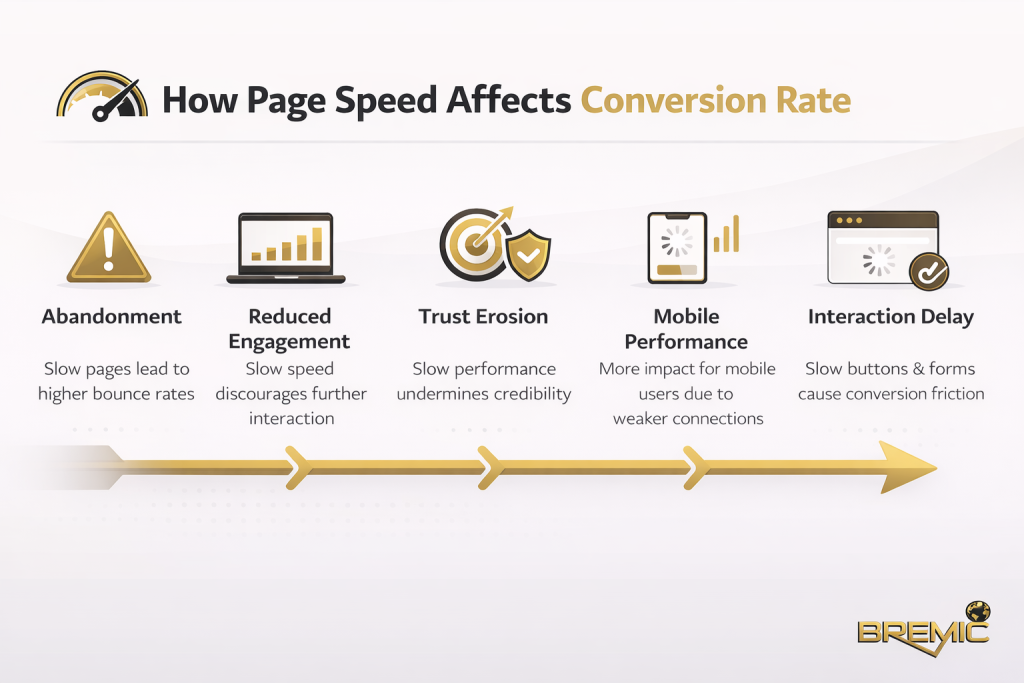
Page speed affects conversion rate through several mechanisms, not just one.
First, there is abandonment. Some users leave before the page fully loads. This is the most obvious effect.
Second, there is reduced engagement. Users may stay, but view fewer pages, scroll less, or hesitate before interacting.
Third, there is trust erosion. A slow or unstable page can make the business feel less credible, especially on mobile devices where patience is lower and distractions are higher.
Fourth, there is interaction delay. Even if visual content appears quickly, lag in buttons, menus, forms, or filters can make the site feel broken or unreliable.
These problems stack. A page does not need to fail completely to lose conversions. It only needs to introduce enough friction to weaken intent.
Perceived speed matters as much as measured speed
A common mistake is to look only at total load time. Users do not experience websites as a single number. They experience them in stages.
What matters is how quickly the page becomes usable and whether it remains stable while loading. A page that shows meaningful content early and responds quickly can feel faster than a page that technically loads in a similar time but delays interaction or shifts elements around.
This is why performance work should focus on real user experience, not just lab scores.
Mobile performance has outsized influence
Mobile users are often dealing with weaker connections, smaller screens, and less tolerance for delay. They also tend to be less forgiving when a page is hard to use.
If your site performs acceptably on desktop but poorly on mobile, conversion losses can be significant. This is especially true for local businesses, ecommerce stores, and B2B lead generation sites where a large share of discovery happens on mobile even if the final conversion happens later elsewhere.
Important Subtopics
Core Web Vitals and user experience
Core Web Vitals are useful because they focus on how users experience loading, interactivity, and visual stability.
These signals matter for conversion because they reflect real friction points:
Loading performance
If the main content appears too slowly, users cannot engage with the page quickly enough to maintain intent.
Interactivity
If the page looks loaded but buttons, filters, or forms do not respond promptly, users lose confidence.
Visual stability
If elements move while loading, users can tap the wrong thing, lose their place, or feel that the page is poorly built.
For CRO, these are not abstract technical metrics. They are direct experience issues that can interrupt the path to action.
Speed versus design complexity
Modern websites often become slow because they are overloaded with features that seem valuable in isolation: animations, third-party scripts, chat widgets, tracking tools, heavy image assets, and visual effects.
The problem is not that these elements are always bad. The problem is that many sites add them without evaluating whether they improve performance enough to justify the cost.
A useful CRO mindset is to ask: does this element help the user decide, understand, or act? If not, it may be slowing down the page without supporting conversion.
Intent alignment still matters
Speed cannot compensate for weak positioning, poor messaging, or unclear offers. A fast page with low relevance will still struggle to convert.
That is why page speed should be treated as a conversion multiplier, not a replacement for sound strategy. It helps strong pages perform closer to their potential. It also prevents avoidable losses on pages that already have solid intent alignment.
Common Mistakes
Treating page speed as a standalone SEO fix
Some teams improve speed scores and expect rankings or conversions to jump automatically. That is rarely how it works.
Performance improvements are valuable, but they work best when tied to pages with real traffic, real intent, and real conversion opportunities.
Optimizing for tools instead of users
It is easy to chase perfect performance scores while ignoring whether the actual user experience has improved. A page can score well in a testing tool and still feel frustrating in real-world conditions.
The goal is not to win a benchmark. The goal is to remove friction.
Ignoring third-party script bloat
Marketing and analytics tools often create major performance costs. Many sites accumulate scripts over time without auditing whether they still serve a meaningful purpose.
This creates a hidden conversion problem. Every added dependency can slow down rendering, interaction, or stability.
Focusing only on the homepage
Conversion impact usually shows up more clearly on deeper pages. Product detail pages, pricing pages, booking flows, and lead forms deserve more attention than the homepage alone.
Practical Guidance
Start with commercial pages and real user behavior
Begin by identifying pages that combine meaningful traffic with conversion importance. Then review performance alongside user behavior signals such as bounce patterns, scroll depth, form completion, and device split.
This helps you focus on the pages where speed improvements are most likely to affect business outcomes.
Prioritize the biggest blockers first
In most cases, the highest-impact fixes are not exotic. They include:
- reducing unnecessary scripts
- compressing and properly sizing images
- improving server response time
- deferring non-essential assets
- simplifying above-the-fold design
- minimizing layout shifts on mobile
These changes often produce better results than minor design tweaks.
Measure before and after
Performance work should be tied to outcomes, not assumptions. Track baseline conversion metrics before major changes, then compare results after deployment.
Look beyond overall site conversion rate. Review landing page performance, form completion rate, checkout completion, and mobile versus desktop behavior. That is where the real picture usually appears.
Collaborate across SEO, UX, and development
The best results come when page speed is not treated as a siloed technical task. SEO teams understand intent and landing page priorities. UX teams understand user friction. Developers understand implementation constraints.
When those perspectives come together, performance improvements are more likely to support both rankings and revenue.
Timing and Expectations
Page speed improvements can produce noticeable gains quickly, especially on pages with obvious performance issues and strong purchase or lead intent. But results are not always immediate or dramatic.
Some changes improve user experience right away without creating a large visible jump in overall conversion rate because other bottlenecks still exist. In other cases, the effect becomes clearer over time as more users pass through the improved page.
It is also important to avoid binary thinking. The goal is not to make a site “fast enough” once and move on. Performance is ongoing. New plugins, scripts, templates, and design updates can gradually degrade speed again.
A realistic expectation is steady improvement through prioritization, testing, and maintenance.
Conclusion
Understanding how page speed affects conversion rate is essential for any business that wants better results from its existing traffic. Slow pages do more than frustrate users. They reduce momentum, weaken trust, and interrupt the path to action.
From both an SEO and Conversion Rate Optimization (CRO) perspective, speed matters because it influences whether visitors actually benefit from the content and offers you have worked to put in front of them.
The most effective approach is not to chase vanity scores or treat performance as an isolated technical task. It is to improve speed where it matters most: on high-intent pages, in real user conditions, with a clear connection to business outcomes.
That is where page speed stops being a technical checkbox and becomes a strategic advantage.