Google ads lead generation case study Thailand: what businesses should evaluate before calling a campaign successful
A google ads lead generation case study Thailand businesses can actually learn from should do more than show clicks, impressions, or a drop in cost per lead. For service-based companies and B2B firms in Thailand, the real question is simpler: did Google Ads generate qualified enquiries that could realistically turn into revenue?
That distinction matters because lead generation campaigns often look healthy on the surface while underperforming in practice. A campaign may produce form fills, LINE messages, or phone calls, yet still deliver low-quality leads, poor sales fit, or inconsistent pipeline value. In Thailand, that risk is even higher when campaigns are built without enough attention to language, location intent, mobile behavior, or the difference between research traffic and ready-to-buy traffic.
This article explains how to assess a Google Ads lead generation campaign in Thailand with a more strategic lens. It covers what a credible case study should include, how lead quality should be judged, where campaigns commonly go wrong, and what businesses should expect from a properly structured approach. For more examples and related project breakdowns, see our case studies.
What a Google Ads lead generation case study should actually show
A useful case study is not just a performance snapshot. It should explain the commercial context behind the numbers.
For lead generation, that usually means clarifying four things upfront:
- What kind of business was being advertised
- What counted as a lead
- Which traffic was being targeted
- How lead quality was evaluated after conversion
Without that context, metrics are easy to misread. A low cost per lead might sound positive, but it does not tell you whether the leads were relevant, whether they came from the correct geography, or whether the sales team could close them.
In Thailand, case studies also need to reflect local demand behavior. Search intent is often fragmented across English and Thai keywords, branded and non-branded terms, and different contact preferences such as forms, calls, and chat-based enquiries. A campaign that appears efficient in platform reporting may still underperform if it captures too many low-intent users or people outside the target service area.
A strong case study should therefore connect ad performance to business quality signals, not just media metrics.
Why lead generation campaigns in Thailand require local strategic nuance
Google Ads for lead generation is not just a technical setup exercise. Market conditions shape how campaigns perform.
Thailand presents a few recurring realities that affect lead quality and conversion efficiency:
Search behavior is often bilingual or mixed-intent
Many users search in Thai, English, or a blend of both, depending on industry and audience. In some sectors, English keywords attract decision-makers. In others, Thai search terms produce stronger local relevance. Campaigns that ignore this usually miss demand or attract the wrong traffic mix.
Mobile-first behavior changes the conversion path
A large share of paid search traffic in Thailand comes from mobile devices. That affects how users interact with landing pages, how quickly they abandon weak forms, and whether they prefer direct contact options instead of long enquiry flows.
Geographic targeting needs tighter control
Businesses that serve Bangkok, specific provinces, or tightly defined service areas often waste budget when location targeting is too broad. This is a common source of poor-quality leads in local and regional campaigns.
Lead intent varies sharply by keyword type
Some searches indicate immediate buying intent. Others signal comparison behavior, early research, or a request for pricing with little real commitment. Good campaigns separate these patterns instead of treating all conversions as equal.
These factors are exactly why a google ads lead generation case study Thailand companies can trust should explain the targeting logic behind the campaign, not just the end result.
How Google Ads lead generation should be evaluated beyond cost per lead
Cost per lead matters, but it is not enough on its own.
A more reliable evaluation framework looks at performance across the full lead path.
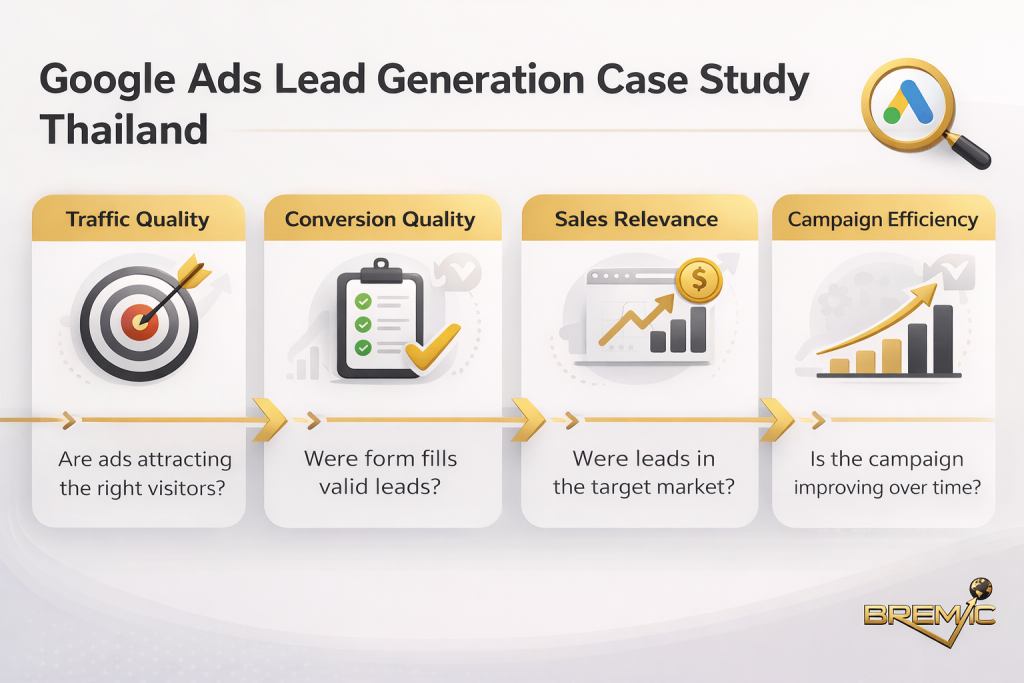
Traffic quality
The first question is whether the campaign is attracting the right kind of visitor. That comes down to keyword intent, match type control, search term quality, ad relevance, and landing page alignment. If these pieces are weak, the campaign may generate activity without generating serious enquiries.
Conversion quality
Not every submitted form or inbound call is a valid lead. Some are irrelevant, duplicated, poorly qualified, or outside the target market. A case study should make clear whether conversion actions were filtered, validated, or reviewed against sales reality.
Sales relevance
For lead generation, the most important performance question is whether leads were commercially useful. Were they in the right industry, budget range, location, or service need? Platform conversion counts do not answer that by themselves.
Efficiency over time
Short-term volatility is normal. Campaigns often need search term refinement, negative keyword expansion, landing page adjustments, and bidding calibration before quality improves consistently. A credible case study should reflect this rather than implying instant perfection.
Attribution discipline
Businesses often over-credit Google Ads when tracking is weak, or under-credit it when offline sales handling is poor. Good evaluation depends on clean conversion tracking, consistent CRM follow-up where possible, and realistic attribution expectations.
What a well-structured lead generation campaign usually includes
When Google Ads is used seriously for lead generation in Thailand, the campaign architecture tends to follow a disciplined structure.
First, keywords are grouped by intent rather than by broad thematic similarity alone. High-intent service terms, commercial comparison searches, branded searches, and exploratory queries should not all sit in the same campaign logic.
Second, ad messaging needs to qualify as well as attract. Good ad copy does not chase every click. It helps filter traffic by making the offer, service scope, or target audience clearer from the start.
Third, landing pages must match the search context. If a user searches for a specific service, the page should not force them to navigate a generic homepage. Clear service relevance, trust cues, friction-aware forms, and obvious next steps usually matter more than flashy design.
Fourth, negative keyword management is critical. Many campaigns in Thailand lose efficiency because they continue spending on informational, irrelevant, or poorly matched searches that never had strong lead potential to begin with.
Finally, lead handling must be part of the strategy. If forms go unanswered, phone calls are missed, or follow-up takes too long, campaign performance will look worse than it really is. Paid search can generate demand, but it cannot compensate for broken sales response.
Common reasons Google Ads lead generation campaigns underperform
A weak campaign is rarely caused by one issue alone. More often, underperformance comes from several manageable problems stacking together.
One common issue is measuring too broadly. Businesses often count every form completion as success, even when a meaningful share of those submissions are irrelevant or unqualified. That creates false confidence and pushes optimization in the wrong direction.
Another issue is poor keyword discipline. Broad targeting without enough negatives often brings in research-heavy or off-target searches. This can make click volume look healthy while lead quality declines.
Landing page mismatch is also common. Ads may promise a clear commercial service, but the destination page is too generic, too slow, too long, or too vague. That weakens both conversion rate and user trust.
There is also a frequent overreliance on platform automation before the account has enough clean data. Smart bidding can work well, but only when conversion signals are reliable. If the account is feeding low-quality conversions back into the system, automation can scale the wrong behavior.
In Thailand specifically, another issue is failing to account for real contact preferences. Some businesses assume a form is enough, while users may prefer to call, message, or enquire through a more direct channel. Campaign structure and landing pages need to reflect how prospects actually convert.
What businesses should look for in a credible case study
When reviewing a google ads lead generation case study Thailand agencies or consultants publish, look for evidence of strategic rigor rather than polished presentation.
A credible case study should explain:
- the business objective behind the campaign
- the target audience and service area
- how conversions were defined
- how lead quality was assessed
- what changes were made during optimization
- which limitations or trade-offs existed
This matters because honest case studies acknowledge complexity. Not every campaign starts with clean tracking. Not every keyword group performs equally. Not every lead source closes at the same rate. Real expertise shows up in how these issues are handled, not in the claim that none of them existed.
Practical recommendations for businesses running lead generation campaigns in Thailand
If you are evaluating or planning a lead generation campaign, start with lead definition before media execution. Decide what qualifies as a meaningful enquiry and how that will be reviewed after submission.
Next, separate campaigns by intent and geography wherever possible. This creates clearer optimization signals and reduces waste. It also makes reporting more useful because you can see which segments are driving business value instead of treating all traffic as one pool.
Invest in search term review early. This is one of the fastest ways to improve lead quality and protect budget. In many accounts, performance improves not because more keywords are added, but because irrelevant searches are removed.
Make landing page alignment a priority. Strong lead generation usually comes from clear relevance, not from excessive persuasion. The user should immediately understand what is offered, who it is for, and how to take the next step.
Finally, judge performance on qualified lead outcomes, not vanity metrics. Click-through rate, impressions, and even raw conversion totals can all improve while business results stay flat. A better campaign is one that creates more commercially relevant opportunities, even if some front-end metrics look less dramatic.
Realistic expectations for timing and results
Lead generation campaigns rarely become fully efficient in the first few weeks. Initial data collection often reveals targeting gaps, conversion friction, and search term noise that need adjustment.
For many businesses, early progress comes from improving relevance and filtering waste rather than aggressively scaling spend. Once lead quality becomes more consistent, bidding and budget decisions become more reliable.
That is why performance should be reviewed as a process of refinement, not as a one-time launch event. Good campaigns improve through disciplined iteration.
Strategic takeaway
A serious google ads lead generation case study Thailand businesses can learn from should answer one core question: did the campaign create qualified sales opportunities, not just platform conversions?
That standard is higher than many reports suggest, but it is the right one. In Thailand, where search behavior, language, geography, and conversion habits all influence performance, lead generation requires more than basic campaign setup. It requires intent-focused targeting, tight measurement, strong landing page alignment, and a clear view of what a good lead actually looks like.
At Bremic, that is the framework worth using when assessing paid search performance. The goal is not to produce impressive-looking numbers in isolation. It is to build a campaign that generates the right enquiries, supports commercial growth, and stands up to real business scrutiny.