If you run a local business in Thailand, ranking well is not just about having a website. You need to be visible where local intent actually happens: Google Search and Google Maps. That means your Google Business Profile, business information, location signals, reviews, and website all need to work together. Google says local results are primarily influenced by relevance, distance, and prominence, so the goal is not to “hack” Maps rankings. It is to make your business easier for Google to understand and easier for customers to trust.
This local SEO checklist Thailand businesses can use is built for practical execution. It is especially relevant for companies that want stronger visibility in city-level searches, service-area searches, and Google Maps results without drifting into vague or outdated tactics.
What local SEO means in practice
Local SEO is the process of improving your visibility for searches with local intent, such as:
- accounting firm Bangkok
- dentist near me
- web design Phuket
- aircon repair Chiang Mai
For most small businesses, local search optimization has two fronts. The first is your Google Business Profile, which influences how you appear in Maps and local packs. The second is your website, which supports entity clarity, service relevance, and trust. Google recommends keeping business information complete and accurate, and it also supports structured data that helps search engines understand local business details on your site.
In Thailand, the execution often needs more care because customers may search in Thai, English, or a mix of both. That makes consistency especially important. Your business name, address details, phone number, services, opening hours, and page targeting need to be stable across every major touchpoint.
The local SEO checklist Thailand businesses should follow
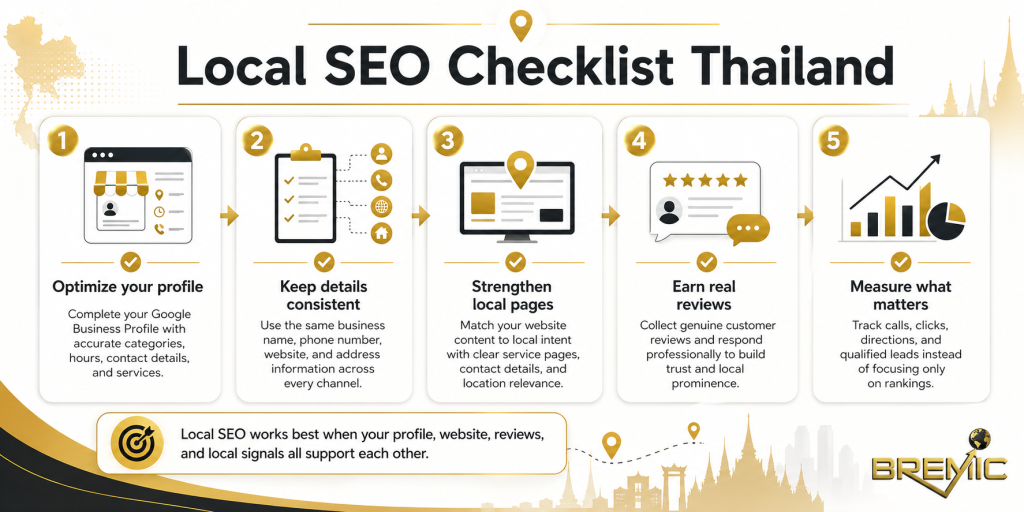
1. Set up or clean up your Google Business Profile first
For most local businesses, this is the foundation of Google Maps SEO Thailand.
Make sure your profile has:
- the real business name used publicly
- the correct primary category
- accurate phone number and website URL
- correct address or service-area setup
- opening hours that match reality
- a clear service description
- current photos
- products or services where relevant
Google’s own guidance is clear: complete and accurate information improves your chances of appearing in local results, and misrepresentation can lead to edits, suspensions, or profile restrictions.
A common mistake is treating the profile like ad copy. Do not stuff keywords into the business name, categories, or descriptions. Choose the nearest real category match and present the business exactly as customers know it offline.
2. Choose the correct business model: storefront, hybrid, or service area
This is one of the most overlooked local SEO issues.
If customers visit your location, you may show your address. If you go to customers and do not serve them at your location, Google expects you to remove the address and use service areas instead. Google also states that service-area businesses can only have one profile for the area they serve, rather than separate listings for every city.
For local SEO for small business owners in Thailand, this matters because many service businesses try to create extra map listings for every district or province they want to rank in. That is usually the wrong move. A better approach is:
- one compliant Google Business Profile
- a clear service-area setup
- strong city or service landing pages on the website where appropriate
3. Keep your NAP and core business details consistent
Your name, address, and phone number do not need to appear in exactly the same formatting everywhere, but they do need to be meaningfully consistent.
What consistency should cover:
- business name spelling
- address structure
- local phone number
- website URL
- opening hours
- primary services
If your business uses both Thai and English naming, decide on a primary standard and use it consistently. This is less about perfect formatting and more about reducing ambiguity. In local SEO, confusion is friction. Friction weakens trust signals.
4. Get your primary categories, services, and pages aligned
A strong local presence depends on alignment between:
- your Google Business Profile category
- the services described in the profile
- the services explained on your website
- the intent of the page you want to rank
If your profile says you are a marketing consultant, but your site mainly talks about web hosting, branding, and software development without a clear local service structure, Google gets mixed signals.
A practical fix is to make sure your main local services have dedicated sections or pages. Then support those pages with internal navigation and clear topical depth. If you want broader SEO support material on-site, point users naturally to your marketing and SEO resources.
5. Build location relevance into the website, not just the profile
Your profile helps you appear. Your website helps validate why you should.
Important on-page elements include:
- a clear service and city focus in title tags and headings
- a usable contact page
- location details in the footer or contact section where appropriate
- embedded map only if it genuinely helps users
- unique location or service pages when there is real business relevance
- local proof points such as service areas, team presence, response times, or office details
Do not build thin “Bangkok,” “Pattaya,” and “Chiang Mai” pages that say nearly the same thing. That does not create authority. It creates duplication. Each local page should serve a real purpose, with unique context, services, FAQs, and commercial information.
6. Add local business structured data correctly
Structured data does not guarantee rankings, but it helps Google understand your business details and can support clearer search presentation. Google documents LocalBusiness structured data for this purpose and recommends validating markup and monitoring performance after implementation.
For most businesses, this means marking up items such as:
- business name
- address
- phone number
- opening hours
- website URL
- relevant business type
This is not a substitute for a strong profile or strong content. It is part of a clean technical foundation.
7. Earn reviews the right way and respond to them
Reviews influence customer trust and can support local prominence. Google explicitly says that more reviews and positive ratings can help local ranking. It also enforces policies against fake or incentivized reviews, and businesses can report reviews that violate policy rather than trying to manipulate the system.
The right review process is simple:
- ask real customers after a real interaction
- make leaving a review easy
- do not gate feedback
- do not offer rewards for positive reviews
- respond professionally, including to negative reviews
For Thailand-based businesses, this often works best when the request language matches the customer’s language preference. What matters is not volume alone. It is review quality, review freshness, and operational credibility.
8. Publish content that supports local intent
Local search optimization is not only profile management. Content still matters.
Useful local content might include:
- service pages for specific areas you genuinely serve
- FAQ pages that answer local buying questions
- pages about delivery areas, booking policies, or coverage zones
- articles addressing local service concerns, pricing factors, or process expectations
The key is relevance. Local content should help a user choose, compare, or understand your service in a Thai market context. It should not exist just to insert place names.
9. Track the right indicators
Do not judge local SEO by national keyword rankings alone.
A better measurement set includes:
- Google Business Profile visibility and engagement
- calls, direction requests, and website clicks from the profile
- organic traffic to local landing pages
- rankings by target city or service area
- lead quality, not only lead volume
Also remember that profile updates are not always instant. Google states that changes to business information can take up to three days to appear in search results, and business detail updates from your website may take around a week to be found and reflected.
Common local SEO mistakes in Thailand
The biggest problems are usually operational, not technical.
Creating multiple map listings for one business
This is especially common with service businesses trying to rank in several cities. It creates compliance risk and usually weakens long-term stability. Google’s guidance for service-area businesses is clear on this point.
Using a keyword-stuffed business name
This may produce short-term movement, but it is not a durable strategy. It also risks profile edits or restrictions.
Building thin city pages
If every page says the same thing with only the location swapped, that is not a real local strategy.
Ignoring website quality because “Maps is enough”
It rarely is. Google Maps visibility is stronger when the underlying business signals are supported by a trustworthy, service-aligned website.
Chasing vanity metrics
Ranking for a broad term is not the goal. Getting found by the right nearby customers is.
What a realistic rollout looks like
For a small business, a sound local SEO program usually happens in stages.
First, fix the foundation: profile accuracy, categories, business model, site contact details, and core service pages.
Next, improve authority signals: reviews, local landing pages, internal linking, structured data, and better local content.
Then refine based on evidence: which locations convert, which services trigger discovery, and which pages support actual leads.
This is a process, not a one-time setup. Google’s local system is built around relevance, distance, and prominence, so gains usually come from stronger alignment and consistency rather than a single tactic.
Strategic takeaway
A good local SEO checklist Thailand businesses can rely on is not complicated, but it does require discipline. Get the business profile right. Keep your operating details consistent. Build website pages that genuinely support local intent. Ask for reviews ethically. Use structured data correctly. Measure leads and visibility by market, not by vanity rankings.
That is what separates a compliant, durable local presence from a profile that looks active but never becomes a serious acquisition channel.