For many local businesses in Thailand, Google Business Profile is the strongest visibility asset they control outside their website. It influences whether a company appears in Google Maps, the local pack, branded searches, and location-based service queries. It also shapes first impressions before a user visits the site, calls the business, or asks for directions.
That is why Google Business Profile optimization in Thailand should not be treated as a one-time setup task. It is an ongoing local SEO process that affects discovery, trust, and conversion quality.
This guide explains what strong optimization looks like, why it matters for local business SEO in Thailand, and how to improve a profile in a way that supports both rankings and lead generation.
What Google Business Profile optimization means in practice
Google Business Profile optimization is the process of improving the accuracy, completeness, relevance, and trust signals of a business listing so Google can confidently match it to local searches.
In practice, that includes:
- choosing the right primary and secondary categories
- writing a useful business description
- aligning business information with the website
- adding relevant services or products
- publishing strong visual assets
- managing reviews properly
- maintaining profile activity and accuracy over time
For businesses competing in local search, this connects directly to Google Maps SEO. A well-optimized profile helps Google understand what the business offers, where it operates, and why it should be shown for nearby intent-driven searches.
In Thailand, this work often needs extra care because businesses may serve both Thai-speaking and English-speaking audiences, operate in tourist-heavy areas, or target multiple service zones from one location. That makes precision more important, not less.
Why Google Business Profile matters for local business SEO in Thailand
A business can have a solid website and still underperform locally if its Google Business Profile is weak. Local search behavior is often immediate and action-oriented. Users searching for a clinic, law firm, restaurant, renovation company, or digital agency are usually comparing nearby options fast.
A strong profile matters because it helps with three things at once.
Visibility in local search results
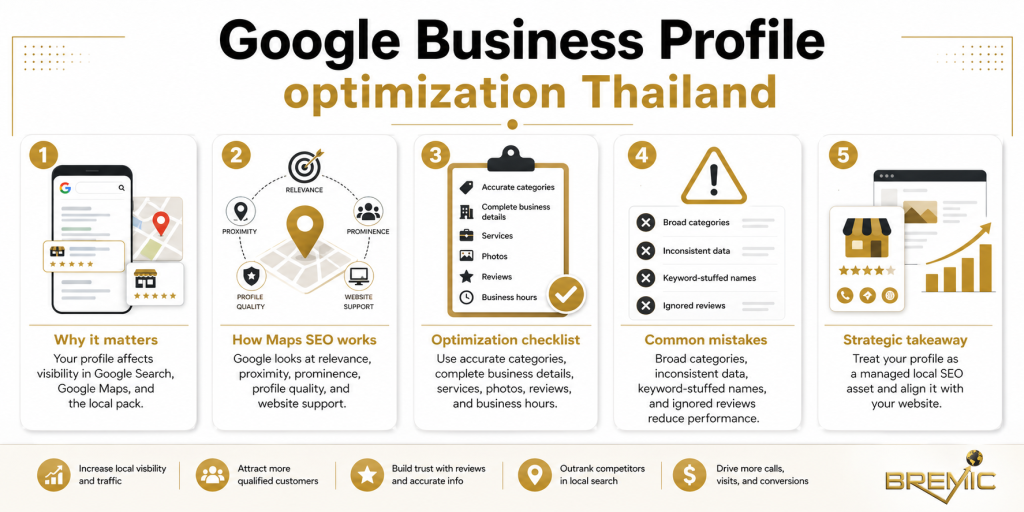
Google uses business profile signals to decide which listings deserve visibility in the map pack and Google Maps results. Relevance, proximity, and prominence all play a role. You cannot control proximity, but you can improve relevance and prominence by optimizing the profile and supporting it with a credible local SEO foundation.
Better click and contact quality
Ranking alone is not enough. A profile also needs to convert attention into action. Clear categories, accurate hours, strong photos, trusted reviews, and useful service details all influence whether users call, visit the website, or request directions.
Brand trust before the website visit
For many searchers, the Google Business Profile is the first brand touchpoint. If the listing looks outdated, incomplete, or inconsistent, that weakens trust immediately. If it looks active, accurate, and well-managed, it supports every other marketing channel.
How Google Maps SEO works with your profile
Google Maps SEO is not separate from Google Business Profile optimization. It is the outcome of doing core local SEO work properly.
When Google evaluates whether a profile should appear for a local query, it looks at signals such as:
- category relevance
- business description and service relevance
- review quantity and quality
- website quality and local relevance
- consistency of business details
- location strength and proximity
- profile completeness and freshness
This is why weak profiles often struggle even when the business is legitimate. Google needs enough signals to trust the listing and match it confidently to search intent.
For example, a business in Bangkok targeting “international school admissions consultant” or “villa renovation company Phuket” needs more than a business name and phone number. The profile should reinforce the service focus, geographic relevance, and trustworthiness of the company.
A practical Google Business Profile checklist for Thailand-based businesses
A good Google Business Profile checklist should focus on fields and actions that actually influence visibility and user confidence.
Claim and verify the profile properly
Start with ownership and verification. Make sure the correct business entity controls the listing and that access is not tied to a former employee, agency, or personal email that may become inaccessible later.
Without proper ownership, even basic profile management becomes risky.
Choose the right primary category
This is one of the most important profile decisions. The primary category tells Google what the business fundamentally is, not everything it does.
A law firm should not choose a broad category if a more specific relevant category exists. A dental clinic should not dilute the listing with unrelated category choices just to appear for more queries. Relevance beats overreach.
Secondary categories can support broader service coverage, but the primary category should reflect the core business model.
Make business details consistent
Your business name, address, phone number, website URL, and opening hours should be accurate and consistent with the website.
For Thailand-based businesses, consistency matters especially when the business uses Thai and English naming variations. Decide how the official brand name is presented and keep that stable across key assets. Inconsistency creates confusion for both users and search engines.
Write a business description that supports relevance
The business description should explain what the company does, who it serves, and where it operates, without sounding promotional or repetitive.
Good descriptions are specific. Weak descriptions are generic. Instead of vague claims about being “the best” or “leading,” explain the service focus, service area, and business type in natural language.
This is also a sensible place to reinforce local business SEO Thailand relevance where appropriate, especially if the business serves a Thai market with local intent.
Add services or products strategically
Service and product sections can help Google understand the scope of the business. They also help users evaluate fit quickly.
Use real services, not keyword dumps. Group them clearly, describe them in plain language, and align them with the service pages on the website where possible.
Upload photos that reflect the real business
Photos improve trust and can influence user behavior. The most useful images are not generic stock-style visuals. They are real photos of the storefront, office, team, work environment, completed work, menu items, rooms, or equipment, depending on the business type.
For local businesses in Thailand, this is especially useful when users are deciding whether the business looks established, accessible, and credible.
Build and manage reviews the right way
Reviews are one of the strongest trust and local relevance signals. Focus on getting real reviews from actual customers and responding to them professionally.
A good review strategy includes:
- asking consistently rather than in bursts
- directing customers to the correct profile
- replying to positive and negative reviews with context
- avoiding scripted or manipulative review practices
Reviews also shape conversion quality. A profile with strong, recent, relevant reviews usually performs better than one with an empty or outdated reputation footprint.
Keep hours, attributes, and contact points updated
This sounds basic, but many profiles lose trust because of outdated hours, broken links, or missing attributes. If holiday schedules, temporary closures, parking details, accessibility features, or service methods change, the profile should reflect that.
Connect the profile to a strong local landing page
A Google Business Profile should not point to a generic homepage if a better location or service page exists. The linked page should reinforce the business offering, geography, and trust signals.
That page should also support the broader site architecture. If you are building local authority, supporting content from a resource hub such as Bremic’s SEO and marketing resources can help connect the profile strategy to a wider content ecosystem.
Common weaknesses that limit local performance
Many underperforming profiles are not failing because of one major issue. They are held back by multiple small weaknesses.
Treating setup as optimization
Claiming a profile is not optimization. A listing with minimal data, weak categories, no review process, and poor website alignment is only partially set up.
Using categories too broadly
Broad categories may feel safer, but they often reduce relevance. Category selection should reflect how customers actually search and how the business should be understood locally.
Ignoring the website connection
Google Business Profile does not replace the website. The website helps validate the profile. If the website lacks local relevance, service clarity, or trust signals, the profile has less support.
Adding keywords unnaturally to the business name
This is a common shortcut and a risky one. The business name should reflect the real-world business name, not a string of target keywords. Inflated names can trigger edits, suspensions, or trust issues.
Leaving reviews unmanaged
Ignoring reviews weakens both user trust and profile quality. Even brief, professional responses show the profile is active and customer-facing.
Strategic recommendations for businesses targeting local visibility in Thailand
The strongest results usually come from integrating the profile into a wider local SEO system rather than treating it as a stand-alone asset.
Start with the core business model. Define what the company most wants to rank for, which locations matter, and what kind of customers it wants to attract. Then align the profile around that focus.
For example:
- a single-location business should optimize tightly around its primary city and core services
- a service-area business should avoid pretending to have multiple staffed offices and instead build relevant service pages plus a credible service area strategy
- a business serving both Thai and international customers should make sure its branding, website language, and customer-facing profile content are coherent
This is where local business SEO Thailand becomes more strategic than mechanical. The goal is not to complete every field for the sake of completeness. The goal is to build a trustworthy local entity that Google can understand and users can trust.
What to expect from optimization over time
Google Business Profile optimization is not instant, especially in competitive markets. Some improvements, such as better calls or higher engagement, can happen soon after profile cleanup and stronger reviews. Ranking improvements may take longer and depend on local competition, website strength, and overall prominence.
A realistic view is:
- profile cleanup can improve trust and usability quickly
- review improvements and category alignment can support stronger local relevance over time
- sustained map visibility usually depends on the profile, website, and broader local SEO working together
Businesses that expect immediate ranking jumps from minor edits usually misread how local search works. Steady, structured improvements tend to outperform shortcuts.
Final takeaway
Google Business Profile optimization in Thailand is not about filling in fields and hoping for map visibility. It is about helping Google understand the business clearly and helping customers trust it quickly.
The businesses that perform best in Google Maps SEO usually do the fundamentals well: accurate categories, consistent business details, strong review management, useful profile content, and clear alignment with the website.
If your goal is stronger local business SEO in Thailand, start with a serious Google Business Profile checklist, fix what is weak, and treat the profile as a managed local asset rather than a static listing. That approach is far more likely to produce durable visibility than any short-term tactic.