A landing page can attract traffic, hold attention, and move a visitor toward action, but only if it is built with a clear conversion goal. That is why landing page best practices for lead generation sit at the intersection of SEO, messaging, design, and Conversion Rate Optimization (CRO).
Many businesses assume that more traffic will solve a weak lead pipeline. In practice, the real issue is often lower down the funnel. If a landing page is vague, distracting, or misaligned with user intent, even qualified visitors will leave without converting. A well-optimized page does not just look polished. It removes friction, builds trust, and makes the next step feel obvious.
This article explains what makes a lead generation landing page effective, why it matters for organic growth and business performance, and how to apply a more strategic approach without turning the page into a generic sales asset.
What is Conversion Rate Optimization (CRO)?
Conversion Rate Optimization (CRO) is the process of improving a page so that a higher percentage of visitors take a desired action. On a lead generation landing page, that action is usually filling out a form, booking a call, requesting a quote, downloading a resource, or starting a conversation.
In practical terms, CRO is not about tricks or aggressive persuasion. It is about reducing uncertainty and improving clarity. Good CRO helps users understand:
- what the offer is
- why it matters
- who it is for
- what happens next
- why they should trust the business
For lead generation pages, CRO is especially important because the user is being asked to give something up, usually their contact information or time. That is a meaningful decision. The page has to earn it.
Why Landing Page Best Practices for Lead Generation Matter
Landing pages influence more than form submissions. They affect the quality of leads, the efficiency of paid and organic acquisition, and the overall return on content and SEO investment.
From an SEO perspective, a page that matches intent and satisfies users is more likely to support stronger engagement signals. While rankings are influenced by many factors, user experience and relevance still matter. If users land on a page and immediately bounce because the message does not match their expectations, the page is failing at both search intent and conversion intent.
Lead generation pages also play an important role in topical authority. A pillar page may target a broad commercial or informational theme, while cluster pages support more specific queries. When those pages are internally linked and strategically aligned, the site becomes easier for users and search engines to understand. A landing page within that structure should not exist in isolation. It should support the broader site architecture and connect naturally to related resources such as service pages, case studies, pricing content, or CRO guidance.
How Landing Page Best Practices for Lead Generation Work in Practice
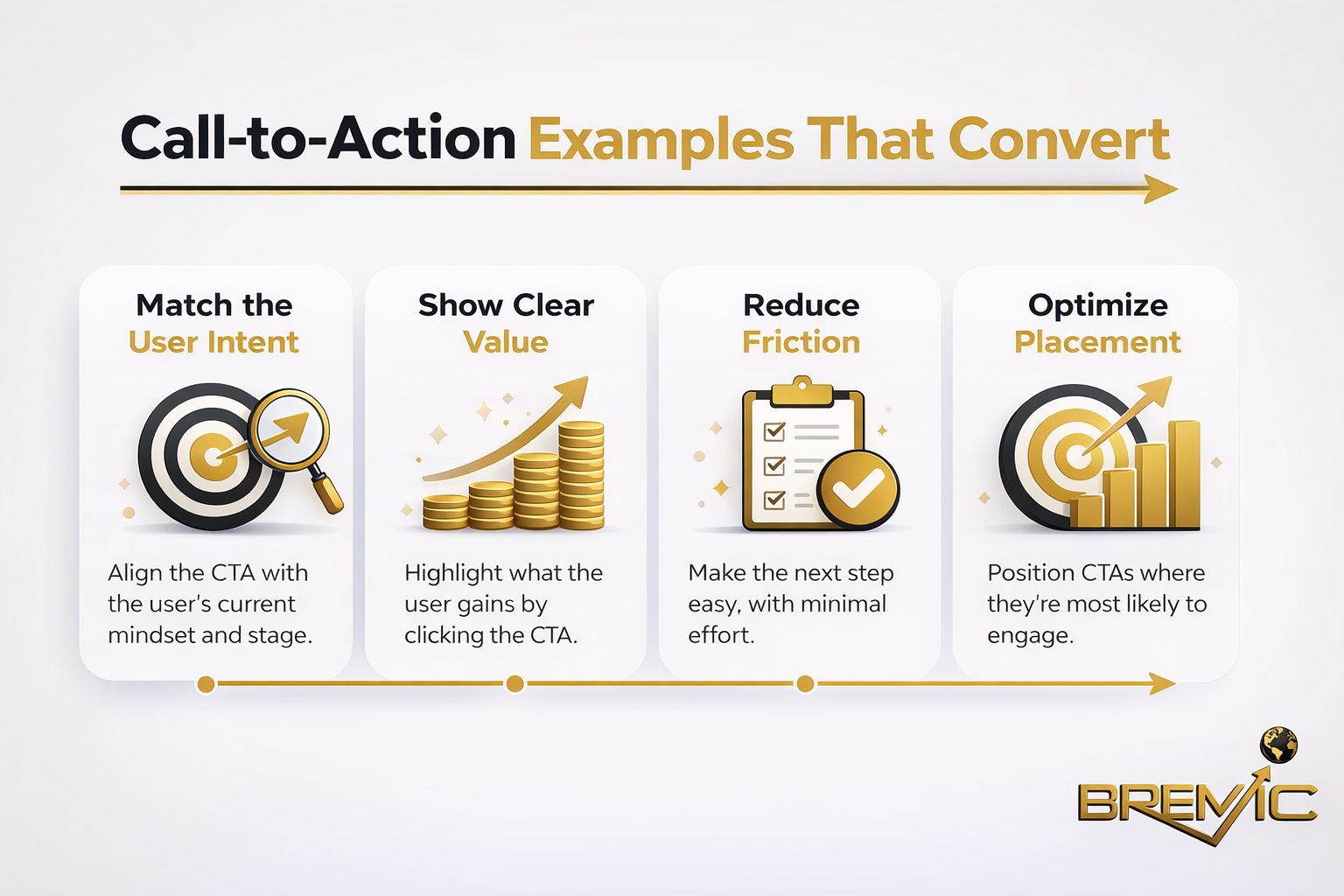
The best landing pages do not try to do everything. They focus on one audience, one offer, and one next step.
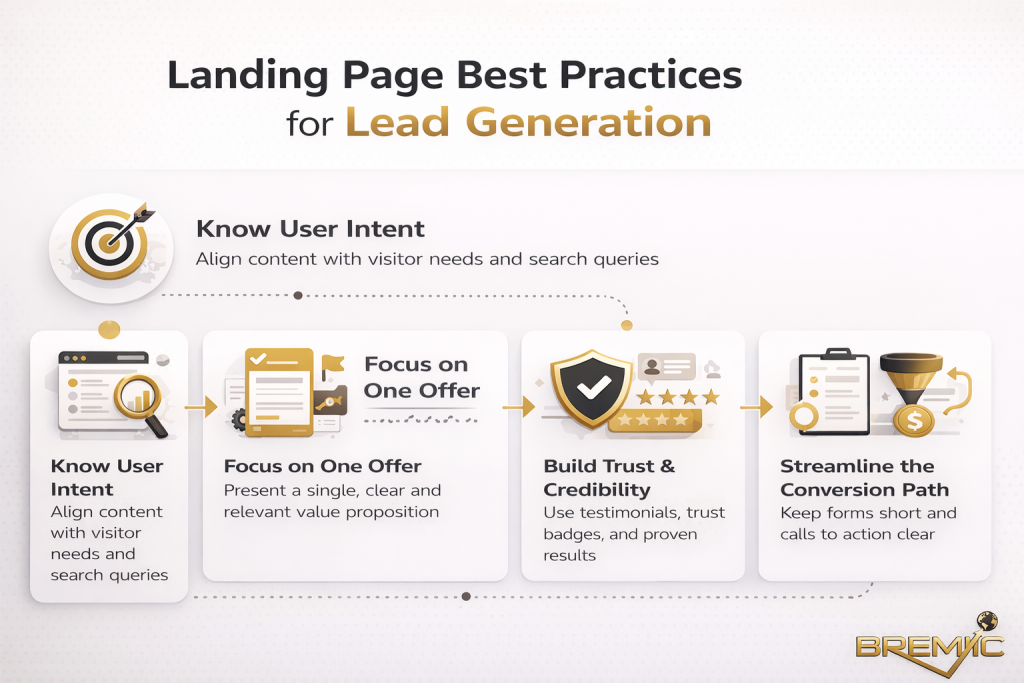
Start with search and visitor intent
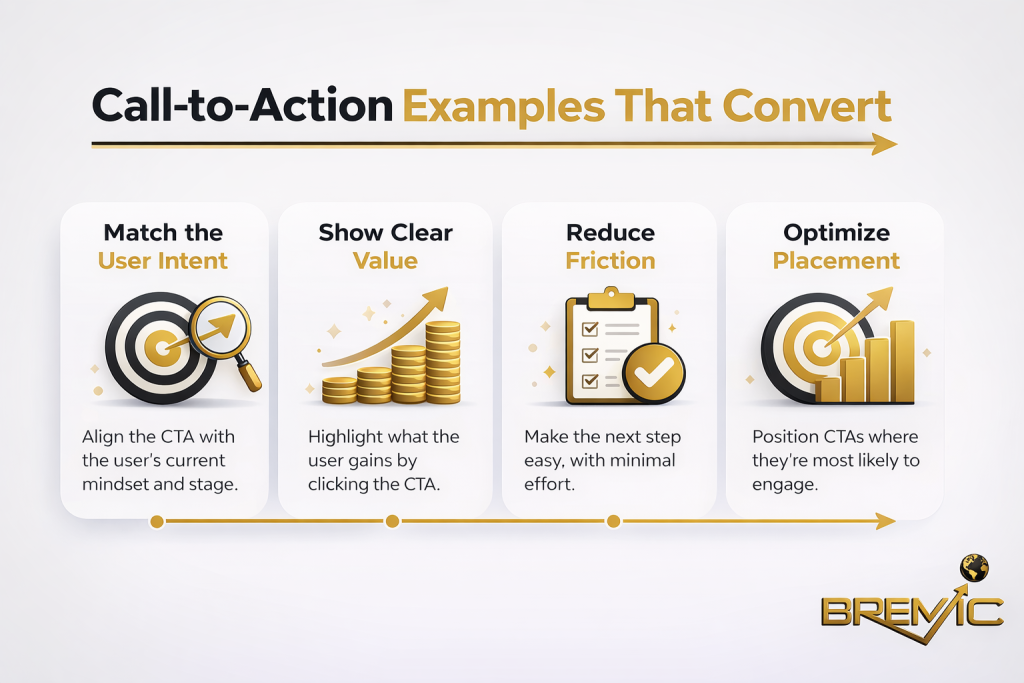
Before design or copy, define why the visitor is on the page. Someone searching for a template, comparison, or educational guide needs a different page experience than someone looking for a demo or consultation.
Intent affects every major decision:
- headline framing
- depth of explanation
- form length
- proof elements
- call to action
- supporting content
If the traffic source and page intent are misaligned, performance usually suffers. A page can be visually strong and still convert poorly because it is solving the wrong problem.
Build around one clear value proposition
A lead generation page needs a strong central promise. That does not mean hype. It means clarity. Within a few seconds, a visitor should understand what is being offered and why it is relevant.
A strong value proposition usually answers three questions quickly:
- What is this?
- Who is it for?
- Why should I care?
The headline should carry the core promise. The subheading should add context. Everything below that should support the same message rather than compete with it.
Keep the path to conversion simple
One of the most important landing page best practices for lead generation is to reduce choice overload. Too many links, competing buttons, or unrelated page elements weaken focus.
A landing page should guide the visitor toward a primary action. That does not mean removing all supporting information. It means structuring the page so that the main action remains obvious from start to finish.
The form itself should also reflect the stage of the decision. Early-stage offers typically convert better with shorter forms. Higher-intent offers can justify asking for more detail, but every extra field should have a clear reason.
Important Subtopics That Shape Performance
Message match between source and page
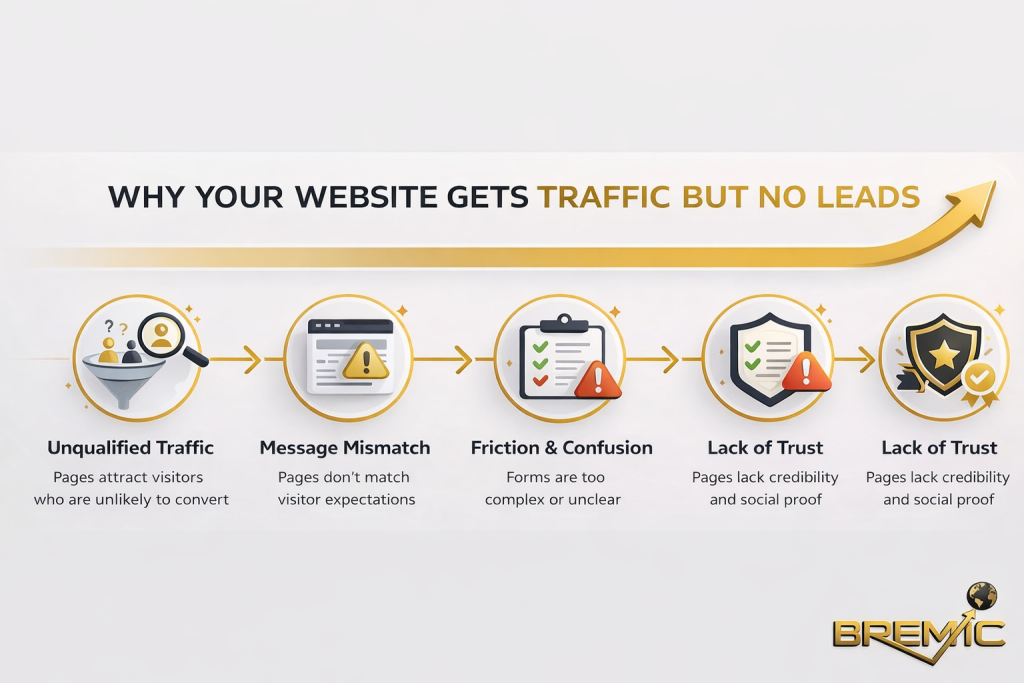
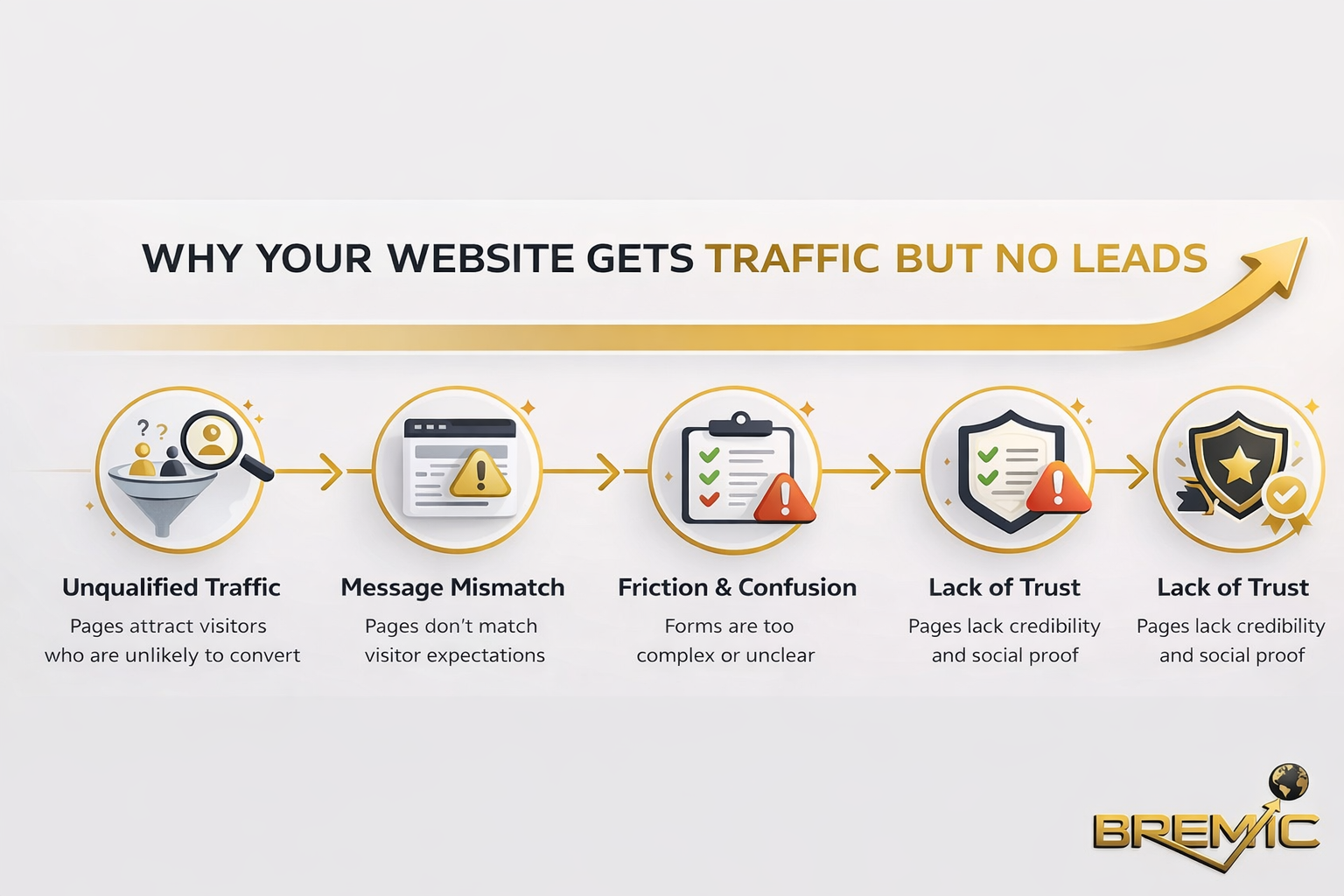
A common conversion problem is weak message match. The visitor clicks based on a specific expectation, but the page speaks in broader or different terms.
If a user arrives from a search query about lead generation landing page strategy, the page should address that directly. If the headline shifts into vague agency language or a broad brand pitch, trust drops immediately.
Message match matters across organic search, paid campaigns, email, and internal links. The closer the page aligns with the promise that brought the visitor there, the stronger the conversion potential.
Trust signals and proof
Lead generation pages ask for commitment, so trust cannot be treated as an afterthought. Good trust signals reduce perceived risk and help users feel confident enough to act.
Useful trust elements include:
- client logos where appropriate
- short testimonials tied to outcomes
- review excerpts
- certifications or credentials
- concise privacy reassurance near the form
- clear contact details or company information
Proof works best when it is specific and relevant. Generic statements like “trusted by many businesses” are weak. Concrete evidence tied to the audience or offer is more persuasive.
Page structure and readability
A page does not need to be long to convert well, but it does need to be easy to scan. Visitors should be able to understand the offer without reading every line.
That means using:
- clear heading hierarchy
- short paragraphs
- strong section sequencing
- enough visual space
- repeated but not excessive calls to action
This is where CRO and content strategy overlap. A page that is easy to process usually performs better because it lowers cognitive friction.
Mobile experience
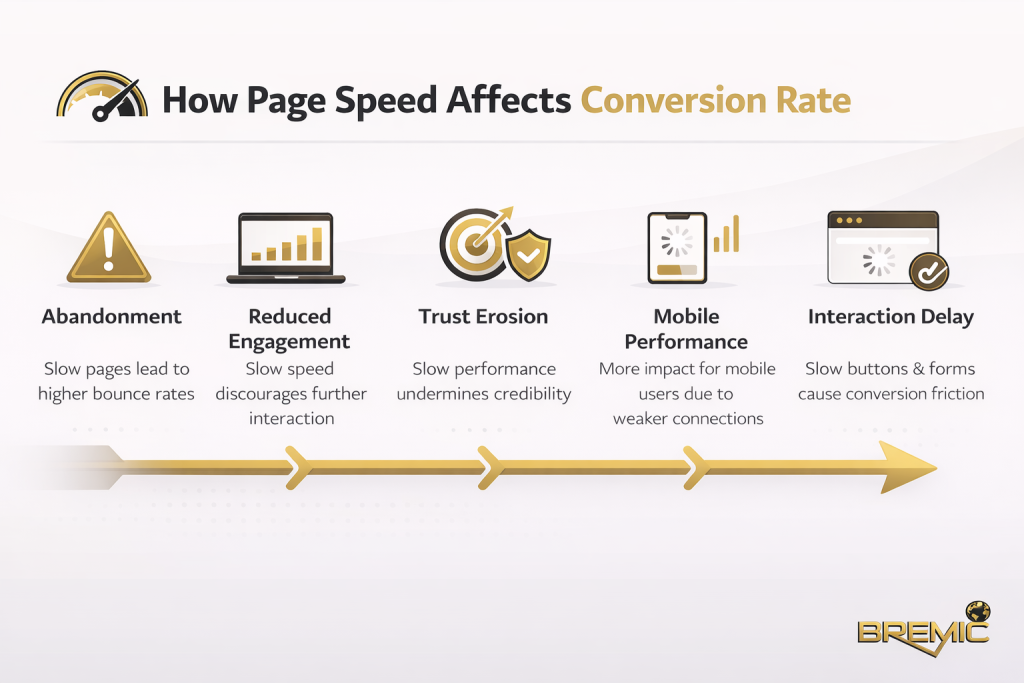
A large share of landing page traffic now comes from mobile devices, yet many pages are still designed with desktop logic. Long forms, cramped layouts, oversized banners, or sticky elements that cover content can quietly damage performance.
Mobile optimization is not just a technical requirement. It is part of the conversion strategy. Buttons need to be easy to tap, forms need to be manageable, and the key message needs to appear early without forcing too much scrolling.
Common Mistakes
Writing the page like a homepage
A landing page is not a company overview. When businesses try to explain every service, audience, and differentiator at once, the page loses focus. Visitors do not know what action to take because the page is not built around one outcome.
Asking for too much too soon
Long forms, premature sales pressure, or vague calls to action often reduce lead volume. The ask should match the value offered and the visitor’s level of intent.
Prioritizing design over clarity
A visually impressive page can still underperform if the message is buried. Conversion usually improves when the copy is clearer, the offer is more concrete, and the structure is easier to follow.
Ignoring follow-through
Lead generation does not end at the form submission. If the thank-you page, email follow-up, or sales response is weak, the page may generate leads without generating real business value. A landing page should be evaluated as part of the full funnel.
Practical Guidance for a Stronger Approach
The most reliable way to improve performance is to treat landing pages as strategic assets, not one-off pages.
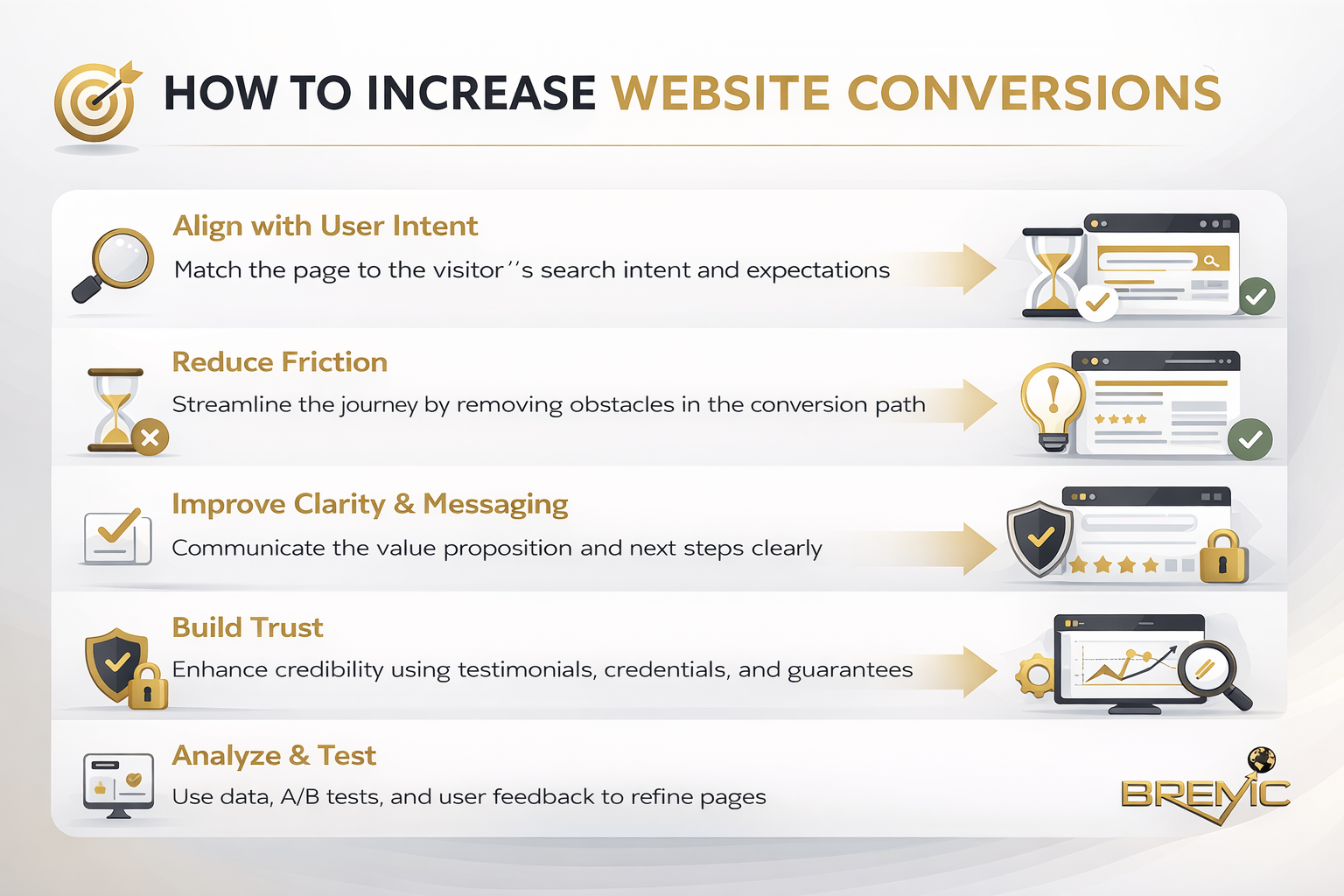
Start by auditing the page against a few core questions:
- Does the page match the user’s intent and acquisition source?
- Is the value proposition clear within the first screen?
- Is there one obvious next step?
- Are trust signals visible at the point of decision?
- Is the form appropriate for the offer?
- Does the page support the broader internal linking structure?
From there, refine based on evidence. Review analytics, session recordings, heatmaps, CRM lead quality, and user behavior. Not every issue is visible from the copy alone. Sometimes the page attracts the wrong audience. Sometimes it attracts the right audience but creates too much friction. Those are different problems and require different fixes.
This is also where internal linking becomes valuable. A landing page can support stronger performance when it is connected to relevant cluster content such as articles on lead qualification, form optimization, offer design, or SEO landing page strategy. Those links should be helpful, not forced. Their purpose is to support the user journey and reinforce topical depth.
Timing and Expectations
Improvements in landing page performance do not always happen immediately. Some changes, such as simplifying a form or clarifying a headline, can produce faster conversion gains. Others require more time because they depend on traffic quality, testing volume, or broader funnel changes.
For SEO-driven landing pages, results often unfold in stages. Rankings, click-through rates, on-page engagement, and conversion performance do not all improve at the same pace. It is realistic to expect iteration rather than instant transformation.
That is why landing page best practices for lead generation should not be treated as a checklist you apply once. They are part of an ongoing process of alignment between search intent, messaging, UX, and CRO.
Conclusion
The best landing page best practices for lead generation are not about adding more elements. They are about making the page more focused, more credible, and easier to act on.
A strong lead generation landing page understands the visitor’s intent, communicates a clear offer, reduces friction, and supports trust at the right moment. It also fits into a broader SEO and content strategy rather than operating as a disconnected conversion page.
Businesses that approach landing pages strategically tend to see better outcomes over time, not because they rely on gimmicks, but because they build pages that respect how real users make decisions. That is the foundation of effective Conversion Rate Optimization (CRO), and it is what turns traffic into meaningful opportunities.