Choosing between shared hosting vs VPS hosting is one of the first infrastructure decisions that affects how a website performs, scales, and holds up under pressure.
For small websites, either option can seem “good enough” at first. But once traffic grows, plugins stack up, and performance issues start showing up in load times, uptime, or backend lag, the differences become harder to ignore. This is where many site owners make an expensive mistake: they either stay on cheap shared hosting for too long, or move to VPS hosting before they actually need it.
The right choice depends on how your website is used, how much control you need, and how much performance risk your business can tolerate. This article breaks down shared hosting vs VPS hosting in practical terms, explains why the decision matters beyond price, and shows how to choose the right setup without overcomplicating it.
What Is Web Hosting?
Web Hosting is the service that stores your website’s files and makes them available online when someone visits your domain.
In practical terms, hosting is the environment where your site lives. It affects how fast pages load, how reliably your site stays online, how secure the server environment is, and how much technical flexibility you have.
Not all hosting types work the same way. Some prioritize affordability and simplicity. Others prioritize control, performance, and scalability.
Shared hosting and VPS hosting are both common forms of Web Hosting, but they serve different needs.
What Is Shared Hosting?
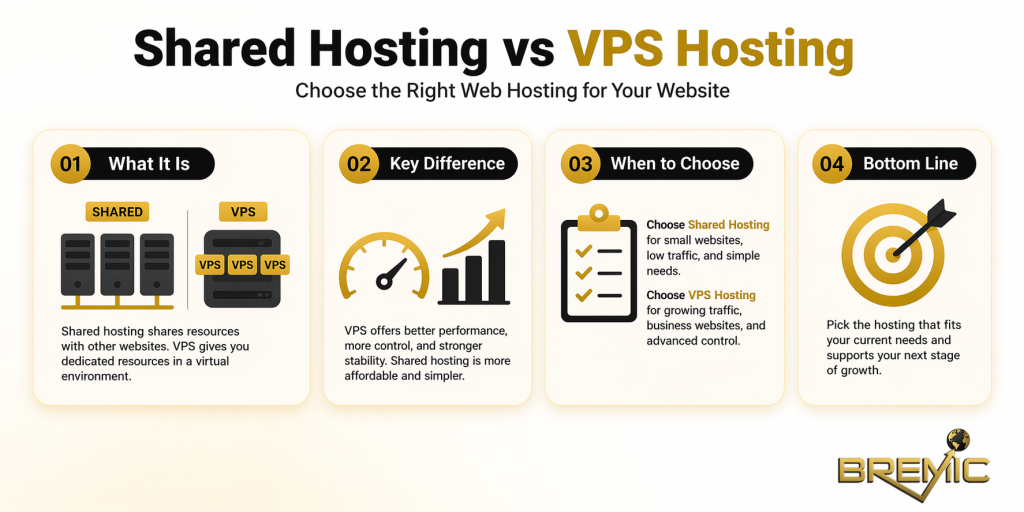
Shared hosting means multiple websites use the same server and share its resources, including CPU, memory, and storage.
It is usually the most affordable option and is designed for ease of use. The hosting provider manages most of the server-level setup, which makes shared hosting attractive for beginners, brochure sites, personal blogs, and small business websites with modest traffic.
The trade-off is that you are sharing the environment with many other websites. If one of those websites consumes excessive resources or experiences a spike in traffic, your site can be affected.
What Is VPS Hosting?
VPS stands for Virtual Private Server.
With VPS hosting, one physical server is divided into multiple virtual environments, and each environment gets its own dedicated share of resources. You are still on a shared physical machine in many cases, but your server space is more isolated and more predictable than standard shared hosting.
This gives you more control, better performance stability, and more flexibility for custom configurations, advanced applications, or growing traffic.
Why Shared Hosting vs VPS Hosting Matters
The shared hosting vs VPS hosting decision is not just about cost. It shapes the technical ceiling of your site.
Hosting influences page speed, uptime, site responsiveness during traffic spikes, and the overall experience for users and search engines. While hosting alone does not determine rankings, poor hosting can create performance problems that undermine SEO efforts, especially when a site becomes slow, unstable, or inaccessible.
A good content strategy can bring more visitors in. Better technical SEO can improve crawlability and site quality. But if the hosting environment cannot support the site properly, gains in traffic can expose infrastructure weaknesses instead of helping growth.
This matters most when:
- your site relies on organic traffic
- conversion rates are sensitive to speed and usability
- you run WordPress with several plugins or dynamic features
- uptime has direct business impact
- you expect traffic growth over time
For a very small site, shared hosting may be enough. For a site with business dependency, growth plans, or heavier technical demands, VPS hosting often becomes the more sustainable option.
How Shared Hosting and VPS Hosting Work in Practice
The difference is easier to understand when you look beyond definitions and focus on resource behavior.
Resource Allocation
In shared hosting, resources are pooled. You are using a shared system where limits exist, but performance can still vary depending on what other accounts on the server are doing.
In VPS hosting, resources are allocated more clearly to your virtual environment. That does not make it unlimited, but it usually makes performance more consistent.
If your site experiences traffic bursts, scheduled campaigns, or heavier backend processing, VPS hosting is far less likely to become unstable purely because of neighboring accounts.
Control and Server Access
Shared hosting is built for convenience. The provider typically restricts root access and limits what you can install or configure at the server level.
VPS hosting offers more control. Depending on the provider and management level, you may be able to configure software stacks, adjust server settings, create custom environments, and optimize the server for your exact application.
That flexibility matters for developers, agencies, ecommerce operators, and businesses running specialized tools.
Security and Isolation
Shared hosting is not automatically insecure, but the environment is less isolated. A reputable host can still maintain strong security standards, but there is more shared exposure by design.
VPS hosting gives you stronger separation between accounts. That does not remove your security responsibilities, but it reduces some of the risks that come with a crowded shared environment.
For businesses handling customer data, transactions, or sensitive workflows, that extra isolation can be a meaningful advantage.
Shared Hosting vs VPS Hosting: The Key Differences
Cost
Shared hosting is cheaper upfront. That is its biggest advantage.
If your website is simple, traffic is limited, and the business risk of slower performance is low, the lower monthly cost can be entirely reasonable.
VPS hosting costs more because you are paying for reserved resources and greater flexibility. But it often becomes more cost-effective when your site starts generating revenue or supporting core operations. At that point, the cost of poor performance usually outweighs the savings from cheaper hosting.
Performance Consistency
Shared hosting can perform well under light conditions, especially with a good provider. But consistency is the issue.
VPS hosting is generally better for websites that need predictable performance. That matters more than many site owners realize. Stable load times, smoother admin performance, and fewer issues during traffic peaks improve operations even before you measure SEO or conversion impact.
Scalability
Shared hosting is often suitable up to a point, then becomes restrictive quickly.
VPS hosting gives you more room to grow. You can usually upgrade resources more easily without fully re-platforming your site. That makes VPS a stronger option for websites that are expected to evolve rather than remain static.
Technical Responsibility
This is where many comparisons get oversimplified.
Shared hosting is easier to manage because the provider handles most of the server environment.
VPS hosting can require more technical knowledge, especially if it is unmanaged. Managed VPS reduces that burden, but it is still a more advanced hosting model than shared hosting.
The better option is not always the more powerful one. It is the one your team can manage properly.
Important Subtopics to Consider Before Choosing
Traffic Profile Matters More Than Raw Visitor Numbers
A site with moderate traffic but heavy dynamic features can outgrow shared hosting faster than a simple content site with higher pageviews.
For example, a WordPress site using page builders, WooCommerce, membership tools, or multiple third-party scripts often puts more strain on hosting than a lightweight informational site.
This is why the right hosting decision should be based on workload, not just vanity traffic metrics.
Website Type Changes the Hosting Decision
A local service website with a few landing pages may do fine on strong shared hosting for a long time.
An ecommerce store, membership platform, SaaS landing environment, or lead-generation site with active campaigns usually benefits more from VPS hosting because performance issues are more expensive in those contexts.
The Hosting Provider Still Matters
Not all shared hosting is poor, and not all VPS hosting is well managed.
A strong shared hosting provider can outperform a badly configured VPS. Server quality, support, infrastructure standards, backup policies, and resource transparency all matter.
When comparing shared hosting vs VPS hosting, the hosting company itself is part of the decision.
Common Mistakes
Choosing Based on Price Alone
Cheap hosting is attractive at the start, but price-only decisions often create migration headaches later.
If a website supports lead generation, sales, or client credibility, hosting should be evaluated as operational infrastructure, not just a monthly expense.
Upgrading Too Late
Many site owners stay on shared hosting until the site becomes noticeably slow or unstable.
By that stage, the problem has already started affecting users and possibly search visibility. Upgrading after repeated issues is often more disruptive than upgrading when growth signals first appear.
Upgrading Too Early
The opposite mistake also happens.
A new or simple site does not always need VPS hosting. If traffic is low, the site is lightweight, and the budget is tight, paying for unnecessary capacity does not create strategic value.
Ignoring Management Requirements
A VPS is only better if it is configured and maintained properly.
Businesses sometimes move to VPS hosting for performance reasons, then overlook patching, monitoring, backups, and server management. That can create more risk than the original shared environment.
Practical Guidance: Which One Should You Choose?
Choose shared hosting if:
- your site is small and relatively static
- traffic is still limited
- budget is the main constraint
- you want minimal technical overhead
- the site is not yet business-critical
Choose VPS hosting if:
- your website generates leads or revenue
- traffic is growing or unpredictable
- site speed and uptime directly affect outcomes
- you need custom server configurations
- you run resource-heavy applications or plugins
- you want a more scalable setup
For many businesses, the most practical path is not choosing the most advanced hosting immediately. It is starting with the simplest option that genuinely supports current needs, then upgrading before growth turns technical limitations into business problems.
Timing and Expectations
Moving from shared hosting to VPS hosting can improve performance quickly, but it is not a magic fix.
If your site has bloated code, poor caching, oversized media, or plugin conflicts, better hosting will help but will not solve every issue. Hosting is one part of a broader performance stack.
From an SEO perspective, better hosting can support stronger outcomes by improving site speed, uptime, and crawl reliability. But rankings usually improve through the combined effect of technical quality, strong content, clean site architecture, and consistent user experience.
In other words, better hosting creates a stronger foundation. It does not replace actual SEO work.
Conclusion
The real question in shared hosting vs VPS hosting is not which option is “best” in general. It is which one fits the current demands and future direction of your website.
Shared hosting is often the right starting point for smaller, simpler websites that need affordability and ease of use. VPS hosting is the better fit when performance, control, stability, and growth start to matter more than keeping costs at the lowest possible level.
A sensible hosting decision supports the wider goals of the site. It protects performance, reduces avoidable technical friction, and gives the business room to grow without constantly running into preventable limits.
For serious websites, Web Hosting should be treated as part of the long-term digital infrastructure, not an afterthought.