Choosing between short-tail and long-tail keywords is one of the most common decisions in SEO, and one of the most misunderstood.
Many websites treat it as a simple either-or question. They chase broad, high-volume terms because they look attractive in a keyword tool, or they focus only on low-volume phrases because they seem easier to rank for. In practice, strong SEO strategy rarely works at either extreme.
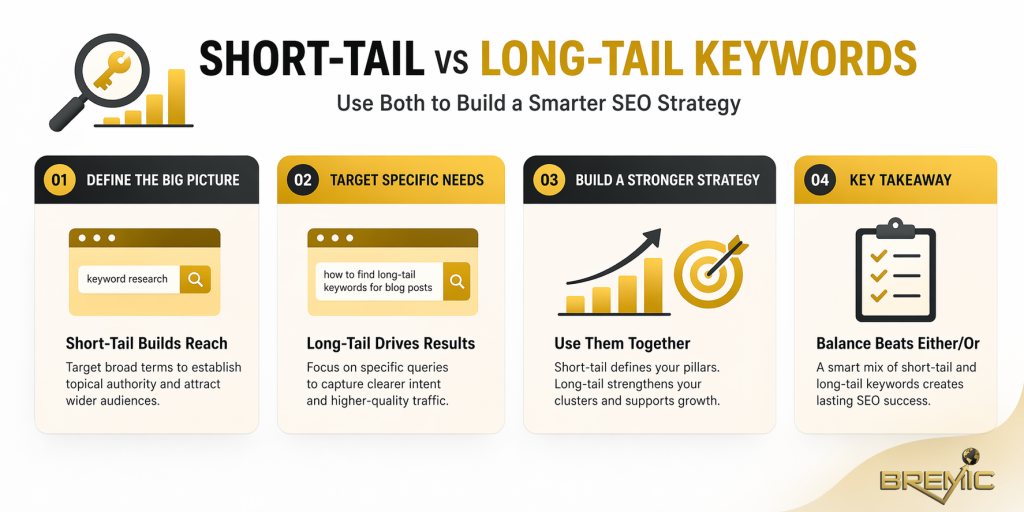
The real value comes from understanding how different keyword types support different goals. Short-tail keywords can help define broad topical relevance and support category or pillar content. Long-tail keywords are often better aligned with specific search intent, clearer conversion paths, and more focused cluster content. Both matter, but they do different jobs.
This is where good Keyword Research becomes strategic rather than mechanical. You are not just collecting phrases with search volume. You are building a structure that connects intent, content format, internal linking, and realistic ranking opportunity.
In this article, we will break down short-tail vs long-tail keywords in practical terms, explain why the distinction matters, and show how to use both in a way that strengthens topical authority instead of fragmenting it.
What is Keyword Research
Keyword Research is the process of identifying the terms people use in search engines and evaluating which ones your website should target.
That definition is accurate, but incomplete. In real-world SEO, Keyword Research is not only about finding phrases. It is about understanding demand, intent, competition, content gaps, and the role each query should play within your site architecture.
A useful keyword list answers questions such as:
- What is the user actually trying to do?
- How broad or specific is the topic?
- Which page type should target this query?
- How hard will it be to compete?
- How does this keyword connect to related pages on the site?
Without that context, keyword data can be misleading. A phrase with high volume may be too broad to convert well. A low-volume term may represent strong commercial relevance. A long-tail keyword may look small on its own, but a cluster of related long-tail queries can add up to meaningful traffic and authority.
That is why Keyword Research should always feed into content planning, internal linking, and topical coverage, not just page-by-page optimization.
Why short-tail vs long-tail keywords matters
The distinction matters because search behavior is not uniform.
Some users search in broad terms because they are exploring a topic. Others search with very specific language because they are closer to taking action or solving a defined problem. Search engines respond differently to those patterns, and your content strategy should as well.
Short-tail keywords are usually broad, high-level phrases with higher search volume and stronger competition. They often reflect general interest rather than precise intent.
Long-tail keywords are more specific phrases, usually longer and lower in individual search volume, but often clearer in meaning and intent.
From an SEO perspective, that difference affects several important things.
Rankings and competition
Short-tail keywords are usually harder to rank for because many authoritative sites compete for them. Search engines often favor established domains, comprehensive resources, and brands with strong link profiles.
Long-tail keywords typically offer more realistic entry points, especially for growing websites. They allow you to compete on relevance and specificity rather than pure authority.
Search intent alignment
Broad terms often hide mixed intent. A keyword like “keyword research” could signal someone looking for a definition, a process, a tool, a template, or a service provider.
A query like “how to find long-tail keywords for blog posts” is more specific. That gives you a clearer content brief and a better chance of satisfying the user.
Traffic quality
More volume does not automatically mean better traffic.
A page that ranks for a broad keyword may attract a large audience with uneven relevance. A page that ranks for highly targeted long-tail queries often attracts users who are more engaged and more likely to convert, subscribe, inquire, or continue deeper into the site.
Topical authority
Short-tail and long-tail keywords also play different roles in a pillar-and-cluster model. Broad terms often belong on pillar pages or major category pages. Long-tail phrases are usually better suited to cluster content that supports the pillar with focused depth.
That structure helps search engines understand both breadth and specificity across the topic.
How short-tail vs long-tail keywords works in practice
The simplest way to think about it is this: short-tail keywords define the territory, while long-tail keywords map the routes inside it.
A short-tail keyword might be:
- keyword research
- SEO strategy
- content marketing
A long-tail keyword might be:
- keyword research for small business websites
- how to build an SEO content strategy for a new site
- content marketing for B2B SaaS lead generation
The shorter phrase represents a broad topic area. The longer phrase reflects a narrower need within that area.
Where short-tail keywords fit
Short-tail keywords are often most useful for pages that need to establish broad relevance. These may include:
- pillar pages
- category pages
- service pages
- high-level educational guides
Their role is not always to win quickly. In many cases, they provide the thematic foundation for the site. They also help shape your content hierarchy, because broad terms reveal the major topics your site should cover.
That said, targeting a short-tail keyword does not mean repeating it excessively or building a thin page around a broad phrase. It usually means creating a genuinely authoritative resource that can support multiple related subtopics and internal links.
Where long-tail keywords fit
Long-tail keywords are usually better for:
- cluster pages
- blog articles
- FAQ-style resources
- problem-specific guides
- intent-led supporting content
These pages work because they answer clearer questions. They also tend to align well with semantic search, where Google understands topic relationships beyond exact-match phrasing.
A focused article targeting a long-tail variation can rank for many closely related terms, especially when the page solves a distinct problem well and sits inside a strong internal linking structure.
Important subtopics that shape keyword decisions
Search intent matters more than phrase length alone
Not every long keyword is valuable, and not every short keyword is too broad.
The key question is intent.
A four-word query can still be vague. A two-word query can sometimes be highly commercial and clear. That is why you should not classify keywords by word count alone. Look at the search results, the content formats ranking, and the likely user goal.
If the results are dominated by beginner guides, a transactional page will struggle. If the results show product pages, a broad educational article may not fit.
Topic clusters are more useful than isolated keywords
One of the biggest mistakes in Keyword Research is evaluating keywords in isolation.
A long-tail phrase is rarely valuable just because it exists. It becomes valuable when it supports a broader topic cluster. For example, a pillar page on Keyword Research can be supported by cluster pages on search intent, keyword difficulty, competitor keyword analysis, and short-tail vs long-tail keywords.
This creates a stronger site architecture and gives each page a distinct purpose. It also prevents overlap, which is a common cause of cannibalization.
Volume is only one signal
Search volume matters, but it should not control the entire decision.
Low-volume long-tail keywords are often dismissed too quickly. Many keyword tools underreport them, group them loosely, or fail to capture the full range of related variations a page can rank for. A well-structured page targeting one precise topic can collect traffic from dozens of semantically related searches.
At the same time, high-volume short-tail keywords can create unrealistic expectations if they are targeted without sufficient authority, depth, or patience.
Common mistakes
A common mistake is assuming short-tail keywords are always the main goal and long-tail keywords are only for beginners. That framing is too simplistic.
Another mistake is creating a separate page for every minor keyword variation. This usually leads to thin content, duplication, and internal competition. Long-tail targeting should improve specificity, not create unnecessary fragmentation.
Many sites also ignore page type. They try to rank a blog post for a broad head term that really belongs on a pillar page, or they optimize a major landing page around a narrow query that deserves its own supporting article.
There is also a frequent reporting mistake: judging keyword choices only by raw traffic. Some of the most valuable long-tail pages generate less traffic but better leads, stronger engagement, and clearer paths into related content.
Practical guidance for using both effectively
Start with the broader topic area, not the keyword list.
Identify the core themes your site needs to own. These usually become your pillar pages or major topic hubs. Then break those themes into narrower subtopics that reflect specific questions, use cases, or stages of awareness.
For most websites, the practical model looks like this:
Use short-tail keywords to define your primary content hubs. These pages should be comprehensive, strategically internal-linked, and strong enough to support multiple related articles.
Use long-tail keywords to build focused cluster pages that answer narrower questions in depth. These pages should connect back to the pillar and sideways to relevant supporting articles where appropriate.
When deciding which keyword type to prioritize, ask:
- Is this page meant to own a broad topic or answer a narrow question?
- Is the site strong enough to compete for a broad term yet?
- Does the keyword reflect exploratory intent or specific intent?
- Would combining these terms on one page strengthen relevance or create a muddled page?
In many cases, the right answer is not choosing one over the other. It is sequencing them correctly.
A newer site may gain traction faster by building strong long-tail cluster content first, while gradually developing broader pillar pages. A more established site may already have the authority to compete for broader terms and can use long-tail content to deepen coverage and support internal linking.
Timing and expectations
Long-tail keywords often produce earlier traction because they are less competitive and more specific. That does not mean they rank instantly, and it does not mean every long-tail page will perform.
Short-tail keywords usually take longer, especially in competitive industries. Ranking for them often depends on broader site quality, topical depth, internal linking, backlink strength, and consistent content development over time.
This is why expectations need to stay realistic. SEO gains usually come from compounding relevance and authority, not from publishing one page around a promising phrase and expecting fast results.
A strong site builds coverage gradually. It earns trust by matching the right page to the right intent, then reinforcing that relevance through structure and consistency.
Conclusion
The real lesson in short-tail vs long-tail keywords is not that one is better than the other. It is that each serves a different strategic purpose.
Short-tail keywords help define the broad topics your site wants to be known for. Long-tail keywords help you address real user needs with precision, improve intent match, and build depth around those broader themes.
Good Keyword Research brings both together. It does not chase volume blindly or prioritize specificity without structure. It builds a content system where pillar pages establish topical relevance and cluster pages create focused, useful coverage that search engines and users can trust.
If your goal is long-term SEO performance, treat short-tail and long-tail keywords as complementary assets within a broader architecture. That is how you move from scattered content production to genuine topical authority.