Publishing frequency is one of the most misunderstood questions in Content Marketing. Many businesses assume more is always better. Others publish sporadically, then wonder why rankings and traffic stall. The real answer is more strategic: the right publishing cadence depends on your goals, resources, site maturity, and ability to maintain quality.
If you publish too slowly, you may struggle to build topical depth and momentum. If you publish too aggressively without a plan, quality drops, internal structure weakens, and content becomes difficult to sustain. That usually leads to thin articles, overlapping topics, and inconsistent performance.
This article explains how often you should publish blog content, why frequency matters for SEO, and how to set a cadence that supports long-term authority rather than short-term activity.
What Is Content Marketing?
Content Marketing is the process of creating and publishing useful content to attract, educate, and convert a relevant audience. In practice, that usually includes blog articles, guides, landing pages, case studies, email content, and other assets that help people solve a problem or make a decision.
From an SEO perspective, blog content plays a specific role. It helps a website target informational queries, build topical relevance, answer related questions across a subject area, and create internal linking pathways back to more commercial pages. A blog is not just a publishing channel. It is often the structure that supports organic visibility across a cluster of related topics.
That is why publishing frequency matters. It is not about filling a calendar. It is about steadily expanding useful coverage around the topics your audience actually searches for.
Why Publishing Frequency Matters
Search engines do not reward websites simply for posting often. They reward pages that satisfy search intent, demonstrate relevance, and contribute to an overall strong site experience. Still, consistent publishing does matter for several practical reasons.
First, frequent publishing helps build topical authority. If your site covers a subject with depth, clear structure, and useful supporting pages, it becomes easier to signal expertise across that topic cluster.
Second, a steady publishing cadence increases your opportunities to rank. One strong article can perform well, but a structured set of related pages gives you far more entry points from search.
Third, publishing consistently improves internal linking opportunities. Each new page can support pillar content, strengthen cluster pages, and distribute authority more effectively across the site.
Fourth, consistency creates operational discipline. Teams that publish on a realistic schedule are more likely to maintain editorial standards, update aging content, and keep their strategy aligned with business goals.
So the question is not whether frequency matters. It does. The better question is how often you can publish while maintaining quality, intent alignment, and structural coherence.
How Often Should You Publish Blog Content?
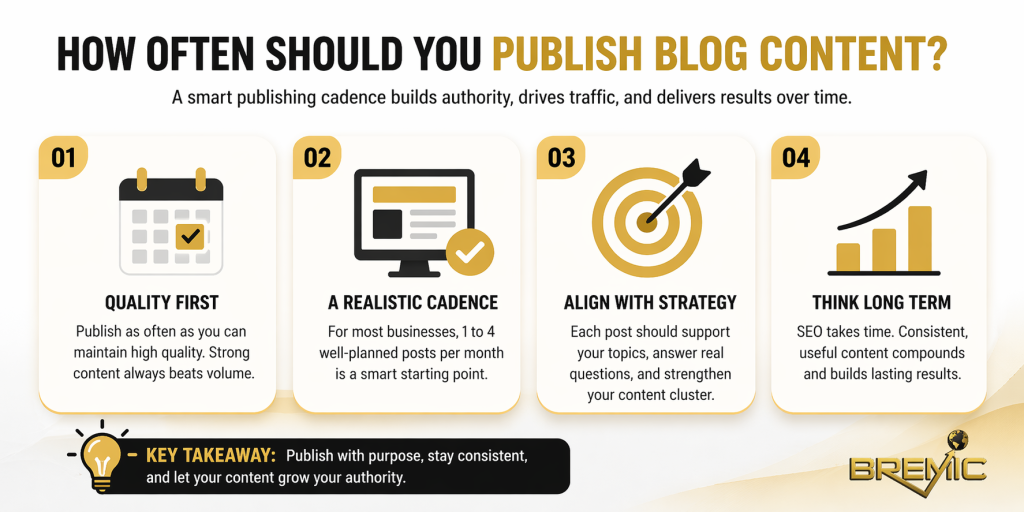
For most businesses, the best starting point is one to four high-quality blog posts per month. That range is realistic enough to sustain and strong enough to build momentum over time.
A smaller site in a competitive niche may benefit from publishing weekly if it has the resources to do it well. A newer site with limited capacity may be better served by publishing twice a month, as long as each piece is strategically chosen and genuinely useful.
The wrong approach is chasing an arbitrary number. Publishing twelve mediocre posts a month is usually less effective than publishing four well-planned articles that target clear search intent and fit into a topical cluster.
A good publishing cadence depends on four factors
1. Your available resources
Frequency must match your actual operational capacity. That includes research, writing, editing, SEO review, publishing, internal linking, and updates. If your team can only produce one strong article per week, that is better than forcing three weak ones.
2. Your site’s current authority
A newer website often needs a more deliberate buildout of foundational content. That does not always mean daily publishing, but it does mean creating core pages in a logical sequence. Established sites can sometimes slow down new production and shift more focus toward content improvement and consolidation.
3. Competition in your niche
In highly competitive industries, consistency matters because your competitors are likely investing heavily in content production. Even then, quality still wins over raw output. The goal is not to match volume blindly. It is to publish enough strong content to remain relevant and expand coverage where gaps exist.
4. The complexity of the topics you cover
Some topics require deeper expertise, original examples, or more careful explanation. In those cases, lower frequency may be the smarter choice. A serious article that demonstrates real strategic understanding will usually outperform rushed content built around surface-level definitions.
How Publishing Frequency Works in Practice
A strong blog schedule should follow site architecture, not just a calendar. That means your publishing plan should support a clear pillar-and-cluster model.
Start with the pillar topic: the broad subject your website wants to own. Then build cluster content around subtopics, questions, comparisons, and supporting issues connected to that pillar. Each new article should have a defined role within that structure.
For example, if your broader topic is Content Marketing, your supporting articles might cover content calendars, editorial workflows, content refresh strategy, blog SEO, topic clusters, and content measurement. In that context, an article about how often you should publish blog content functions as a focused cluster page answering a common planning question.
This approach improves more than topical depth. It also prevents random publishing. Instead of asking what to post next in isolation, you ask which supporting page will strengthen the cluster, fill a search gap, or support a higher-value page through internal links.
Publishing consistency beats publishing bursts
Many sites publish heavily for a month, then go quiet for a quarter. That pattern is difficult to sustain and often weakens results over time. A consistent cadence is usually more valuable than short bursts of activity because it keeps the content system operational.
Consistency also makes performance easier to evaluate. If you publish on a stable schedule, it becomes easier to identify whether issues relate to topic selection, content quality, internal linking, or unrealistic expectations.
Important Subtopics That Influence Frequency
Content quality should set the ceiling
Your publishing schedule should be limited by the highest quality you can maintain consistently. If increasing output leads to repetitive angles, shallow coverage, or poor editing, your cadence is too aggressive.
That matters because weak content does more than fail individually. It can dilute your site’s overall quality signals, create keyword overlap, and waste crawl attention on pages that add little value.
Search intent matters more than volume
A site can publish often and still underperform if the content does not match what users actually want. Frequency only supports SEO when each page has a clear purpose and satisfies a specific intent.
For informational blog posts, that usually means answering the query directly, covering the right depth, and avoiding unnecessary detours into unrelated commercial messaging.
Updating existing content is part of the strategy
Publishing new blog content is only one side of the equation. Mature content strategies also include updates, mergers, pruning, and internal link improvements. In many cases, refreshing a solid older article can produce better SEO gains than publishing a new one on a marginal topic.
That is especially true for sites that already have dozens or hundreds of blog posts. At that stage, the question shifts from how often should you publish blog content to how you balance new production with maintenance.
Common Mistakes
One common mistake is treating frequency as the goal. Publishing regularly is useful, but it is still a means to an end. The goal is stronger visibility, better topic coverage, and more qualified traffic.
Another mistake is setting a cadence based on aspiration rather than resources. Ambitious editorial calendars often look good on paper and fail in execution. The result is inconsistency, rushed content, and abandoned clusters.
A third mistake is publishing disconnected topics. Even good articles underperform when they do not support a broader structure. Without a clear cluster model, you lose internal linking strength and make it harder for search engines to understand your site’s subject depth.
Finally, many businesses ignore performance signals for too long. If your cadence is producing content that does not rank, engage, or support conversions, the issue may not be volume alone. It may be topic selection, weak intent matching, or poor page quality.
Practical Guidance
For most teams, the best approach is to set a publishing cadence you can sustain for at least six months without sacrificing quality.
A practical model looks like this:
- Start with 2 to 4 articles per month
- Map every article to a pillar or cluster theme
- Prioritize topics with clear informational intent
- Review internal links every time you publish
- Reassess output after enough time has passed to gather meaningful data
If your team is small, two strong articles per month can still work well, especially when paired with regular updates to older content. If your team is more established and has clear workflows, weekly publishing can be effective. The key is sustainability and structure.
If you want a simple rule, use this one: publish as often as you can while keeping content useful, strategically aligned, and worth indexing.
Timing and Expectations
Blog content rarely produces meaningful SEO results immediately. Even strong pages can take time to be crawled, indexed, evaluated, and positioned against competitors. For most sites, it is more realistic to assess content performance over months rather than weeks.
That means publishing frequency should be planned with patience. A sound strategy compounds over time. As clusters expand, internal links strengthen, and more pages rank for related queries, the site becomes more resilient and more authoritative.
This is one reason consistency matters so much. SEO gains often come from accumulated relevance rather than isolated wins.
Conclusion
So, how often should you publish blog content? Often enough to build topical depth and maintain momentum, but not so often that quality, structure, and intent alignment break down.
For most businesses, that means publishing one to four strong articles per month, with every page serving a clear role in the wider Content Marketing strategy. A realistic cadence will outperform an aggressive one that cannot be maintained.
The strongest content programs are not built on volume alone. They are built on consistency, useful coverage, smart internal architecture, and a long-term view of authority. When publishing frequency supports those goals, it becomes an asset. When it replaces them, it becomes noise.