Website speed is often treated as a technical issue, but the business impact is much broader than page load time alone. Slow websites create friction at the exact moment a user is deciding whether to stay, browse, trust the brand, or take action. That is why understanding how website speed affects conversions matters for marketers, business owners, and SEO teams alike.
A fast site does not guarantee higher sales or more leads. But a slow site regularly undermines them. It weakens first impressions, interrupts user flow, increases abandonment, and reduces the efficiency of every traffic source you pay for or work to earn.
This article explains the relationship between speed and conversions in practical terms, shows where Web Hosting fits into the picture, and outlines how to approach performance improvements strategically rather than as a box-ticking exercise.
What Is Web Hosting
Web Hosting is the service that stores your website’s files and makes them available to users when they visit your site. In practical terms, your hosting environment affects how quickly your pages can be delivered, how reliably your site stays online, and how well your website handles traffic.
That matters because speed is not only a front-end issue. It is also shaped by infrastructure. Even a well-designed website can feel slow if it runs on poor hosting, overloaded servers, or an environment that is not configured for performance.
Hosting influences factors such as:
- server response time
- uptime and stability
- resource allocation
- database performance
- caching support
- scalability during traffic spikes
If you are trying to improve conversions, hosting should not be viewed as a back-end detail. It is part of the user experience.
Why Website Speed Matters for Conversions
When people search for how website speed affects conversions, they are usually trying to understand one core business question: does site speed really influence results?
The answer is yes, because speed shapes behavior before a user ever fills out a form, adds a product to cart, or books a call.
Speed affects trust immediately
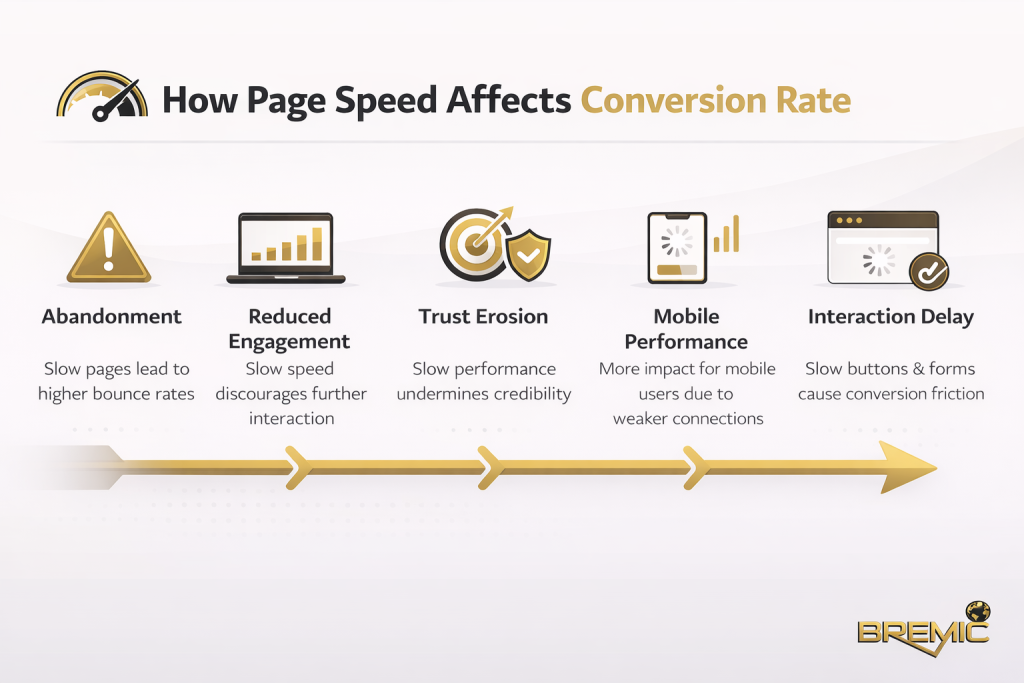
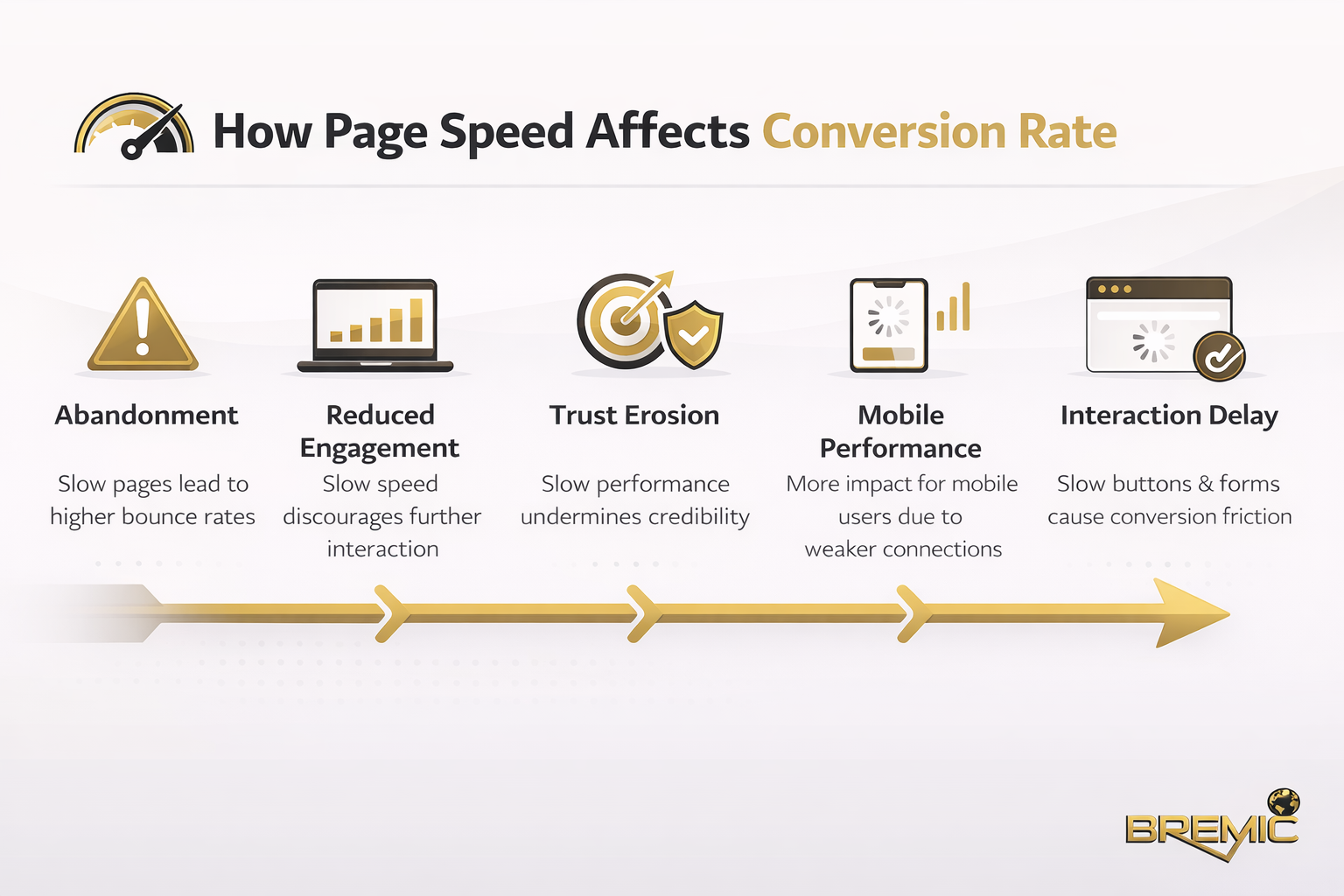
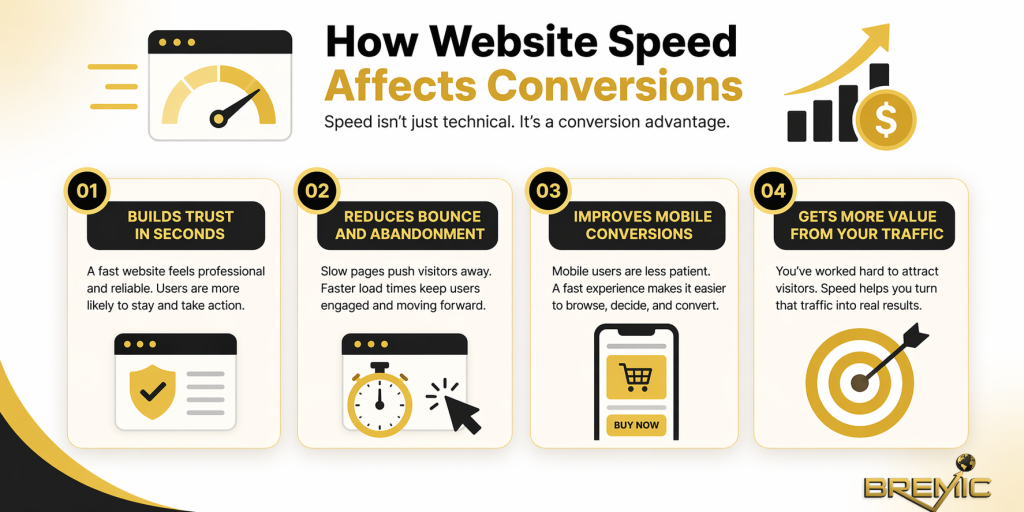
Users make judgments fast. If a page hesitates, jumps around, or feels unresponsive, the site appears less polished and less trustworthy. This is especially damaging on high-intent pages such as service pages, pricing pages, product pages, and checkout flows.
A fast site feels more credible. A slow site introduces doubt.
Speed affects engagement before conversion
Conversion rarely happens on the first screen alone. Users often compare options, read supporting content, review offers, and navigate between pages. Slow performance disrupts that journey.
If category pages lag, filters freeze, or the next page takes too long to load, many users simply stop. That means lost conversions even when your offer is strong.
Speed affects the efficiency of your SEO and paid traffic
From an SEO perspective, performance supports usability and page experience. Search engines aim to send users to pages that work well. While speed alone is not the only ranking factor, it contributes to the overall quality of the experience.
More importantly, even if rankings stay stable, slow pages reduce the value of the traffic you already receive. A site can win impressions and clicks, then lose conversions because the experience breaks down after the visit begins.
That is why speed is not just a technical SEO topic. It sits at the intersection of SEO, UX, CRO, and infrastructure.
How Website Speed Affects Conversions in Practice
The relationship between speed and conversions is not abstract. It shows up in very specific parts of the user journey.
First-page load sets the tone
The first load is where patience is lowest. A visitor from search, social, or paid ads does not yet have much loyalty to your brand. If the site feels slow from the start, bounce risk rises immediately.
This is where server performance, image weight, script loading, and Web Hosting quality all matter at once.
Mobile users are more exposed to performance issues
Desktop users often tolerate more because they have stronger devices and more stable connections. Mobile users do not. They may be on weaker networks, switching between apps, or interacting one-handed while distracted.
That means mobile conversion rates are often more sensitive to sluggish page rendering, oversized media, intrusive popups, and slow interactive elements.
Speed influences micro-conversions too
Not every conversion is a purchase. Performance also affects smaller actions that lead to revenue later, such as:
- clicking to a service page
- subscribing to a newsletter
- downloading a guide
- starting a form
- viewing a product detail page
When speed improves, these micro-conversions often improve first. That is useful because it shows where friction exists before it becomes obvious in bottom-line sales data.
The Role of Web Hosting in Website Speed
Many businesses focus on design changes, plugin cleanup, or image compression while overlooking the hosting environment. That is a mistake.
Server response time matters
Before the browser can render your page, the server has to respond. If the hosting environment is slow, unstable, or underpowered, the rest of your optimization work starts from a weak foundation.
This is particularly noticeable on content-heavy websites, ecommerce stores, and sites with dynamic functionality.
Shared hosting can become a hidden bottleneck
Low-cost shared hosting may be acceptable for a very small site with limited traffic. But once a site becomes commercially important, weak hosting can create inconsistent performance. A page may load acceptably one moment and poorly the next, depending on server demand.
That inconsistency is hard to diagnose and even harder to convert around.
Better hosting does not solve everything
At the same time, upgrading Web Hosting is not a magic fix. If your site is overloaded with scripts, poorly built themes, unnecessary plugins, and unoptimized assets, premium hosting alone will not produce a strong conversion experience.
The right view is this: hosting supports performance, but performance still depends on the full stack.
Important Subtopics That Influence Conversion Performance
Core Web Vitals and real user experience
If your broader content cluster includes pages about Core Web Vitals, this is where the connection becomes useful. Metrics such as loading stability, responsiveness, and visual shift matter because they reflect how a page actually feels to use.
A website may appear technically online but still feel slow or frustrating because interactive elements lag or the layout shifts during loading.
Caching and content delivery
Caching reduces repeated work by serving prebuilt content faster. A CDN helps distribute assets closer to the user geographically. These are not just developer concerns. They affect how quickly pages load for real visitors in real markets.
For businesses with national or international traffic, this can materially improve consistency.
Images, scripts, and third-party tools
A common reason conversion pages become slow is not the main content itself, but everything attached to it: tracking scripts, chat widgets, review apps, animation libraries, tag managers, heatmaps, and video embeds.
Each tool may seem justified on its own. Together, they can slow the page enough to reduce the value of the campaign they were meant to support.
Common Mistakes
Treating speed as an SEO issue only
This narrows the conversation too much. Speed is not only about rankings. It is about business performance. The most useful teams evaluate site speed through conversion paths, not just audit scores.
Chasing perfect performance scores
A high score in a testing tool can be useful, but it is not the goal. The goal is a faster, smoother user experience on the pages that matter most. A site can score well and still convert poorly if the journey is confusing or trust signals are weak.
Optimizing the wrong pages first
Not every page deserves the same priority. Start with pages that influence revenue or lead generation: homepage, key landing pages, category pages, product pages, pricing pages, and checkout or contact flows.
Ignoring hosting limits
Businesses sometimes keep investing in SEO, content, and advertising while leaving the site on weak Web Hosting. That creates a structural ceiling. Traffic grows, but the site becomes less capable of handling it well.
Practical Guidance for Improving Conversions Through Speed
Start with your conversion path, not with a random speed report. Identify the pages where users first land, compare options, and complete actions. Then review those pages for performance friction.
Look at speed in three layers.
First, assess infrastructure. Is your hosting environment appropriate for the site’s size, traffic level, and functionality? Are server response times consistent? Can the environment handle peaks without degrading?
Second, reduce front-end weight. Compress and properly size images, remove unnecessary scripts, defer non-critical resources, and simplify elements that add visual complexity without adding conversion value.
Third, test the actual experience. Do forms respond quickly? Do buttons feel immediate? Does the page remain stable as it loads? Can a mobile user complete the key action without delay or annoyance?
This is also where related topics in a topical cluster become useful. Pages on image optimization, technical SEO audits, caching, Core Web Vitals, and site architecture all support this topic naturally because they solve adjacent pieces of the same performance problem.
Timing and Expectations
Speed improvements can have a noticeable effect quickly, especially when major friction points are removed from high-intent pages. But not every result appears overnight.
SEO-related outcomes may take longer because rankings depend on more than performance alone. Conversion improvements also need enough traffic and clean measurement to validate. In practice, businesses should expect an iterative process: diagnose, fix, test, compare, and refine.
It is also important to separate correlation from causation. If conversions rise after speed improvements, that is valuable, but the real question is where and why the experience improved. The strongest teams measure by page type, device, and funnel stage rather than assuming one sitewide change explains everything.
Conclusion
Understanding how website speed affects conversions means looking beyond load times as a technical metric. Speed shapes trust, usability, engagement, and the commercial performance of your traffic. It affects how users move through the site and whether they stay long enough to act.
Web Hosting plays an important role because infrastructure influences the baseline performance your site can deliver. But hosting is only one part of the picture. Real conversion gains come from combining solid hosting, lean pages, smart technical decisions, and a clear user journey.
The strategic takeaway is simple: treat speed as a conversion lever, not just a maintenance task. When performance improves on the pages that matter most, the site becomes easier to trust, easier to use, and better equipped to turn traffic into results.