Businesses investing in SEO usually ask the same question first: how long until it starts working? In Thailand, that is a sensible question, but it needs a realistic answer. SEO is not a switch you turn on. It is a process of improving relevance, trust, technical performance, and topical depth so that Google has strong reasons to rank your pages.
That matters even more in the Thai market because timelines can vary widely depending on language, competition, search intent, local targeting, and the current condition of the website. A Bangkok law firm, a Phuket hotel, and a national e-commerce brand will not see progress at the same pace, even if all three invest in Search Engine Optimization (SEO).
So, how long does SEO take in Thailand? In most cases, businesses can expect early movement within three to six months if the site has solid foundations and the work is done properly. More competitive results often take six to twelve months or longer. For newer websites, weak domains, or highly competitive industries, the timeline can extend further.
The key point is this: SEO can produce meaningful long-term growth in Thailand, but only when expectations are tied to strategy rather than guesswork.
What is Search Engine Optimization (SEO)?
Search Engine Optimization (SEO) is the process of improving a website so it can rank more prominently in search engines for relevant queries. In practice, that means helping search engines understand what your site offers, why it is credible, and which pages best match user intent.
SEO is not only about rankings. It also affects the quality of traffic you attract. A well-optimized site brings in visitors who are already searching for your services, products, expertise, or location. That is why SEO is often more valuable than channels that generate attention without intent.
In practical terms, SEO usually involves five core areas:
- technical performance, such as crawlability, speed, indexing, and site structure
- content quality and topical coverage
- on-page optimization, including titles, headings, internal linking, and relevance
- authority signals, such as mentions and backlinks
- local and market relevance, especially for geographically targeted searches
When businesses ask how long does SEO take in Thailand, they are really asking how long it takes to improve these signals enough for Google to reward the site consistently.
Why SEO Matters in Thailand
Thailand is a competitive digital market, especially in sectors such as hospitality, healthcare, property, legal services, beauty, education, and e-commerce. Users also search in different ways depending on audience and context. Some queries are in Thai, some in English, and some mix both. That changes how content should be planned and optimized.
SEO matters because it helps businesses capture demand that already exists. Instead of interrupting users, it positions the website where people are actively looking for answers or providers. For local businesses, this can mean appearing for city-based and service-based searches. For national businesses, it can mean building authority across a broader topic cluster over time.
Done well, SEO supports more than traffic. It can improve lead quality, strengthen brand credibility, and reduce dependency on paid acquisition. But those benefits usually come from consistent execution, not isolated changes.
How SEO Works in Thailand
SEO timelines in Thailand depend on how quickly a website can build relevance and trust in its market. That happens through a combination of technical work, content quality, internal linking, and off-page signals.
Technical foundations come first
If Google cannot crawl, index, and interpret the website properly, content improvements will have limited effect. Common technical blockers include poor site architecture, duplicate pages, broken internal links, slow performance, weak mobile usability, and thin location pages.
In many cases, the first month or two of SEO work is spent fixing what prevents growth rather than creating visible ranking wins.
Content must match actual search intent
A page will not rank well simply because it contains the target keyword. It needs to satisfy the reason behind the search. For example, someone searching how long does SEO take in Thailand wants realistic expectations, not a generic sales pitch about digital marketing.
This is where expert content strategy matters. Pages must be built around a clear intent, supported by relevant subtopics, and connected to the rest of the site through a logical internal linking structure.
Authority takes time to build
Google does not evaluate a page in isolation. It also considers the credibility of the domain and the depth of topic coverage. A site with a strong reputation, solid link profile, and established content cluster often ranks faster than a new site publishing similar content.
That is why identical SEO work can produce different timelines on different websites.
What Affects How Long SEO Takes in Thailand?
The answer to how long does SEO take in Thailand depends on several practical variables.
Website age and existing authority
Older domains with useful content and some trust signals typically move faster than brand-new sites. That does not mean older sites automatically perform well, but they often have a head start.
Competition in the niche
Some Thai markets are relatively accessible. Others are heavily contested by large brands, directories, marketplaces, and established publishers. The more competitive the search results are, the longer SEO usually takes.
Language and targeting strategy
Thailand often requires more nuance than single-language markets. A business may need separate Thai and English content strategies depending on audience, location, and service type. Poor bilingual implementation can dilute relevance and slow results.
Local versus national scope
Ranking for a focused local service query is often faster than competing nationally for broad commercial terms. A clinic targeting a specific district in Bangkok may gain traction more quickly than a national wellness brand trying to rank across the country.
Site quality at the start
A clean, technically sound website with strong service pages can improve faster than a site that needs a full rebuild. In many campaigns, the starting point matters more than the monthly budget.
Realistic SEO Timelines
There is no universal timeline, but there are realistic patterns.
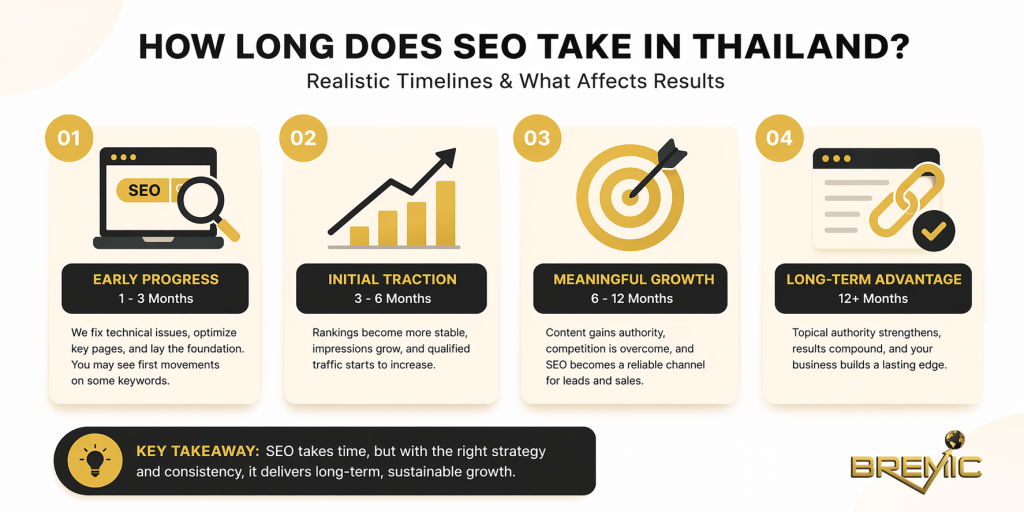
Months 1 to 3: foundation and early signals
At this stage, most businesses are fixing technical issues, improving key pages, clarifying keyword targeting, and building content structure. Some early ranking movement may appear, especially for lower-competition or long-tail queries, but major business outcomes are still limited.
Months 3 to 6: initial traction
This is often when a well-executed campaign starts to show clearer gains. Pages become more stable in search results, impressions grow, and some target terms begin to move into stronger positions. Local SEO campaigns may show earlier lead improvements if the business has a clear geographic focus.
Months 6 to 12: meaningful growth
This is where mature SEO work starts to compound. Content clusters strengthen topical authority, internal linking becomes more effective, and trust signals accumulate. For many businesses in Thailand, this is the period when SEO starts becoming a dependable acquisition channel rather than an experiment.
Beyond 12 months: competitive advantage
In harder industries, long-term consistency is what separates average performance from strong organic visibility. SEO becomes more defensible when the site has depth, authority, and a clear structural advantage over weaker competitors.
Common Mistakes That Slow SEO Down
Many businesses delay results not because SEO is inherently slow, but because the execution is weak.
One common mistake is expecting rankings from isolated blog posts without improving service pages, internal linking, or site structure. Another is targeting high-volume keywords before the site has enough authority to compete.
A few other problems show up frequently:
- publishing content that does not match search intent
- translating pages directly without adapting them for Thai search behavior
- ignoring technical issues while focusing only on content volume
- measuring success too early and changing direction every month
- treating SEO as a one-time project rather than an ongoing system
These mistakes matter because SEO is cumulative. Poor decisions at the structural level can delay progress for months.
Practical Guidance for Businesses in Thailand
A better approach is to treat SEO as a strategic build rather than a quick campaign.
Start with the pages that matter most commercially. Make sure the site is technically sound, then align service pages and supporting content with real search demand. Build topical depth around the business’s core themes instead of chasing unrelated traffic.
For most businesses, the right sequence looks like this:
- fix technical and indexing issues
- improve core commercial pages
- create supporting content around clear search intent
- strengthen internal linking across the topic cluster
- build credibility through consistent quality and authority signals
This is also where expectations should stay grounded. SEO progress should be measured through multiple indicators, not just rankings for a handful of keywords. Useful signs include better indexing, growth in impressions, stronger engagement on landing pages, more qualified traffic, and improved lead quality.
Timing Expectations: What Businesses Should Really Expect
If you are asking how long does SEO take in Thailand, the most honest answer is that it depends on the competitiveness of the opportunity and the quality of the execution.
A local business with a decent website may see encouraging movement within a few months. A new site in a competitive sector may need six to twelve months before strong results appear. In tougher markets, SEO should be viewed as a long-term investment rather than a short-term fix.
What businesses should not expect is instant ranking growth from a few optimized pages or a brief burst of content. Google usually needs time to crawl updates, interpret site quality, compare competitors, and observe whether the site consistently deserves stronger visibility.
The good news is that when SEO starts working, it often becomes more efficient over time. Strong content, better structure, and topical authority do not disappear the moment ad spend stops.
Conclusion
How long does SEO take in Thailand? Usually longer than businesses hope, but often faster than they fear when the strategy is focused and the fundamentals are strong.
The realistic range for early progress is often three to six months, with more meaningful results appearing over six to twelve months or longer depending on competition, authority, and execution. That is not a weakness of SEO. It is a reflection of how search engines evaluate trust, relevance, and quality.
For businesses in Thailand, the smartest approach is to stop looking for shortcuts and start building a site that deserves to rank. That means technical discipline, content built around search intent, a clear topical structure, and patience long enough to let good work compound.