If you are working on google-business-profile-optimization-thailand, the goal is not simply to fill out a listing and hope for rankings. A Google Business Profile is one of the core assets in local search, but its performance depends on how well it aligns with search intent, business credibility, local relevance, and the wider signals coming from your website and business presence.
That matters even more in Thailand, where local search behavior can be highly specific. People search by district, neighborhood, landmark, service type, and language. A business may need to appear for both Thai-language and English-language discovery, and in some sectors the difference between visibility and invisibility comes down to profile structure, category accuracy, review quality, and website support.
This article explains what Local SEO means in the context of Thailand, why Google Business Profile optimization matters, how to apply it strategically, and what businesses often get wrong.
What Is Local SEO
Local SEO is the process of improving your visibility in searches with geographic intent. That includes Google Maps results, the local pack, location-based organic search results, and branded or non-branded searches where proximity and local relevance matter.
In practical terms, Local SEO helps Google answer four questions:
- What does this business offer?
- Where is it located or which areas does it serve?
- Is it legitimate and trustworthy?
- Is it a better result than nearby alternatives?
A Google Business Profile plays a central role in that process, but it is only one part of the local search ecosystem. Your website, reviews, citations, business data consistency, and service relevance all influence whether Google sees your business as a strong local result.
For businesses in Thailand, Local SEO often has an additional layer. Searchers may use different languages, location modifiers, and intent patterns depending on whether they are residents, expats, tourists, or B2B buyers. That makes optimization more nuanced than a generic listing setup.
Why It Matters
A well-optimized Google Business Profile can influence visibility at the exact stage where intent is strongest. Someone searching for a nearby clinic, law firm, hotel consultant, dentist, restaurant, or SEO agency is often already close to making a decision.
That affects more than map rankings. It can influence:
- discovery in Google Maps
- calls and direction requests
- website visits
- lead quality
- trust before the first contact
From a broader SEO perspective, strong local visibility also supports brand authority. If your business appears consistently in map results, branded searches, and locally relevant organic results, that reinforces credibility across the customer journey.
In Thailand, this is especially relevant in competitive urban markets such as Bangkok, Chiang Mai, Pattaya, Phuket, and regional business hubs where search competition is shaped by density, proximity, and category overlap. A weak profile can disappear behind stronger competitors even if the business itself is legitimate and established.
How Google Business Profile Optimization Works
When businesses talk about google-business-profile-optimization-thailand, they often focus too narrowly on adding photos or collecting reviews. Those things matter, but real optimization is more structural.
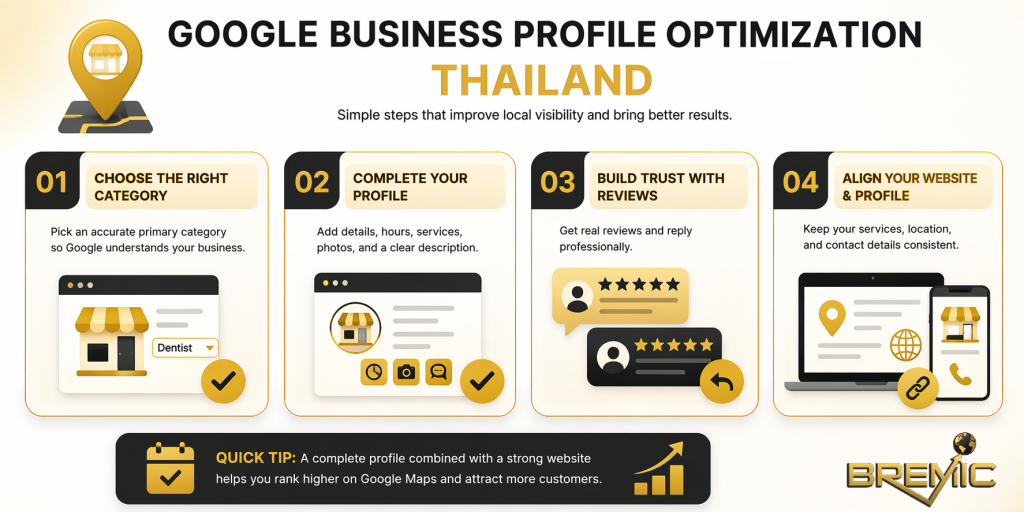
Start with category accuracy
Your primary category is one of the strongest relevance signals in the profile. It helps Google decide which searches your business should appear for.
If the category is too broad, too vague, or simply wrong, the profile will struggle to rank for the right terms. Secondary categories can help, but they should support the main business offer rather than turn the listing into a catch-all.
For example, a dental clinic, property law firm, or digital marketing agency should be categorized based on its main commercial service, not on a broader umbrella label that weakens relevance.
Build complete and trustworthy business information
A profile should be complete, accurate, and stable. That includes:
- official business name
- address or service area
- main phone number
- website URL
- hours
- services
- business description
- attributes where relevant
This is not busywork. Google uses profile completeness as part of its trust evaluation. Users do the same. Incomplete listings often underperform because they look weak to both the algorithm and the searcher.
Align the profile with the website
One of the most common Local SEO mistakes is treating the profile as separate from the site.
Your website should confirm the same signals your profile is sending. If the profile says you provide SEO services in Bangkok, but the website is vague, thin, or missing location context, Google receives a weaker relevance signal.
That does not mean you should force location keywords everywhere. It means the business offering, service focus, and local relevance should be clearly supported on the site through:
- strong service pages
- clear contact information
- location references where appropriate
- internal links to related local content
- consistent branding and business details
Strengthen review signals
Reviews are not just a reputation asset. They help Google and users understand whether a business is active, trusted, and relevant.
For Thailand-based businesses, review strategy should be handled carefully. Natural reviews in the language customers actually use are more valuable than forced volume. A profile with credible, specific reviews usually performs better than one with generic, low-quality review patterns.
Replying to reviews also matters. It shows profile activity and reinforces trust, especially in service-based industries where credibility influences conversion.
Important Subtopics in Google Business Profile Optimization Thailand
Language and search behavior
Thailand is a market where language can shape visibility. Some businesses are discovered primarily through Thai-language queries, while others attract English-language searches from expats, tourists, or international clients.
That does not mean a single profile can dominate every variation automatically. The business name, description, services, website content, and reviews all contribute to how Google interprets relevance across languages.
The right approach depends on the business model. A local Thai service provider may need stronger Thai-language support. A business targeting international customers in Bangkok or Phuket may need a cleaner English-language presence alongside accurate local signals.
Service areas versus physical locations
This is an important distinction. A storefront business and a service area business do not compete in exactly the same way.
If you operate from a physical location, your address and proximity signals are central. If you serve clients across multiple areas without a walk-in office, your visibility depends more heavily on service area setup, category precision, and website relevance.
Many businesses in Thailand assume they can rank broadly across several cities just by adding multiple service areas. That is rarely enough. Google still wants evidence that the business is genuinely relevant in those locations.
Local relevance beyond the listing
Google Business Profile optimization works best when it is part of a wider local strategy. That may include supporting content around location pages, service pages, local case studies, FAQ content, and citations.
This is where a pillar-and-cluster structure becomes useful. A broader local SEO pillar page can support cluster pages around topics such as Google Maps visibility, review management, citation consistency, service area SEO, and local landing pages. That creates a more coherent topical structure and gives the business profile stronger support from the site itself.
Common Mistakes
A lot of businesses damage their own local visibility by trying to shortcut the process.
Using the wrong business name format
Stuffing keywords into the business name might look tempting, especially if competitors are doing it. In practice, it creates compliance risk and can weaken trust if the listing no longer reflects the real-world brand.
Choosing categories based on traffic, not reality
A category should reflect what the business actually is, not what it wishes to rank for. Misaligned categories confuse Google and usually hurt long-term performance.
Ignoring NAP consistency
If your name, address, and phone number are inconsistent across your website, directories, and profile, local trust becomes weaker. This often happens after rebranding, relocation, or careless use of tracking numbers.
Publishing a thin website
A Google Business Profile cannot compensate for a weak site indefinitely. If the site does not explain services clearly or support local intent, rankings often stall.
Expecting immediate movement
Local SEO improvements can take time to settle, especially in competitive areas. Fixing a profile does not guarantee instant map visibility.
Practical Guidance
A strategic approach to google-business-profile-optimization-thailand should focus on the highest-impact work first.
Start with the fundamentals:
- confirm the correct primary and secondary categories
- complete every important profile field accurately
- make sure your website clearly supports the same services and locations
- clean up inconsistent business data across major citations
- build a steady review process based on real customer feedback
- add strong photos and service descriptions that improve clarity, not just appearance
Then move to competitive improvements. Review the businesses that already rank in your target locations. Compare their categories, review profile, website quality, service clarity, and local signals. That comparison usually reveals whether your problem is trust, relevance, or authority.
This is also the stage where internal linking becomes useful. A business working on local SEO in Thailand should connect its Google Business Profile page or service content to related articles about local rankings, map visibility, location pages, and review strategy. That strengthens topical clarity without turning the article into a broad SEO guide.
Timing and Expectations
Results from Google Business Profile optimization vary depending on the starting point.
If the profile has obvious issues such as incomplete fields, weak categories, or inconsistent data, improvements can come relatively quickly once those problems are fixed. If the issue is competitive strength, thin website support, or weak review signals, the process usually takes longer.
That is the right way to think about Local SEO: not as a single update, but as a compounding process.
A good profile helps Google trust the business. A good website helps Google understand it. Strong reviews and consistent local signals help Google justify showing it.
Conclusion
Google-business-profile-optimization-thailand is not about ticking boxes inside a listing. It is about building a local search presence that is relevant, consistent, and credible enough for Google to rank with confidence.
For businesses in Thailand, that means taking local context seriously. Language, service areas, city-level competition, category accuracy, and website support all shape performance.
The strongest results usually come from businesses that treat their Google Business Profile as part of a wider Local SEO strategy, not as a standalone shortcut. That is what creates durable visibility, better lead quality, and a stronger foundation for long-term local growth.