Local SEO rarely fails because a business has no value to offer. It usually fails because the website is targeting the wrong searches, using language customers do not use, or publishing pages without a clear local intent behind them.
That is why learning how to do keyword research for local businesses matters. Good local keyword research does not start with a keyword tool and a spreadsheet full of search terms. It starts with understanding how people actually look for nearby services, how Google interprets local intent, and which pages on your site should rank for which searches.
For local companies, the goal is not to chase traffic for its own sake. The goal is to identify the searches that lead to calls, bookings, quote requests, foot traffic, and qualified leads. That requires a more strategic approach than broad Keyword Research for national or purely informational websites.
In this guide, you will learn how to do keyword research for local businesses in a way that supports rankings, site structure, and long-term topical authority without creating thin or overlapping content.
What Is Keyword Research for Local Businesses
Keyword research for local businesses is the process of identifying the search terms people use when looking for products or services in a specific geographic area.
In practical terms, that means finding keywords that combine three things:
- The service or product
- The location
- The search intent behind the query
For example, a general keyword like “roof repair” is too broad on its own. A local business may need to target variations such as “roof repair in Austin,” “emergency roofer near me,” or “flat roof repair South Austin,” depending on how customers search and how the business operates.
Local Keyword Research is not only about obvious city-based phrases. It also includes:
- service keywords with local modifiers
- “near me” searches
- neighborhood and district terms
- problem-based queries with local intent
- branded and competitor-related searches
- supporting informational searches that build authority around local services
The real job is to map those keyword types to the right pages, rather than dumping them all into one generic service page.
Why It Matters
Local keyword research shapes the foundation of your SEO strategy. If the targeting is wrong, everything built on top of it becomes less effective.
It improves ranking relevance
Google wants to match local searches with the most relevant local result. That means your pages need to reflect the way users phrase their searches, the services you actually provide, and the locations you serve. Strong keyword targeting helps search engines understand that alignment.
It supports better conversions
A local business does not need thousands of irrelevant visits. It needs the right visitors. Someone searching “commercial pest control in Phoenix” is much closer to action than someone reading a broad article about insect prevention. Local keyword research helps separate informational visibility from commercial opportunity.
It prevents weak site architecture
Many local websites either target everything on the homepage or create dozens of near-duplicate city pages with little value. Proper Keyword Research helps define which topics deserve service pages, which deserve location pages, and which should be covered in supporting content.
It strengthens topical authority
A business that consistently publishes well-structured content around its services, locations, and related customer questions builds a stronger topical footprint. Over time, that improves internal linking opportunities, contextual relevance, and trust signals across the site.
How It Works
The best way to approach how to do keyword research for local businesses is to break it into stages.
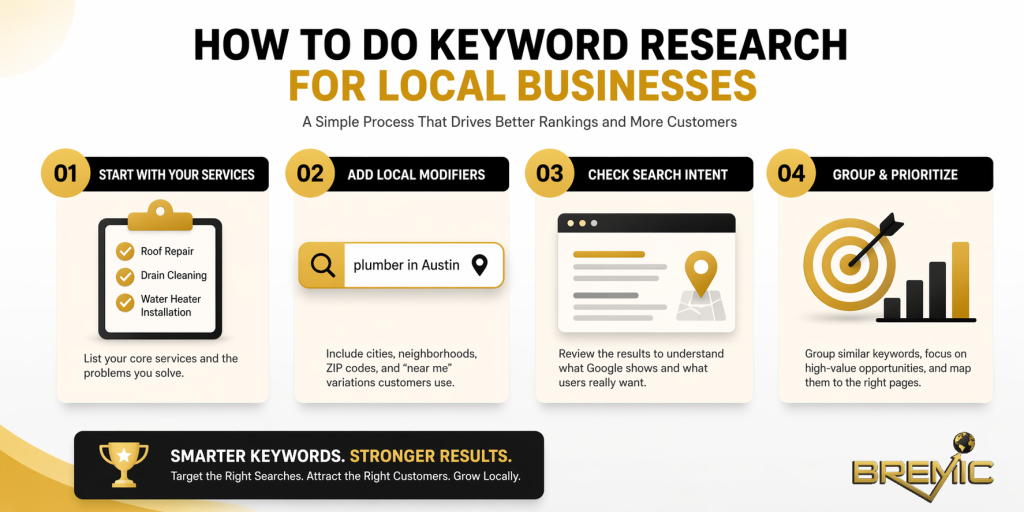
Start With Services, Not Keywords
Before opening any SEO tool, list the actual services the business wants to rank for.
That sounds basic, but it is where many campaigns go wrong. Businesses often target internal terminology, overly broad categories, or pages based on how they describe themselves rather than how customers search.
A better starting point is a service inventory. Ask:
- What do customers buy?
- What problems are they trying to solve?
- Which services drive the most revenue?
- Which services have distinct search intent and deserve separate pages?
A plumbing company, for example, may offer many related services, but search behavior for “drain cleaning,” “water heater repair,” and “emergency plumber” is different enough to justify separate targeting.
Add Local Modifiers
Once you have core service terms, expand them with geographic qualifiers.
These may include:
- city names
- suburbs
- neighborhoods
- ZIP code areas
- “near me” variants
- regional language customers actually use
This is where local context matters. A business may technically serve an entire metro area, but actual search demand may cluster around a few high-intent locations. Keyword research should reflect that reality rather than forcing pages for every town on a map.
Study Search Intent Carefully
Local keywords are not all transactional. Some are informational, some are commercial, and some are navigational.
A few examples:
- “dentist in Brooklyn” usually signals local commercial intent
- “best dentist in Brooklyn for implants” blends local and comparison intent
- “how much does Invisalign cost in Brooklyn” is informational but commercially valuable
- “emergency dentist open now near me” shows urgent conversion intent
This matters because one page cannot effectively satisfy every kind of intent. If you try to rank a service page for a pricing question, a “best of” query, and a general how-to search all at once, the page will usually underperform.
Use SEO Tools for Expansion, Not for Strategy
Keyword tools are useful, but they should support judgment rather than replace it.
Use them to find:
- related service variations
- local modifiers
- question-based searches
- long-tail opportunities
- SERP patterns
- parent topics and close variants
But do not make decisions based only on search volume. Local keywords often have low reported volume, incomplete data, or misleading estimates. A query with modest volume can still be highly valuable if it attracts qualified local leads.
For local businesses, relevance and intent usually matter more than raw volume.
Important Subtopics to Cover
Separate Service Pages From Location Pages
One of the most important parts of how to do keyword research for local businesses is understanding the difference between service targeting and location targeting.
A service page targets what the business does.
A location page targets where the business offers that service.
Those are related but not interchangeable.
For example:
- a “kitchen remodeling” page should explain the service in depth
- a “kitchen remodeling in Denver” page should localize that offer meaningfully if there is enough demand and the business genuinely serves that area
If every location page says the same thing with a swapped city name, it will not add much value. Keyword research should help you identify where unique local pages are justified.
Look for local packs and SERP features
Search the terms manually and examine the results. If Google shows a local pack, map results, service-area businesses, or heavily localized pages, that is a strong signal of local intent.
If the results are mostly national guides or informational blog posts, the keyword may not belong on a core service or location page.
SERP review is one of the most reliable ways to validate local keyword intent.
Include Supporting Informational Topics
Local SEO is not only about service and city pages. Supporting content helps build relevance around the core topics your business wants to own.
Examples include:
- pricing questions
- timeline expectations
- service comparisons
- maintenance and care topics
- local compliance or permitting issues
- problem-identification queries
This type of content supports the cluster model well. It gives you room to target informational searches while internally linking back to the service and location pages that drive conversions.
Prioritize by Business Value
Not every keyword deserves equal attention.
A practical prioritization model should consider:
- commercial value
- search intent
- competitiveness
- service profitability
- geographic importance
- fit within your site architecture
That means a lower-volume keyword tied to a high-margin service may deserve attention before a broader term with more traffic but weaker conversion potential.
Common Mistakes
Targeting only high-volume keywords
Many local businesses ignore the terms that actually convert because they look too small in keyword tools. Local SEO often wins through specificity, not scale.
Creating pages for every keyword variation
Not every variation needs its own page. Some keywords are close enough in meaning and intent to be covered together. Creating separate pages for each slight variation leads to cannibalization and thin content.
Ignoring real-world language
Customers often search differently from the way businesses describe their services. A company may talk about “exterior surface restoration,” while customers search “brick cleaning service.” Good Keyword Research bridges that gap.
Overbuilding location pages
Local businesses often create dozens of city pages without unique content, proof, or strategic justification. That usually weakens the site instead of strengthening it.
Skipping intent validation
A keyword can look relevant on paper but return a completely different type of result in Google. If you do not inspect the SERP, you can build the wrong page for the query.
Practical Guidance for Doing It Well
A strong local keyword research process usually looks like this:
1. Build a service-based keyword seed list
Start with real services, categories, and customer problems.
2. Expand with local modifiers and related phrases
Add cities, neighborhoods, and natural local variations.
3. Review the SERPs manually
Check what kind of pages rank, whether Google shows local intent, and how competitive the result set looks.
4. Group keywords by intent
Cluster terms that belong on the same page and separate terms that need distinct assets.
5. Map keywords to page types
Decide whether each topic belongs on a homepage, service page, location page, or supporting article.
6. Prioritize based on business impact
Focus first on the keywords most likely to generate leads and strengthen the site’s core topical areas.
That process keeps keyword research connected to site architecture, content planning, and conversion goals. That is what makes it useful.
Timing and Expectations
Keyword research itself can be done relatively quickly, but the business impact takes longer because the research only creates the strategy. Results depend on what you build from it.
If a local site already has decent authority and a clear structure, improved targeting can influence performance within a few weeks to a few months. For newer or weaker sites, the timeline is longer because keyword strategy needs support from content quality, internal linking, Google Business Profile signals, local citations, and link acquisition.
It is also worth being realistic about competition. Ranking for a city-wide legal or medical term is very different from ranking for a niche home service in a smaller market. Good keyword research improves your odds, but it does not remove the need for better pages and stronger SEO execution.
Conclusion
Understanding how to do keyword research for local businesses is not about finding the biggest list of phrases with a place name attached. It is about identifying the searches that reflect real local demand, matching them to the right page types, and building a site structure that supports both rankings and conversions.
Done properly, local Keyword Research helps a business publish more focused pages, avoid keyword overlap, and create a stronger topical cluster around its most valuable services. That is what turns SEO from scattered content production into a deliberate growth strategy.
For local businesses, the smartest keyword strategy is usually not broader. It is sharper, more intentional, and more closely aligned with how customers search when they are ready to act.