A lot of websites publish steadily and still struggle to build meaningful organic visibility. The issue is rarely a lack of effort. More often, the problem is structural. Articles are created one by one, without a clear relationship between them, which makes it harder for search engines to understand topical depth and harder for users to move through the site in a logical way.
That is why pillar pages and cluster content matter. They give your content marketing strategy a structure that supports rankings, internal linking, topical authority, and user experience at the same time.
This model is often discussed in simple terms, but applying it well requires more than grouping a few blog posts around a broad topic. A strong cluster is built around search intent, clear page roles, and deliberate internal linking. When done properly, it helps search engines interpret your expertise and helps readers find the next answer they need without friction.
This article explains pillar pages and cluster content in practical terms, why the model matters for SEO, how it works, where businesses get it wrong, and how to approach it realistically.
What Is Content Marketing?
Content marketing is the process of creating and publishing useful content to attract, educate, and convert a defined audience over time. In practice, that content may include blog articles, landing pages, guides, case studies, product education, and comparison pages.
From an SEO perspective, content marketing is not just about publishing more. It is about publishing the right content in the right structure so that each page serves a purpose and contributes to broader site performance.
Pillar pages and cluster content are part of that structure.
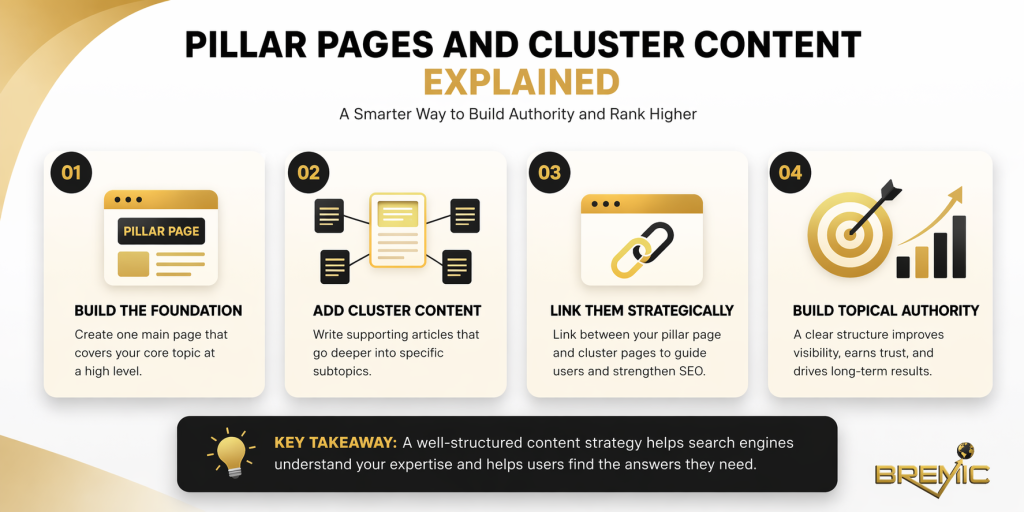
A pillar page is a broad, authoritative page built around a core topic. It covers the main subject at a high level and acts as the central hub in a topic area.
Cluster content consists of supporting articles that explore subtopics related to that main theme in greater depth. These pages answer narrower questions, target more specific keywords, and link back to the pillar page where relevant.
For example, a pillar page about content marketing could be supported by cluster articles on editorial planning, content briefs, internal linking, topic research, content audits, and measurement. Each supporting article goes deep on one issue while reinforcing the authority of the main hub.
Why It Matters
Search engines do not evaluate pages in isolation as neatly as many site owners assume. They look for signals of relevance, consistency, depth, and contextual relationships across a site.
A pillar-and-cluster model helps with that in several ways.
First, it improves topical clarity. When your pages are connected around a well-defined subject area, it becomes easier for search engines to understand what your site covers and which pages are most important within that theme.
Second, it strengthens internal linking. Instead of adding random links between loosely related posts, you create a deliberate structure where broad pages support discovery and deeper pages support specificity. This improves crawl paths and distributes internal authority more intelligently.
Third, it aligns with real search behavior. Users rarely move from complete beginner to decision-ready in one page visit. They start broad, narrow their focus, compare options, and look for deeper explanations. Cluster content supports that journey.
Fourth, it supports long-term authority. One article may rank for a useful keyword, but a coherent cluster gives you a better chance of owning a topic area rather than winning a single query.
For businesses investing in SEO seriously, that difference matters. You are not just trying to rank pages. You are trying to become a credible source within a defined subject.
How Pillar Pages and Cluster Content Work
At a strategic level, the model is simple: one core topic, one central page, multiple supporting pages, and a clear internal linking relationship between them.
The complexity comes from choosing the right topic scope and assigning the right role to each page.
The Role of the Pillar Page
A pillar page should target a broad topic with meaningful search demand and clear business relevance. It should be comprehensive enough to establish authority, but not so broad that it becomes unfocused.
Its role is not to answer every possible question in exhaustive detail. That is where many teams go wrong. A pillar page should give readers a strong overview, define the landscape, explain the main concepts, and guide them to more detailed supporting content where appropriate.
Think of it as the strategic hub, not the only destination.
The Role of Cluster Content
Cluster pages target narrower intents within the same topic family. These pages usually focus on one question, one subtopic, or one stage of the user journey.
That narrower focus is what makes them valuable. Instead of forcing depth into a broad page, cluster content gives each subtopic room to perform on its own terms.
For example, if your pillar page covers content marketing strategy, cluster pages might address:
- how to build a content calendar
- how to structure internal links
- how to identify search intent
- how to measure content performance
- how to audit underperforming articles
Each of those topics deserves a distinct page because the intent is more specific than the parent topic.
The Internal Linking Logic
The linking model is what turns a group of articles into a real cluster.
The pillar page should link naturally to its most important supporting pages. Cluster pages should usually link back to the pillar when the broader topic is relevant. Related cluster pages can also link to one another where there is a genuine contextual connection.
This creates a content architecture that is useful for readers and understandable for search engines.
The key point is that internal links should reflect topic relationships, not just keyword opportunities. If the connection feels forced to a reader, it is usually weak from an SEO perspective as well.
Important Subtopics That Make the Model Work
Search Intent Mapping
A cluster only works when each page has a clear job.
If two pages target the same intent, they may compete with each other. If one page tries to serve informational, commercial, and transactional intent all at once, it often becomes weaker for all three.
Before building a pillar and its supporting content, map the intent behind each keyword group. Decide which page should be the broad hub, which pages should educate, which should compare, and which should support decision-making.
This is where a lot of content marketing strategies become more disciplined and more effective.
Topic Scope and Boundaries
Not every broad keyword deserves a pillar page. Some topics are too narrow and are better handled as standard articles. Others are so broad that a single pillar becomes vague and unmanageable.
A useful test is this: can the main topic naturally support several distinct, high-value subtopics without heavy overlap? If yes, it may be a strong pillar candidate.
You also need boundaries. A content cluster should be tightly related, not just loosely adjacent. Relevance matters more than volume.
Content Depth and Differentiation
Cluster content should not repeat what is already lightly covered on the pillar page. It should expand the topic with real depth.
That means using examples, explaining trade-offs, clarifying when a tactic works and when it does not, and addressing the practical decisions readers actually face. Thin summaries do not build authority. Depth does.
A useful cluster feels like a network of complementary pages, not a series of rewritten introductions.
Common Mistakes
One of the most common mistakes is treating the pillar page as a giant article that tries to rank for every related keyword. This often creates bloated content that is difficult to navigate and weak in intent focus.
Another mistake is publishing cluster pages without a real internal linking plan. If the pages exist but do not reinforce one another clearly, much of the structural value is lost.
A third mistake is choosing topics based only on keyword volume. High-volume topics can look attractive, but if they are too broad, too competitive, or not closely tied to the business, they may not support meaningful results.
There is also a tendency to overproduce. Some sites build dozens of cluster pages before the core structure is sound. In most cases, a smaller, well-planned cluster performs better than a large, loosely organized content library.
Finally, many teams ignore maintenance. Clusters are not static. As search intent shifts, products evolve, and new supporting questions emerge, the structure needs to be reviewed and updated.
Practical Guidance for Building It Correctly
Start with a core topic that matters to your audience and your business. It should be broad enough to justify a hub page, but specific enough that you can own it credibly.
From there, identify the subtopics that deserve standalone pages. Look for clear differences in intent, not just slight keyword variations.
Build the pillar page as the strategic overview. Make it comprehensive, easy to scan, and useful on its own. Then create cluster pages that go deeper into the most important subtopics.
As you publish, link intentionally. The pillar should guide readers into relevant supporting articles. Cluster pages should connect back to the broader topic where useful and across the cluster where the relationship is meaningful.
It is also worth defining page roles before writing. On a mature site, not every page should try to be the main authority page. Some should be hubs. Some should be explainers. Some should be deeper tactical resources. That clarity improves both writing quality and site architecture.
If your site already has content, do not assume you need to start from scratch. Often the better move is to audit what exists, identify overlapping pages, upgrade the strongest assets, and restructure internal links around a clearer cluster model.
Timing and Expectations
Pillar pages and cluster content are long-term SEO assets, not quick wins.
In some cases, improvements in crawl efficiency, internal link flow, and topical clarity can help performance within a few months. But building real authority usually takes sustained publishing, consistent quality, and time for search engines to reassess how your site fits within a topic area.
That is especially true in competitive industries.
The goal is not immediate domination of a broad keyword. The goal is to create a structure that compounds over time. As more high-quality supporting content is added and better internal relationships are established, the topic area becomes more credible and more resilient.
A realistic approach is to treat cluster development as an ongoing editorial process rather than a one-off campaign.
Conclusion
Pillar pages and cluster content are not just a publishing format. They are a way of turning scattered content into a coherent SEO system.
When the model is applied well, it improves topical focus, strengthens internal linking, supports search intent more precisely, and makes your content marketing efforts more strategically useful. It also helps your site demonstrate the kind of depth and organization that supports E-E-A-T over time.
The most effective sites do not publish randomly and hope search engines connect the dots. They build content architecture intentionally.
That is the real value of pillar pages and cluster content explained properly: not as a trend, but as a practical framework for building authority in a way that is structured, scalable, and credible.