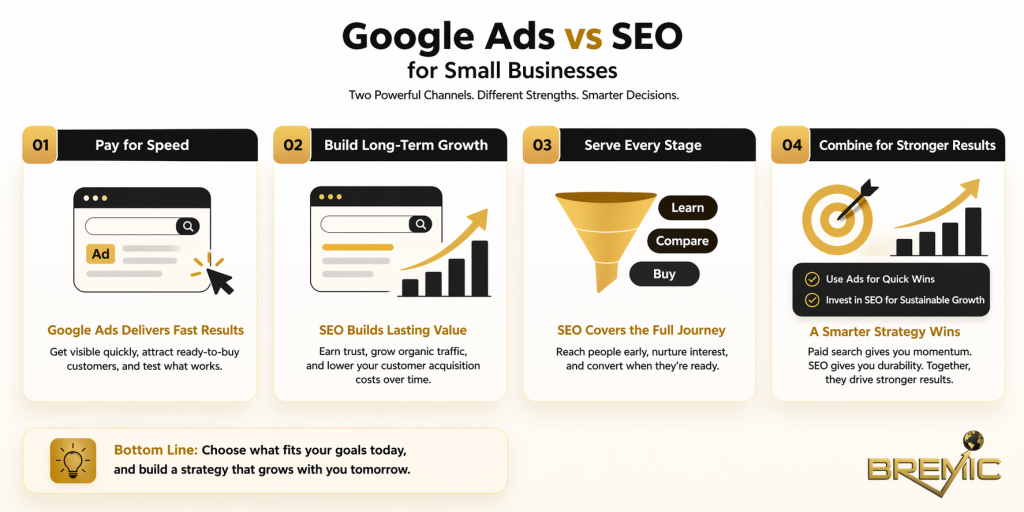
For most small businesses, marketing decisions are rarely about choosing the “best” channel in theory. They are about choosing the right channel for cash flow, sales goals, internal capacity, and how quickly results are needed. That is why the question of google-ads-vs-seo-for-small-businesses matters so much.
Both Google Ads and SEO can drive qualified traffic from people actively searching for a solution. Both can support lead generation and revenue. But they work very differently, and the wrong choice often leads to wasted budget, weak expectations, or a strategy that breaks as soon as the spending stops.
This article explains how each channel works, where each one fits, and how small businesses should think about the trade-offs. The goal is not to push one side. It is to help you make a practical, defensible decision based on business reality.
What Is Search Engine Marketing (SEM)?
Search Engine Marketing (SEM) is the broader practice of gaining visibility in search engines through paid and unpaid strategies. In day-to-day marketing conversations, SEM is often used to refer specifically to paid search advertising, such as Google Ads. In a broader strategic sense, though, search visibility usually involves both paid search and organic search.
For a small business, that distinction matters.
When someone searches for a service, product, or solution, your business can appear in two main ways:
- through paid placements, typically via Google Ads
- through organic rankings, typically through SEO
Google Ads lets you pay for immediate visibility on selected searches. SEO helps your website earn visibility over time by building relevant, useful, and technically sound pages that search engines trust.
Both are search-driven channels. The key difference is how you acquire visibility and what happens after you stop investing.
Why Google Ads vs SEO for Small Businesses Matters
Small businesses usually operate under tighter constraints than larger companies. Budget is limited. Team capacity is limited. Mistakes are harder to absorb. That makes channel selection more strategic.
The reason google-ads-vs-seo-for-small-businesses is such an important comparison is simple: these channels affect growth in very different ways.
Google Ads is often better for:
- immediate lead generation
- testing offers, landing pages, and keywords
- targeting high-intent transactional searches quickly
SEO is often better for:
- reducing long-term customer acquisition costs
- building topical authority and trust
- generating compounding traffic over time
- supporting the entire buying journey, not just bottom-of-funnel searches
For rankings, traffic, authority, and conversions, the choice is not just about visibility. It is about the economics behind that visibility. Paid traffic can scale fast, but every click has a cost. Organic traffic takes time, but strong pages can continue generating visits and leads without paying for each individual click.
That is why small businesses should not ask, “Which one is better?” The better question is, “Which one fits our current stage, goals, and constraints?”
How Google Ads Works in Practice
Google Ads allows a business to bid on search terms and appear in sponsored results. If your campaign structure, targeting, ad copy, and landing pages are solid, you can start generating traffic very quickly.
In practical terms, the process usually looks like this:
Keyword targeting and intent selection
You choose the searches you want to appear for. This is where intent matters most. A search like “emergency plumber near me” is very different from “how to fix a leaking pipe.” One signals immediate commercial intent. The other suggests research.
Google Ads tends to perform best when the search clearly indicates a readiness to act.
Ad creation and click acquisition
You write ads designed to match the search intent. Your goal is not just to attract clicks, but to attract the right clicks. Poor targeting or vague messaging can spend budget fast without producing real opportunities.
Landing page and conversion performance
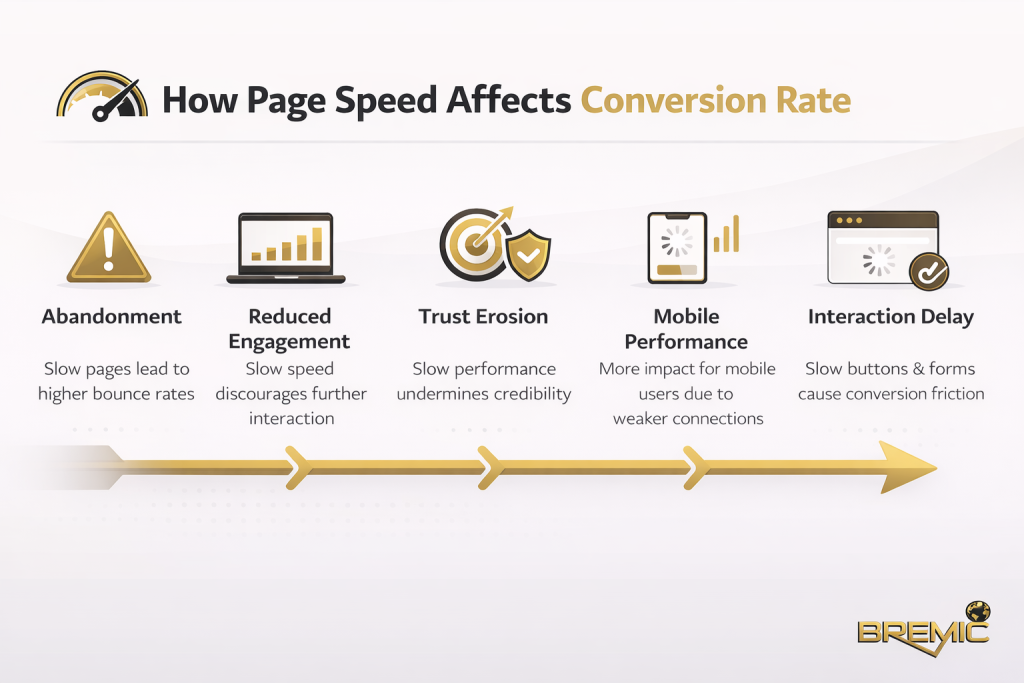
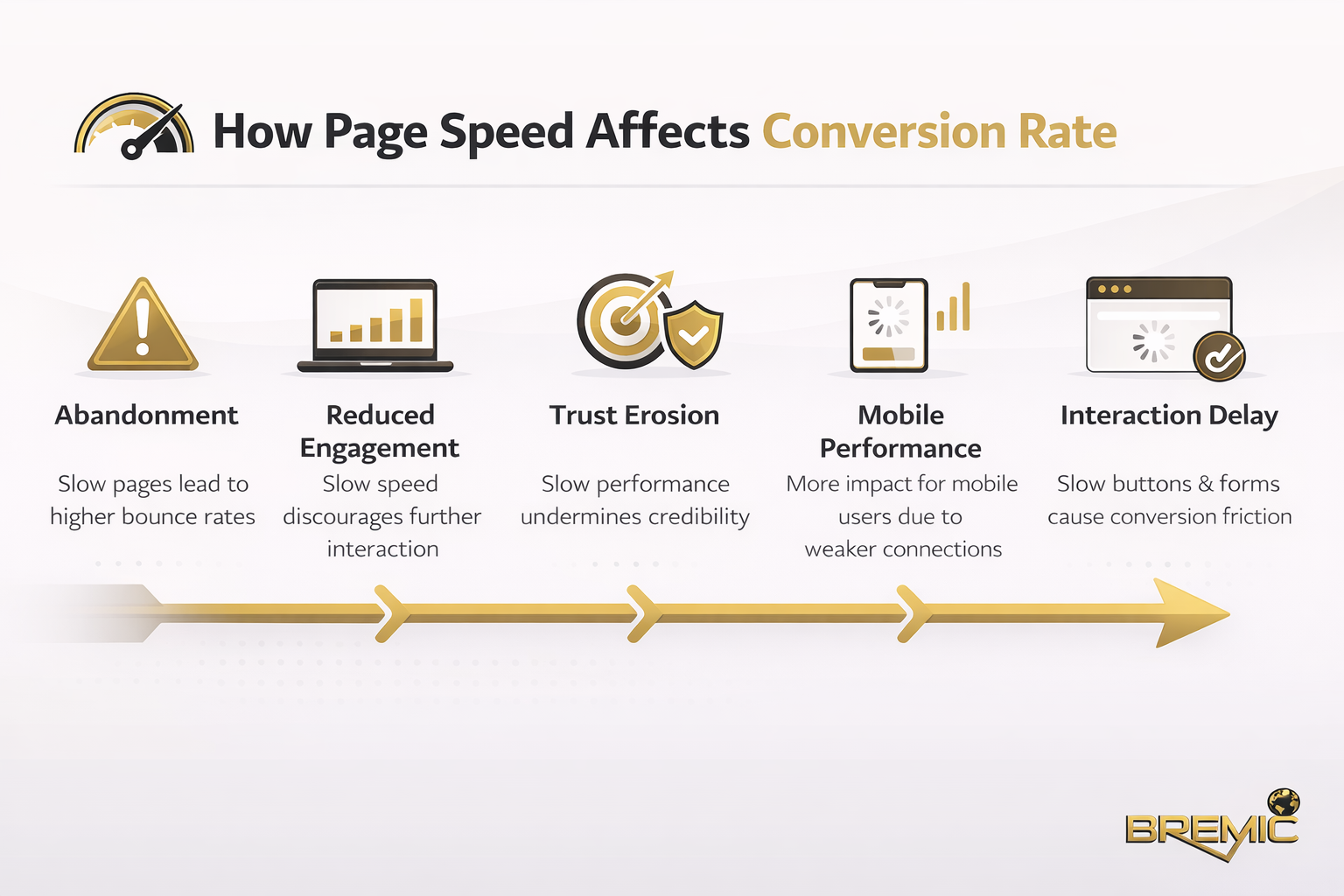
The ad is only one part of the system. The landing page has to do the real work. If the page is slow, generic, confusing, or misaligned with the query, your costs rise and your conversion rate suffers.
This is one reason small businesses often underestimate paid search. They think they are buying traffic. In reality, they are funding a full conversion system.
How SEO Works in Practice
SEO is the process of improving your website so it earns relevant organic visibility. That includes content quality, internal linking, topical coverage, technical performance, page experience, and search intent alignment.
Unlike Google Ads, SEO is not a switch you turn on. It is an asset-building process.
Content and search intent alignment
Strong SEO starts with understanding what the searcher actually wants. Some searches need a service page. Others need a comparison article, a local page, or an educational guide.
For example, a small business comparing channels may search for information before making a budget decision. A page targeting google-ads-vs-seo-for-small-businesses should therefore explain trade-offs, timelines, and decision criteria clearly rather than pushing an aggressive sales pitch.
Authority through topical depth
One strong page is rarely enough in competitive spaces. Search engines increasingly reward sites that show depth and coherence. That is where topical clusters matter.
A pillar page might cover broader digital marketing strategy, while supporting cluster articles cover narrower topics such as local SEO, PPC budgeting, landing page optimization, keyword research, and conversion tracking. Internal linking helps search engines understand the relationship between those pages and strengthens topical signals across the site.
Technical and structural support
Content alone is not enough. SEO performance also depends on crawlability, internal architecture, indexation, page speed, mobile usability, and clear site structure. If the website is technically weak, even good content may underperform.
For small businesses, SEO works best when content, site structure, and user experience are treated as one system.
Important Subtopics Small Businesses Need to Understand
Cost structure is different, not just the timing
A common mistake is assuming Google Ads is expensive and SEO is free. That comparison is too simplistic.
Google Ads has direct media cost. You pay for traffic now.
SEO does not charge you per click, but it still requires investment in strategy, content, technical work, and ongoing optimization. The difference is that SEO creates an owned asset. A well-ranking page can continue driving traffic long after publication.
Small businesses should compare not only monthly spend, but also the durability of the result.
Intent coverage is not the same
Google Ads is usually strongest at the bottom of the funnel, where purchase intent is clear. SEO can serve the full funnel more effectively, from early research to final decision.
That makes SEO particularly valuable for businesses with longer sales cycles, trust-sensitive services, or customers who compare options before buying.
Trust and click behavior matter
Some users click ads readily. Others skip sponsored placements and go straight to organic results because they trust them more. This varies by industry, search type, and customer behavior.
For small businesses in professional services, local services, or B2B niches, organic visibility often supports credibility in a way paid traffic alone does not.
Common Mistakes
Many businesses make the wrong decision not because the channel is wrong, but because the expectations are wrong.
Expecting SEO to work like paid media
SEO is not immediate. Publishing a page does not guarantee rankings next week. Results depend on competition, domain strength, content quality, internal linking, and technical condition.
Running Google Ads without a real conversion system
Sending paid traffic to a weak page is one of the fastest ways to waste money. Ads can create visibility, but they cannot fix a poor offer, bad user experience, or unclear messaging.
Choosing one channel for ideological reasons
Some businesses dismiss Google Ads because they dislike paying for clicks. Others ignore SEO because it feels slow. Both are bad reasons. Channel choice should be based on economics, intent, and growth stage.
Treating SEO as blog publishing alone
SEO is not just writing articles. It is strategy, architecture, intent mapping, internal linking, and ongoing improvement. Content without structure usually produces shallow results.
Practical Guidance: How to Decide Correctly
For most small businesses, the best answer is not absolute. It depends on what problem you are trying to solve.
Choose Google Ads first when:
- you need leads quickly
- you have a validated offer and a good landing page
- you are targeting clear commercial-intent searches
- you can afford testing and optimization
Choose SEO first when:
- you want to build sustainable visibility over time
- your audience researches before buying
- you are willing to invest in content and site quality
- you want traffic that compounds rather than resets each month
In many cases, the strongest approach is a phased combination.
Use Google Ads to generate immediate demand and test conversion assumptions. Use SEO to build long-term authority, lower dependency on paid acquisition, and create durable search visibility. Insights from paid search can inform SEO priorities, especially around keyword intent and landing page messaging. Likewise, strong SEO content can improve paid performance by giving you better destinations for traffic.
For a small business with limited resources, sequencing often matters more than choosing sides.
Timing and Expectations
Google Ads can start producing data and traffic almost immediately after launch, assuming the account setup is sound and the budget is sufficient. That does not mean profitability is immediate. Campaigns often need refinement before they become efficient.
SEO usually takes longer. In lower-competition niches, signs of progress may appear within a few months. In more competitive markets, meaningful gains can take much longer. The exact timeline depends on your domain, content quality, competition, internal linking, and technical condition.
The realistic expectation is this:
Google Ads is faster to launch, faster to test, and faster to fail if managed poorly.
SEO is slower to mature, but stronger at creating cumulative value when executed well.
That is the real strategic difference.
Conclusion
The debate around google-ads-vs-seo-for-small-businesses should not be framed as a winner-takes-all choice. These channels solve different problems.
Google Ads is useful when speed, testing, and immediate visibility matter most. SEO is valuable when the goal is durable traffic, topical authority, and lower long-term dependence on paid acquisition. For many small businesses, the smartest decision is to match the channel to the business stage, then build toward an integrated search strategy over time.
If you need results now, paid search may be the right starting point. If you want search visibility that keeps working after the monthly budget is spent, SEO deserves serious investment. The strongest businesses usually learn how to use both, but in the right order, for the right reasons.