Search teams often treat social media and SEO as separate channels. In practice, they influence many of the same outcomes: visibility, brand recognition, content discovery, link earning, and trust. That is why understanding how social media supports SEO matters for any business that wants sustainable organic growth.
Social media does not replace technical SEO, content quality, or strong site architecture. It also does not guarantee rankings just because a post performs well on LinkedIn, X, Instagram, or YouTube. But it can strengthen the conditions that help SEO perform better over time.
For marketers and business owners, the opportunity is not to chase vanity metrics. It is to use social platforms strategically to amplify content, increase branded demand, improve discoverability, and support the authority signals that search engines value. This article explains where social media fits into that process, what it can realistically do, and how to apply it without turning your SEO strategy into a social content treadmill.
What Is Social Media Marketing & Optimization
Social Media Marketing & Optimization is the practice of creating, publishing, refining, and distributing content on social platforms in a way that supports broader business goals. Those goals may include brand awareness, audience growth, lead generation, thought leadership, and content reach.
From an SEO perspective, social media marketing and optimization is not just about posting frequently. It is about making sure your social activity helps people discover your expertise and your website content.
In practical terms, that includes:
- publishing content that reflects the topics you want to be known for
- sharing site content in formats that fit each platform
- optimizing profiles, messaging, and creative for relevance and clarity
- increasing the likelihood that your content is seen, discussed, referenced, and linked to
This is where many teams get the concept wrong. Social media is not an isolated promotional channel. Used well, it becomes a distribution layer for your content strategy and a reinforcement mechanism for your topical authority.
Why It Matters for SEO
The relationship between social media and search rankings is often misunderstood. Social signals such as likes, shares, and follower counts are not a simple ranking shortcut. Strong social performance does not automatically move a page to page one.
What social media does well is influence the inputs and outcomes that support SEO.
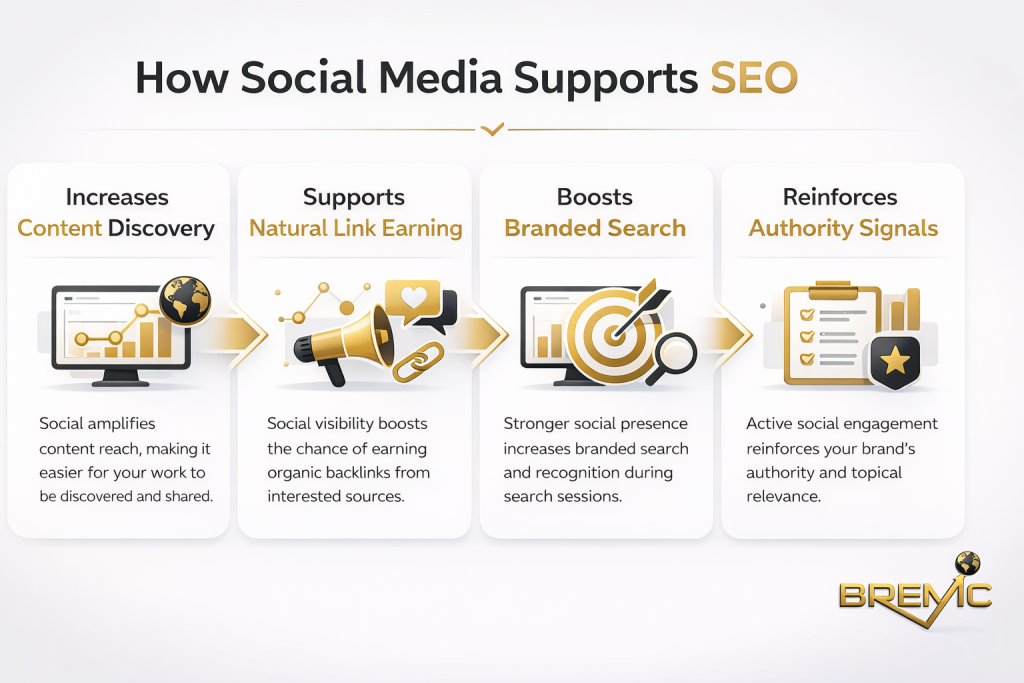
It increases content discovery
Even strong content can underperform if nobody sees it early. Social media helps new articles, research pieces, guides, and opinion content reach an audience faster. That increases the chance of your content being noticed by journalists, bloggers, newsletter writers, podcasters, and industry peers who may later reference it.
Discovery matters because search visibility often improves when content earns attention beyond your site.
It supports link earning indirectly
Social posts do not function like backlinks, but they can help the right people find content worth citing. This is especially true for original insights, useful frameworks, case studies, opinion-led articles, and practical resources.
If your content is repeatedly surfaced to relevant audiences, you improve the odds of earning editorial links naturally. That is one of the clearest ways social media supports SEO in a measurable, non-theoretical sense.
It strengthens branded search and familiarity
When people see your brand repeatedly on social platforms, they are more likely to remember it, search for it directly, and trust it when they encounter it in search results.
That matters because search is not only about rankings. It is also about click behavior and perceived credibility. A familiar brand often earns more clicks than an unknown one, even when both appear for the same query.
It reinforces authority signals
Search engines aim to surface credible sources. While they do not evaluate authority in the same way a human does, the broader web ecosystem still matters. A business that publishes informed content, builds a visible expert presence, and participates consistently in its market tends to create stronger trust signals overall.
Social media can help expose your expertise publicly. That supports brand authority, which in turn makes your content more likely to be cited, shared, and revisited.
How Social Media Supports SEO in Practice
The real value comes from how social activity fits into your content and search strategy.
Social amplifies content distribution
Publishing an article is only the first step. If you want content to contribute to SEO, it needs visibility. Social media gives you a way to distribute the same core topic in multiple formats: short insights, carousels, video clips, quote posts, or commentary threads.
This is useful for cluster content in particular. If your site uses a pillar-and-cluster model, social can help reinforce topic associations by repeatedly discussing related subtopics. Over time, that creates a clearer external footprint around your expertise.
Social creates feedback that improves content
Comments, saves, questions, and objections on social platforms are useful research inputs. They show how real audiences interpret a topic, where confusion exists, and what angles resonate.
That feedback can improve your SEO content in several ways:
- clarifying search intent
- identifying missing subtopics
- refining headings and framing
- uncovering objections worth addressing
- highlighting language your audience actually uses
This is one of the most practical overlaps between Social Media Marketing & Optimization and SEO. Social gives you live audience signals; SEO turns those signals into stronger, more relevant pages.
Social helps build entity and brand recognition
As search evolves, brand recognition matters more. Businesses that are consistently associated with a topic are better positioned to earn attention across channels.
If your company regularly publishes useful commentary on a focused set of themes, social media can help reinforce those associations. That does not replace topical depth on your site, but it complements it. A clear public presence makes your content ecosystem more coherent.
Social supports repurposing and content efficiency
A strong SEO program should not rely on creating every asset from scratch. One in-depth article can support multiple social posts, and social responses can feed future article updates.
This improves content efficiency while keeping your messaging aligned. It also helps ensure that your site content is not built in isolation from audience behavior.
Important Subtopics to Get Right
Platform selection matters more than volume
You do not need to be active everywhere. The best platform is the one where your audience pays attention and where your content format fits naturally.
For B2B SEO, LinkedIn may outperform Instagram. For visual brands, YouTube or Pinterest may contribute more to discovery. For news-driven niches, X may still play a role. Strategic fit matters more than channel count.
Content format affects reach and usefulness
A blog post link with no context rarely performs well. Social content needs to be adapted to the platform. That might mean turning a blog article into a concise insight, a short video explanation, or a carousel built around a key framework.
Better social formatting leads to better reach. Better reach improves the chance of discovery. That is the bridge back to SEO.
Consistency matters more than short bursts
Many businesses post heavily for two weeks, then disappear for a month. That weakens the compounding effect. Social media supports SEO best when it is consistent enough to reinforce topic relevance and keep your best content circulating over time.
Consistency does not mean posting constantly. It means having a repeatable publishing system that supports your core content themes.
Common Mistakes
One of the biggest mistakes is assuming social media directly boosts rankings in a simple, trackable way. That leads teams to measure the wrong things and become disappointed when a viral post does not move a target keyword.
Another common problem is treating every post as promotion. If all your social activity does is push links, your reach and engagement will usually decline. Social works better when it adds perspective, context, or value on its own.
Teams also often spread themselves too thin. Publishing weak content across six platforms is less effective than building a credible presence on one or two.
Finally, many brands fail to connect social output to their site architecture. If your website is built around pillar pages and cluster articles, your social content should reflect those same topic clusters. Otherwise, you lose strategic alignment.
Practical Guidance
A realistic approach starts with your existing SEO priorities.
First, identify the topics your site wants to own. These should map to your pillar pages, cluster content, and core service themes.
Then build social content around those topics, not around random trends. Each post does not need to link back to your site, but it should reinforce the same subject areas.
A practical workflow looks like this:
- Publish a strong article targeting a specific informational or commercial intent.
- Extract three to five social angles from that article.
- Tailor those angles to the platform format.
- Watch for audience reactions, questions, and objections.
- Use that feedback to improve the article, create supporting content, or expand the cluster.
This is where internal linking strategy also becomes stronger. As you publish related articles, you can connect supporting pages back to the pillar page and to adjacent cluster content where relevant. Social distribution helps those supporting assets gain visibility sooner, while internal links help search engines understand how the content fits together.
Timing and Expectations
Social media can create visibility quickly, but SEO gains are usually slower and more indirect. You may see increased traffic from social posts almost immediately. That does not mean organic rankings will move at the same pace.
The SEO benefits of social media usually show up over time through:
- improved content discovery
- stronger branded demand
- more mentions and references
- better audience insight
- higher chances of earning links naturally
In other words, social media supports SEO through momentum and reinforcement, not instant ranking jumps. Businesses that expect immediate ranking improvements from social activity alone are usually measuring the wrong outcome.
Conclusion
The most useful way to think about how social media supports SEO is this: social media strengthens the ecosystem around your search strategy.
It helps people discover your content, builds familiarity with your brand, creates opportunities for references and links, and gives you audience signals that improve content quality. None of that replaces on-page SEO, technical foundations, or well-structured internal linking. But it does make those assets more effective.
For serious SEO growth, social media should not be treated as a side channel or a vanity exercise. It should be used as a strategic amplifier for the topics your website wants to be known for. When your content, site architecture, and distribution strategy work together, the long-term results are far more durable.