For many local businesses, social media feels busy but unproductive. They post a few photos, share the occasional promotion, and hope visibility turns into enquiries. Usually, it does not work that way.
The issue is rarely effort alone. It is usually a strategy problem. Local brands often create content without a clear reason for posting, without understanding what their audience wants to see, and without connecting social activity to broader business goals such as foot traffic, bookings, trust, and repeat customers.
That is why strong social-media-content-ideas-for-local-businesses need to start with intent, not just creativity. Good local social content should build familiarity, show proof of quality, and give people a reason to choose a business nearby instead of a competitor.
This article explains how to approach content ideas strategically, how Social Media Marketing & Optimization fits into the picture, and which content formats tend to work best for local businesses that want practical results rather than empty engagement.
What Is Social Media Marketing & Optimization
Social Media Marketing & Optimization is the process of creating, publishing, refining, and improving content across social platforms so it supports business goals more effectively.
In practical terms, it means more than posting regularly. It includes:
- choosing the right platforms for your audience
- creating content that fits local buying behaviour
- improving post formats, messaging, timing, and calls to action
- learning which topics drive attention, trust, and conversions
- making social media support other channels such as your website, local SEO, email, and reviews
For a local business, optimization matters because attention is limited and competition is close. You are not trying to reach everyone. You are trying to stay visible and relevant to people in your area who may need your product or service now, soon, or repeatedly.
That changes the content strategy. A local restaurant, dentist, gym, law firm, salon, or home service company does not need endless trend-chasing. It needs content that reduces hesitation and reinforces local trust.
Why It Matters
Social media does not replace local SEO, your website, or your Google Business Profile. But it can strengthen all three.
When done well, local social content helps businesses:
- stay top of mind in a defined geographic area
- show credibility through real work, people, and customer experiences
- create more branded searches and direct visits
- support reputation and trust signals
- move prospects from awareness to enquiry more smoothly
This is where social-media-content-ideas-for-local-businesses become strategically important. Content is not only about filling a calendar. It is part of how a business demonstrates relevance, consistency, and expertise in public.
That has indirect SEO value too. Strong brand visibility can support search demand, encourage more review activity, improve click behaviour when people later search for the business by name, and give supporting content that can be repurposed on service pages, location pages, and blog content.
For businesses working on broader Social Media Marketing & Optimization, content ideas are not just creative assets. They are trust assets.
How to Apply Social Media Content Strategically
The best local social strategy starts with a simple question: what does a potential customer need to see before they feel comfortable contacting you or visiting you?
Usually, the answer falls into a few core categories.
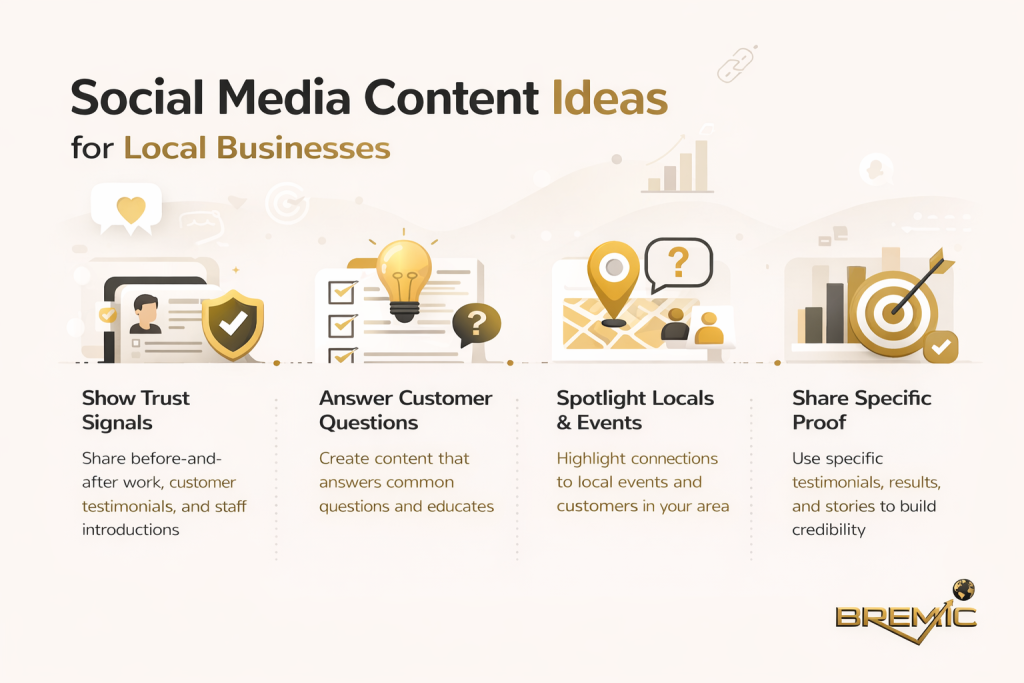
Trust-building content
People buy local partly on confidence. They want proof that your business is real, competent, and consistent.
Trust-building content includes:
- before-and-after work
- behind-the-scenes process content
- staff introductions
- customer testimonials
- short explanations of how you work
- common questions answered clearly
This kind of content is especially important for service businesses where the customer is choosing expertise, reliability, and professionalism.
Decision-stage content
Some content should help people make a decision, not just notice your brand.
This includes:
- pricing context where appropriate
- service comparisons
- what to expect during a visit or consultation
- how long a service takes
- signs someone needs your service
- mistakes to avoid before hiring
These are strong social-media-content-ideas-for-local-businesses because they address hesitation directly. They also give you a chance to show expertise without sounding promotional.
Community and local relevance content
Local businesses do not operate in abstraction. They are part of a place.
Content tied to community can include:
- local event participation
- neighbourhood updates that matter to your audience
- partnerships with nearby businesses
- seasonal local tips
- community milestones
- local customer stories
This type of content helps a business feel familiar and rooted rather than generic. That matters in local markets where proximity and recognition often influence buying decisions.
Best Social Media Content Ideas for Local Businesses
The strongest content mix usually combines credibility, education, personality, and local relevance. Here are the formats worth prioritizing.
Show the work, not just the result
A finished result is useful, but process content often performs better because it shows care, expertise, and effort.
A landscaper can show how a project is planned. A bakery can show preparation early in the morning. A clinic can explain how appointments are handled. A salon can show consultations, not just the final style.
This works because local buyers often want reassurance about the experience, not just the outcome.
Explain common customer questions
FAQ-style content is one of the most practical forms of Social Media Marketing & Optimization for local businesses.
Use posts, short videos, or carousel-style content to answer questions such as:
- How often should this service be booked?
- What does the first appointment involve?
- How should customers prepare?
- What are the most common misconceptions?
- What makes one option better than another?
This kind of content earns attention because it is useful. It also creates a bank of assets that can support website content, sales conversations, and local landing pages.
Turn customer moments into repeatable formats
Do not treat every post as a one-off. Build repeatable content series.
Examples include:
- Customer Question of the Week
- This Week’s Project
- Local Tip Tuesday
- Meet the Team
- What We Fixed Today
- Seasonal Advice for Local Customers
Repeatable formats reduce content planning friction and help audiences recognize what your business regularly shares.
Share proof that feels real
Testimonials are important, but they work best when they are specific.
Instead of posting generic praise, highlight the context. What problem did the customer have? What was the outcome? Why did they choose you? What changed afterward?
For local businesses, proof feels stronger when it reflects real situations people in the area recognize. Specificity is more persuasive than polished language.
Use local context without forcing it
Many businesses try to sound local by mentioning the town name repeatedly. That rarely improves content quality.
A better approach is to reference local reality naturally. Talk about seasonal issues in the area, local customer habits, nearby events, weather patterns, commuting routines, or service needs specific to your region.
That makes content more relevant without feeling engineered.
Important Supporting Subtopics
Platform choice matters more than volume
Not every local business needs to be equally active everywhere.
A visually driven business may benefit from Instagram. A community-focused brand may see better engagement on Facebook. A service provider with strong educational material may get traction from short-form video. A B2B local company may need a lighter but more focused presence.
Optimization starts with matching platform behaviour to audience behaviour. More channels do not automatically create more results.
Offers should be the minority, not the entire strategy
A common mistake is treating social media like a rotating discount board.
Promotional posts matter, but a feed full of offers trains people to ignore the brand unless there is a deal. That weakens positioning over time.
A healthier balance is to make most content useful, credible, or interesting, then use promotional content selectively when timing and context make sense.
Content should connect to business goals
A good content plan should support outcomes such as:
- enquiries
- bookings
- walk-ins
- calls
- repeat purchases
- stronger customer retention
If a post gets attention but does nothing for awareness, trust, or action, it may still have value, but it should not dominate the strategy.
Common Mistakes Local Businesses Make
One mistake is copying large brands. National brands often post for entertainment and broad visibility. Local businesses usually need clarity, trust, and relevance more than mass reach.
Another mistake is posting only when business is slow. That creates inconsistency and weakens audience memory. Social content works better when it compounds over time.
A third mistake is chasing trends that do not fit the business. A trend can increase visibility briefly, but if it weakens credibility or confuses positioning, it is not useful.
Finally, many businesses create content without reviewing what actually drives action. Social Media Marketing & Optimization requires iteration. You should look at saves, comments, profile visits, link clicks, direct messages, and enquiries, not just likes.
Practical Guidance for Building a Better Content Plan
Start with three or four core content pillars rather than trying to publish everything.
For most local businesses, a strong structure looks like this:
- proof and results
- education and FAQs
- people and process
- local relevance and community
From there, build a simple monthly plan. You do not need endless novelty. You need consistent coverage of the concerns your customers already have.
It also helps to document recurring customer questions from calls, in-store conversations, consultations, and emails. Those questions are often better content prompts than generic brainstorming sessions.
When planning social-media-content-ideas-for-local-businesses, focus on what helps a customer move one step closer to trust. That usually produces better content than trying to sound clever.
Timing and Expectations
Results from local social media are rarely instant, especially if the business has posted inconsistently in the past.
In most cases, useful progress comes from steady improvement over months, not days. Early gains may appear as better engagement quality, more direct messages, or stronger brand recognition before they show up as clear revenue impact.
That is normal.
The goal is not to go viral. The goal is to become familiar, credible, and easy to choose within your local market. That takes repetition, relevance, and refinement.
Conclusion
The best social-media-content-ideas-for-local-businesses are not random prompts. They are deliberate trust-building assets that help potential customers understand who you are, what you do, and why they should choose you.
That is the real value of Social Media Marketing & Optimization in a local context. It turns social media from a posting routine into a business support system.
For local businesses, the smartest approach is usually not more content. It is better content: content grounded in customer questions, real proof, local relevance, and consistent positioning.
When that foundation is in place, social media becomes easier to manage, more useful to your audience, and far more aligned with long-term growth.