Choosing the best web hosting in Thailand is not just a technical decision. It affects how fast your site loads, how stable it is during traffic spikes, how easy it is to manage, and how much friction you create for SEO, lead generation, and conversion.
A lot of hosting advice is too generic to be useful. It treats every site the same, overstates the SEO impact of server location, and ignores the real trade-offs between price, performance, support, and operational risk. For businesses targeting Thai users, that approach usually leads to one of two bad outcomes: overpaying for infrastructure you do not need, or saving money on a host that becomes a bottleneck later.
This article takes a more practical view. Rather than ranking random providers, it explains what “best” really means in a Thai context, how Web Hosting affects search performance, and how to choose a setup that fits your site’s stage, audience, and growth plans.
What Is Web Hosting?
Web Hosting is the service that stores your website files and makes them available when someone visits your domain. In practical terms, your host provides the server resources, software environment, and network access that allow your pages, images, databases, and applications to load for users.
That sounds basic, but the hosting layer influences far more than uptime. It affects response times, caching, security, HTTPS setup, backup workflows, and how easily Google can crawl your site after changes or migrations. Google’s own guidance on maintaining SEO emphasizes crawlability, resource access, HTTPS, and overall user experience as part of sound technical site management.
For most businesses, the real question is not simply “What is Web Hosting?” It is: what kind of hosting environment gives your site enough speed, reliability, and flexibility without adding unnecessary complexity?
Why the Best Web Hosting in Thailand Matters
If your audience is primarily in Thailand, hosting decisions should reflect that reality.
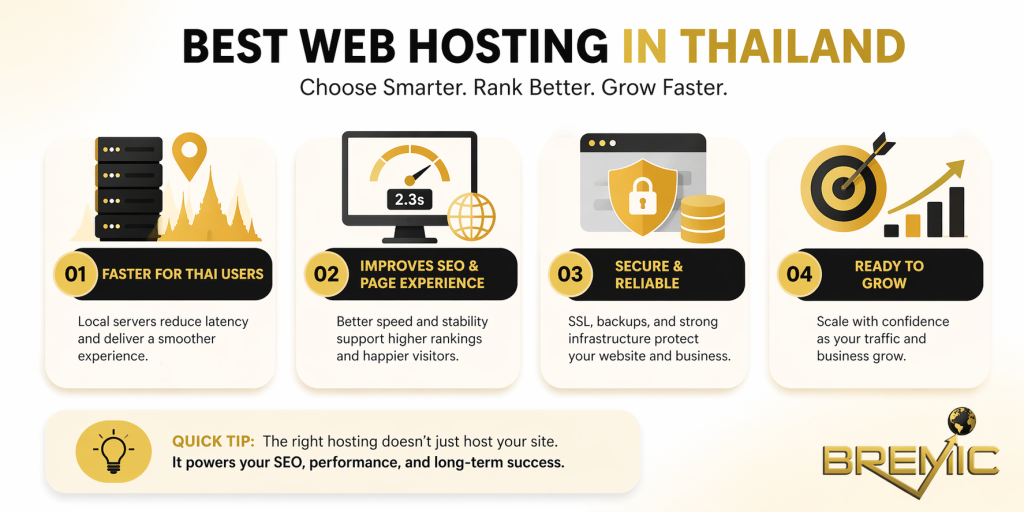
Google says server location can be a signal about a site’s intended audience, but it is not a definitive signal on its own. Google also looks at stronger localization signals such as language, local addresses, phone numbers, currency, and other regional cues. That means hosting in Thailand does not automatically make you rank in Thailand, but hosting closer to users can still help performance and user experience.
That distinction matters. Many site owners treat local hosting as an SEO shortcut. It is not. What it can do is reduce latency, improve stability for local users, and support better page experience when the rest of the stack is configured well.
Google’s documentation is clear that page experience is not a replacement for relevance. The most relevant page can still rank even if its experience is not ideal. But when multiple pages are similarly helpful, stronger page experience can contribute to better search performance. Google also recommends aiming for good Core Web Vitals, with thresholds of LCP within 2.5 seconds, INP under 200 milliseconds, and CLS under 0.1.
So when people search for the best web hosting in Thailand, the strategic answer is this: the right host helps remove technical friction. It does not create topical authority by itself, but it makes it easier for your content, UX, and SEO work to perform as intended.
How the Best Web Hosting in Thailand Should Be Evaluated
Start with the right hosting model
Not every site needs the same hosting architecture.
A simple brochure site or early-stage company site may run perfectly well on quality shared hosting. A content-heavy site, WooCommerce store, membership platform, or high-traffic lead generation site usually needs more predictable resources, better caching, and stronger isolation.
In most cases, the progression looks like this:
- Shared hosting for small, lower-risk sites with modest traffic
- VPS or cloud hosting when you need dedicated resources and better performance control
- Managed WordPress hosting when operational simplicity, security, and WordPress-specific performance matter more than raw server control
The best Web Hosting choice is the one that matches your current requirements without boxing you in six months later.
Prioritize proximity, but do not obsess over Thailand-only servers
For Thai audiences, a Thailand-based server can make sense, especially if your visitors are concentrated in Bangkok or across the domestic market. But a strong regional setup in Singapore or another nearby hub can also perform extremely well when paired with good CDN delivery and caching.
This is where nuance matters. Google does not treat server location as a magic ranking lever, and distributed infrastructure can work perfectly well. The better question is whether your actual users get fast, consistent delivery.
Some Thai-focused cloud providers position themselves around domestic bandwidth, low latency, and Thai-language support. NIPA Cloud, for example, explicitly markets local infrastructure, free domestic bandwidth, and support from Thai professionals. That does not automatically make it the best option for every business, but it illustrates what a local-value proposition in Thailand typically looks like.
Look at the performance stack, not just disk space
A hosting plan can look generous on paper and still perform badly.
What matters more than headline storage numbers is the performance stack behind the server: caching, resource allocation, database handling, PHP performance, and delivery architecture. WordPress documentation notes that server caching can range from simple local caching to more advanced reverse proxy setups in front of the application server.
For a business site, you should care about whether the host supports:
- server-side caching
- CDN integration
- modern PHP versions
- reliable database performance
- enough resources for traffic peaks, plugin load, and admin activity
These are the factors that influence real-world experience more than “unlimited” marketing language.
Security, backups, and support are not optional extras
The best web hosting in Thailand should not be defined only by speed. It should also reduce operational risk.
Google recommends HTTPS for security and ties good user experience to search performance more broadly. If your hosting environment makes SSL difficult, that is a warning sign.
You should also verify three things before signing up:
- how backups are created and restored
- how support works during urgent incidents
- how easy it is to scale resources or migrate later
A host is only “good” when it performs under pressure, not just in a feature comparison page.
Important Subtopics to Consider
Local Thai hosting vs international hosting
A local provider may offer Thai-language support, local billing, local time-zone alignment, and infrastructure designed for domestic traffic. An international host may offer better tooling, broader ecosystems, more mature dashboards, or easier scaling across multiple markets.
The best choice depends on your operating model. If your business is Thailand-first, local support and domestic performance may matter more. If you are targeting Southeast Asia or global traffic, a stronger regional or international stack may be the better long-term decision.
Managed WordPress hosting vs general Web Hosting
If your site runs on WordPress and your team is not technical, managed hosting can save time. That is especially true when updates, staging environments, security hardening, caching, and backups are handled well.
General Web Hosting may be cheaper, but it often pushes more responsibility onto the site owner or agency. For small businesses, that hidden operational cost can outweigh the monthly savings.
Hosting migrations and SEO risk
Switching providers is not automatically dangerous, but poor execution can create unnecessary SEO disruption.
Google’s guidance on changing hosting recommends preparing and testing the new environment first, checking that Googlebot can access it, lowering DNS TTL in advance, and monitoring traffic and crawl activity during the move. Google also notes that a temporary drop in crawl rate after launch is normal, with recovery typically happening over the next few days if the new infrastructure performs well.
That is why the best web hosting in Thailand is not just about selection. It is also about migration discipline.
Common Mistakes
One common mistake is choosing solely on price. Cheap hosting can be perfectly fine for low-stakes sites, but it becomes expensive when downtime, slow admin panels, poor support, or weak backups start affecting revenue.
Another mistake is assuming that a Thailand-based IP guarantees better rankings. It does not. Local relevance comes from a broader mix of signals, while hosting mainly influences performance and user experience.
A third mistake is treating hosting as separate from SEO. In reality, crawl stability, HTTPS, resource accessibility, and site speed all sit close to the hosting layer. Google’s documentation repeatedly connects technical reliability and user experience with how well a site can perform in Search.
Finally, many businesses migrate too quickly. They move DNS, cancel the old host, and only then discover broken forms, missing images, blocked resources, or firewall issues affecting crawlers. That is exactly the type of avoidable risk good hosting planning should eliminate.
Practical Guidance
If you are choosing the best web hosting in Thailand for a business site, use this sequence:
- Define where your real users are located and what your site actually needs.
- Match the hosting model to your current stage: shared, VPS, cloud, or managed WordPress.
- Shortlist providers based on performance stack, support quality, backup policy, and migration options.
- Test page speed from Thailand, not just from US or Europe-based tools.
- Confirm SSL, staging, restore workflows, and scaling paths before purchase.
- If migrating, test the new environment thoroughly before changing DNS and monitor Search Console after launch.
From an internal linking perspective, this topic naturally connects to broader pages on Web Hosting, shared hosting vs VPS, WordPress hosting, site speed optimization, CDN setup, and SEO-safe site migration. That keeps the article focused while supporting a stronger topical cluster.
Timing and Expectations
Better hosting can improve speed and stability quickly, but SEO outcomes are rarely instant.
Google’s SEO Starter Guide says changes can take anywhere from a few hours to several months to be reflected, and that it is usually best to wait a few weeks before judging impact in Search.
That is the right mindset here. Upgrading hosting may improve load times almost immediately. Rankings, crawl behavior, and conversion improvements take longer and depend on the rest of the site as well: content quality, internal linking, indexing, UX, and commercial intent alignment.
Hosting is an enabler, not a shortcut.
Conclusion
The best web hosting in Thailand is not the cheapest plan, the most aggressively advertised provider, or the one with the longest feature list. It is the hosting setup that fits your audience, supports strong page experience, reduces technical risk, and leaves room for growth.
For SEO, the value of good Web Hosting is simple: it helps your site load well, stay accessible, migrate safely, and support the kind of user experience Google wants to reward. It will not replace content quality or topical authority, but it can absolutely strengthen the foundation those things depend on.