Negative reviews are often treated as a reputation problem, but they are also a search visibility problem and a conversion problem. That is why understanding how negative reviews affect SEO and conversions matters for any business that relies on organic traffic, local discovery, or branded search.
A weak review profile does not just make a company look less credible. It can reduce click-through rates from search results, weaken local visibility, shape what appears on branded searches, and lower the percentage of visitors who are willing to enquire, book, buy, or contact sales.
This is where the topic becomes more strategic than many businesses realize. Reviews influence how people judge trust before they ever reach your website. They also contribute to the signals and context search engines use when interpreting brand relevance, quality, and authority. The result is not always a dramatic ranking drop. More often, it is a gradual loss of visibility and demand capture that shows up in weaker traffic quality and lower conversion rates.
This article explains how that works in practice, where Search Engine Reputation Management (SERM) fits in, and how to address negative reviews without resorting to shortcuts or reputation theatre.
What is Search Engine Reputation Management (SERM)
Search Engine Reputation Management (SERM) is the process of shaping how a brand appears in search results by improving the quality, accuracy, trust, and visibility of the assets people see when they search for your business, your products, or your key decision-makers.
In practical terms, SERM is not just about “burying bad reviews.” That is an outdated and shallow view of the discipline. A stronger approach focuses on four things:
- Monitoring what appears in branded and high-intent searches
- Reducing the impact of negative sentiment where possible
- Strengthening trusted assets such as your website, review profiles, and brand pages
- Improving the real customer experience so future sentiment improves naturally
SERM sits at the intersection of SEO, brand perception, customer experience, and conversion optimization. It matters because search users often form an opinion before they ever land on your site. If the first page of results suggests risk, inconsistency, or poor service, the journey breaks early.
For websites building topical authority, this topic also connects naturally to related pages on review management, local SEO, branded search, and trust signals across the funnel.
Why negative reviews matter for SEO and conversions
Negative reviews do not always damage rankings in a direct, simple way. The effect is usually broader and more indirect. Search performance is influenced by visibility, clicks, engagement, brand trust, and the strength of your overall reputation footprint.
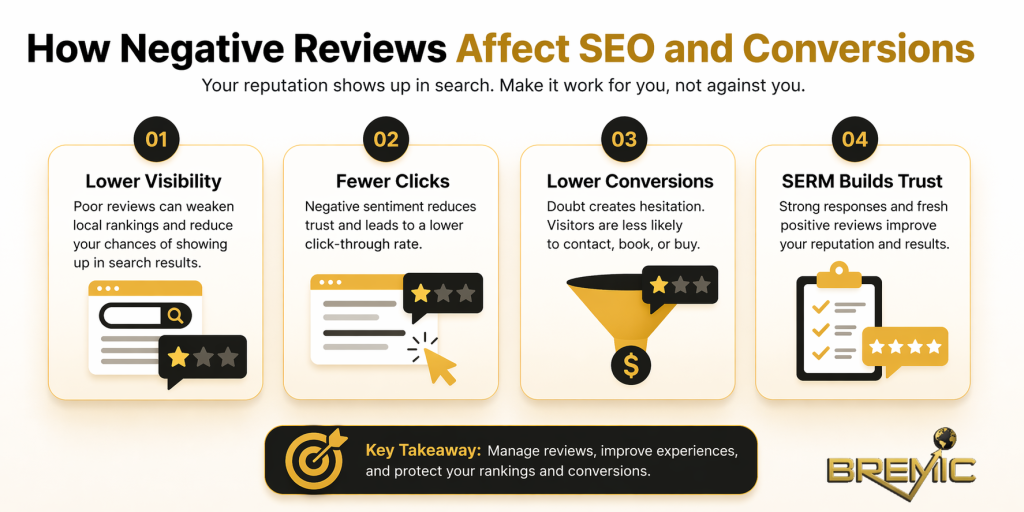
They weaken local SEO performance
For local businesses, reviews are one of the clearest trust indicators tied to local search visibility. Search engines evaluate relevance, prominence, and overall credibility when deciding which businesses deserve visibility in local packs and map results.
A business with consistently poor ratings, unresolved complaints, and weak review recency can struggle to compete against similar businesses with healthier review profiles. Even when the business still appears, the listing may attract fewer clicks because users compare star ratings and review sentiment before choosing where to go next.
This is especially important for businesses where location-based intent is strong, such as dentists, legal firms, home services, restaurants, clinics, and agencies with local market coverage.
They reduce click-through rate from search
Search results are competitive environments. Users make fast decisions based on limited information. If your brand appears with visible review stars, third-party review pages, or negative sentiment in the search results, fewer people will click.
That lower click-through rate matters because search visibility is only useful when it produces traffic. Even if rankings remain stable, poor sentiment can quietly reduce performance by shrinking the number of users willing to engage.
In branded search, this becomes even more important. People searching your company name are often close to taking action. If they see negative review pages, complaint threads, or poor platform ratings, friction enters the journey at the worst possible moment.
They hurt conversions after the click
The conversion effect of negative reviews is often more severe than the ranking effect.
Users rarely evaluate a website in isolation. They compare what your site says with what third-party sources say. If the site promises quality but recent reviews describe missed deadlines, poor communication, or support issues, trust collapses.
That gap between brand promise and public feedback creates hesitation. In conversion terms, hesitation is expensive. It leads to more abandoned enquiries, fewer purchases, longer sales cycles, and a stronger tendency to choose competitors that feel safer.
For higher-ticket or trust-sensitive services, even a small amount of visible negative sentiment can materially affect lead quality and close rates.
They shape perceived authority and brand quality
Search engines want to surface brands that users are likely to trust. Reviews are not the only factor involved, but they contribute to the wider reputation picture around a business.
If negative patterns appear consistently across review platforms, forum discussions, branded search results, and third-party mentions, they can weaken how authoritative your brand appears. This matters even more when a website is trying to build topical authority. Strong content can support expertise, but poor public sentiment can undermine credibility.
How negative reviews affect SEO and conversions in practice
To understand how negative reviews affect SEO and conversions, it helps to break the process into the stages where damage usually occurs.
Stage 1: Negative sentiment appears in search
This can happen on Google Business Profile, Trustpilot, industry directories, app stores, niche forums, Reddit threads, or review sections on marketplaces. In some cases, negative review pages may rank for branded searches or product-specific queries.
Once that sentiment becomes visible in the search landscape, it influences user expectations before they even interact with your website.
Stage 2: Users compare your brand against competitors
Searchers often review multiple options in parallel. If competitors have stronger ratings, more recent positive feedback, and more thoughtful business responses, they look safer and easier to trust.
This comparison is not purely emotional. It is part of decision-making. Reviews act as distributed proof. Users treat them as a shortcut for assessing risk.
Stage 3: Click behaviour changes
When users perceive risk, they are less likely to click your listing and more likely to click another result. On branded searches, they may click third-party reviews before visiting your site. On local searches, they may bypass your profile entirely.
This leads to lower demand capture, even when your brand remains visible.
Stage 4: Conversion intent weakens
If the user does visit your site, the prior exposure to negative sentiment often follows them. That means the website now has to overcome doubt, not just explain value.
This is why businesses with solid traffic can still underperform commercially. The issue is not always acquisition volume. It is trust friction during the evaluation stage.
Important subtopics that influence the outcome
Review recency matters as much as rating
An old negative review profile can often be improved if recent customer feedback tells a better story. Users do not only look at the average score. They look for patterns, especially in the most recent reviews.
A business with a few older complaints but a clear trend of recent improvement is easier to trust than one with a respectable average score but multiple fresh complaints.
Response quality affects trust
A thoughtful response to a negative review can reduce damage. A defensive, vague, or combative response usually makes things worse.
Public responses matter because they show how the business behaves under pressure. Potential customers are not only judging the complaint. They are judging the company’s reaction to it.
Brand SERP control is part of SERM
SERM is closely tied to branded search results. If the first page for your brand name is dominated by your website, strong review profiles, helpful content, and trusted third-party mentions, reputation risk is easier to contain.
If the first page is fragmented and includes unresolved complaint pages or low-trust results, conversion pressure increases. That is why SERM should be connected to branded SEO, structured internal linking, and the publication of strong supporting content.
Common mistakes businesses make
One common mistake is assuming the answer is to remove every bad review. In reality, that is rarely possible, and it misses the deeper issue. The goal is not perfect sentiment. The goal is credible sentiment and a stronger trust profile overall.
Another mistake is responding only at the platform level while ignoring operational issues. If the underlying service problem remains, the review problem will return.
Many businesses also focus too narrowly on star ratings. The written content of reviews, their recency, and the tone of business responses often influence users more than the average score alone.
A further mistake is separating reviews from SEO strategy. Review sentiment affects branded search, local intent, click behaviour, and conversion performance. It should not sit in a silo owned only by customer service.
Practical guidance for handling the issue correctly
Start with a reputation audit. Search your brand name, key products, and common comparison phrases. Review what appears on page one and identify where negative sentiment is visible.
Then assess the review footprint itself. Look at:
- Average rating by platform
- Review recency
- Recurring complaint themes
- Unanswered negative reviews
- Gaps between your brand claims and customer feedback
Once you understand the landscape, address the root causes first. If reviews repeatedly mention missed expectations, pricing confusion, onboarding problems, or poor communication, those issues need operational fixes.
Next, improve your response process. Good responses are calm, specific, accountable, and solution-oriented. They should not read like templates. They should show that the business takes feedback seriously and is prepared to act.
Then build a sustainable review acquisition process. Do not try to manipulate sentiment. Instead, ask satisfied customers for honest feedback at the right moments in the journey. Consistent, recent, authentic reviews are one of the strongest ways to rebalance the reputation profile over time.
From an SEO perspective, support that work with stronger branded assets. This may include a robust about page, service pages with clearer trust signals, case studies, customer success content, and supporting articles related to reputation, reviews, and service quality. In a cluster model, this page can naturally link to broader resources on brand reputation, local SEO, and review response strategy.
Timing and expectations
Results are rarely immediate.
If the issue is mostly conversion-related, improvements can sometimes appear relatively quickly once review responses improve and recent positive feedback starts to appear. If the issue is broader and tied to branded search results, reputation rebuilding usually takes longer.
That is because SERM is cumulative. It depends on new review signals, stronger content assets, improved brand perception, and better customer experience over time.
Businesses should expect steady improvement rather than a sudden turnaround. The more established the negative sentiment, the more disciplined the response needs to be.
Conclusion
Understanding how negative reviews affect SEO and conversions is essential because reviews influence far more than public perception. They shape local visibility, branded search performance, click-through behaviour, trust, and buying decisions.
That is why Search Engine Reputation Management (SERM) should be treated as a strategic part of SEO, not a side task. The strongest approach is not to chase cosmetic fixes. It is to align reputation management, operational improvement, and search visibility into one coherent system.
When businesses do that well, they protect rankings more effectively, improve conversion efficiency, and build the kind of trust that supports long-term organic growth.