Lowering cost per click in Google Ads sounds simple on paper: pay less for each visit and your campaigns become more efficient. In practice, it is not that straightforward. A lower CPC can improve margins, but chasing cheaper clicks blindly often leads to weaker traffic, poorer conversion rates, and wasted budget in places that never produce revenue.
That is why a good Google Ads strategy does not start with “How do I get cheaper clicks?” It starts with a better question: how do I lower cost per click in Google Ads while keeping commercial intent, lead quality, and account performance intact?
This matters for any business using paid search as part of a broader Search Engine Marketing (SEM) strategy. If your CPC is too high, you limit reach, reduce testing freedom, and put pressure on return on ad spend. If you lower it the right way, you create room to scale.
This article explains what SEM means in practical terms, why CPC matters, how Google Ads pricing actually works, and what to do if you want lower costs without weakening performance.
What is Search Engine Marketing (SEM)
Search Engine Marketing (SEM) is the practice of using paid search advertising to appear in search engine results for relevant queries. In most cases, that means running campaigns through Google Ads to attract users who are actively searching for a product, service, or solution.
Unlike SEO, which earns visibility over time through organic rankings, SEM buys visibility through an auction system. You choose keywords, write ads, define bids, and send traffic to landing pages designed to convert.
In practical terms, SEM is about intent capture. You are not interrupting people. You are showing up when they are already looking.
That makes SEM especially valuable for businesses with clear commercial offerings, but it also makes competition intense. When many advertisers target the same high-intent keywords, CPC rises quickly. That is why understanding how to lower cost per click in Google Ads is not just a budget question. It is a strategic SEM skill.
Why Lower CPC Matters
A lower CPC improves efficiency in several ways.
First, it lets you buy more clicks with the same budget. That creates more data, more testing opportunities, and more room to optimize campaigns.
Second, it can improve profitability. If your average lead value or customer value stays constant while click costs fall, your acquisition economics improve.
Third, it supports scale. Many Google Ads accounts plateau not because search demand disappears, but because CPC gets too expensive to maintain profitable growth.
That said, CPC is not a standalone success metric. A campaign with a higher CPC can still outperform a cheaper campaign if the traffic converts better. The real objective is not low CPC at any cost. It is efficient CPC relative to conversion quality and business outcomes.
How Google Ads CPC Actually Works
To lower CPC intelligently, you need to understand what influences it.
Google Ads uses an auction, but advertisers do not simply “buy” positions by offering the highest bid. Actual CPC is influenced by a mix of competition, bid strategy, ad relevance, expected click-through rate, and landing page experience.
A few core factors shape what you pay:
Competition for the Keyword
Some keywords are expensive because many advertisers want them. This is especially common in legal, SaaS, finance, insurance, and high-value B2B markets. If the keyword has strong commercial intent, CPC usually reflects that.
Quality Score Signals
Google rewards relevance. If your keyword, ad copy, and landing page align well, you can often pay less than competitors with weaker relevance. Quality Score itself is a diagnostic metric, but the factors behind it matter operationally.
Ad Rank
Your position depends on Ad Rank, not just bid. A better ad experience can improve your position without requiring a higher bid, which can help reduce actual CPC over time.
User Context
Device, location, audience signals, time of day, and search behavior can all influence auction dynamics. The same keyword may cost more in one market or on one device than another.
So when people ask how to lower cost per click in Google Ads, the real answer is usually a combination of relevance, targeting precision, and better auction efficiency.
How to Lower Cost Per Click in Google Ads
Improve Keyword Targeting Before Anything Else
One of the fastest ways to waste budget is to target broad, loosely qualified keywords and hope Google figures it out.
Start by reviewing whether your keywords reflect real commercial intent. A keyword can have high volume and still be a poor fit if the searcher is early in the research process or looking for something adjacent to your offer.
Tighter keyword targeting usually lowers wasted clicks and often improves ad relevance as well. That can reduce CPC indirectly by improving auction performance.
Use match types carefully. Broad match can work in mature accounts with strong signals and smart bidding, but many advertisers use it too early or too loosely. Phrase and exact match often give more control when you are trying to stabilize spend and improve search intent alignment.
Use Search Terms, Not Just Keywords
Your keyword list tells Google what you want to target. Your search terms report tells you what users actually typed.
This is where CPC problems often become visible. If you see irrelevant or low-intent queries triggering ads, you are paying for traffic that was never likely to convert. Removing these queries through negative keywords is one of the most reliable ways to reduce wasted spend.
Build Smaller, More Relevant Ad Groups
Many accounts pay more than necessary because campaign structure is too broad. A single ad group with unrelated keywords forces generic ad copy, weakens message match, and reduces relevance.
Smaller, tighter ad groups let you:
- write more specific ads
- align headlines to user intent
- send traffic to more relevant landing pages
- improve expected click-through rate and landing page experience
That combination can support better Quality Score signals, which is one of the clearest paths to lower CPC.
Improve Ad Relevance and Click-Through Rate
Google wants ads that match the query and attract engagement. If your ads are vague, generic, or disconnected from the keyword, you may pay more to compete.
Ad copy should reflect what the searcher is actually looking for. That does not mean stuffing keywords into every headline. It means showing clear relevance.
Strong search ads usually do three things well:
- reflect the search intent directly
- communicate a useful differentiator
- set realistic expectations for the landing page
A better click-through rate is not valuable just because it increases traffic. In Google Ads, it can also improve your auction efficiency.
Fix Landing Pages, Not Just Ads
Many advertisers focus heavily on keywords and bids while ignoring the page users land on. That is a mistake.
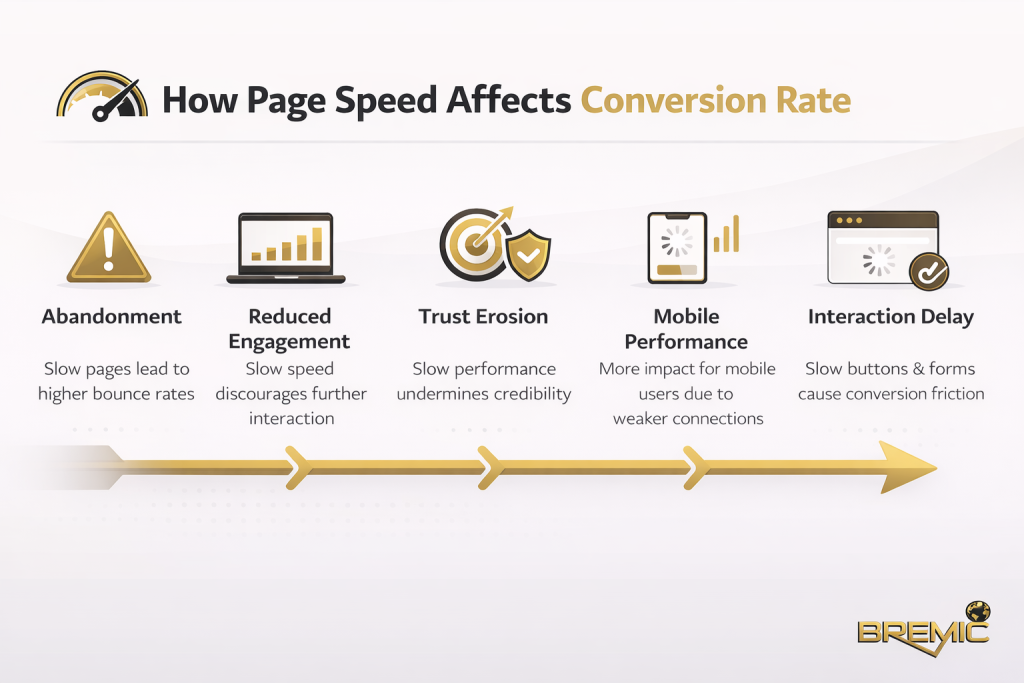
A weak landing page can increase CPC because it damages the relevance and experience signals Google uses in the auction. It can also make your account look worse than it is by reducing conversion rate, which makes every click feel overpriced.
A better landing page does not need to be elaborate. It needs to be aligned.
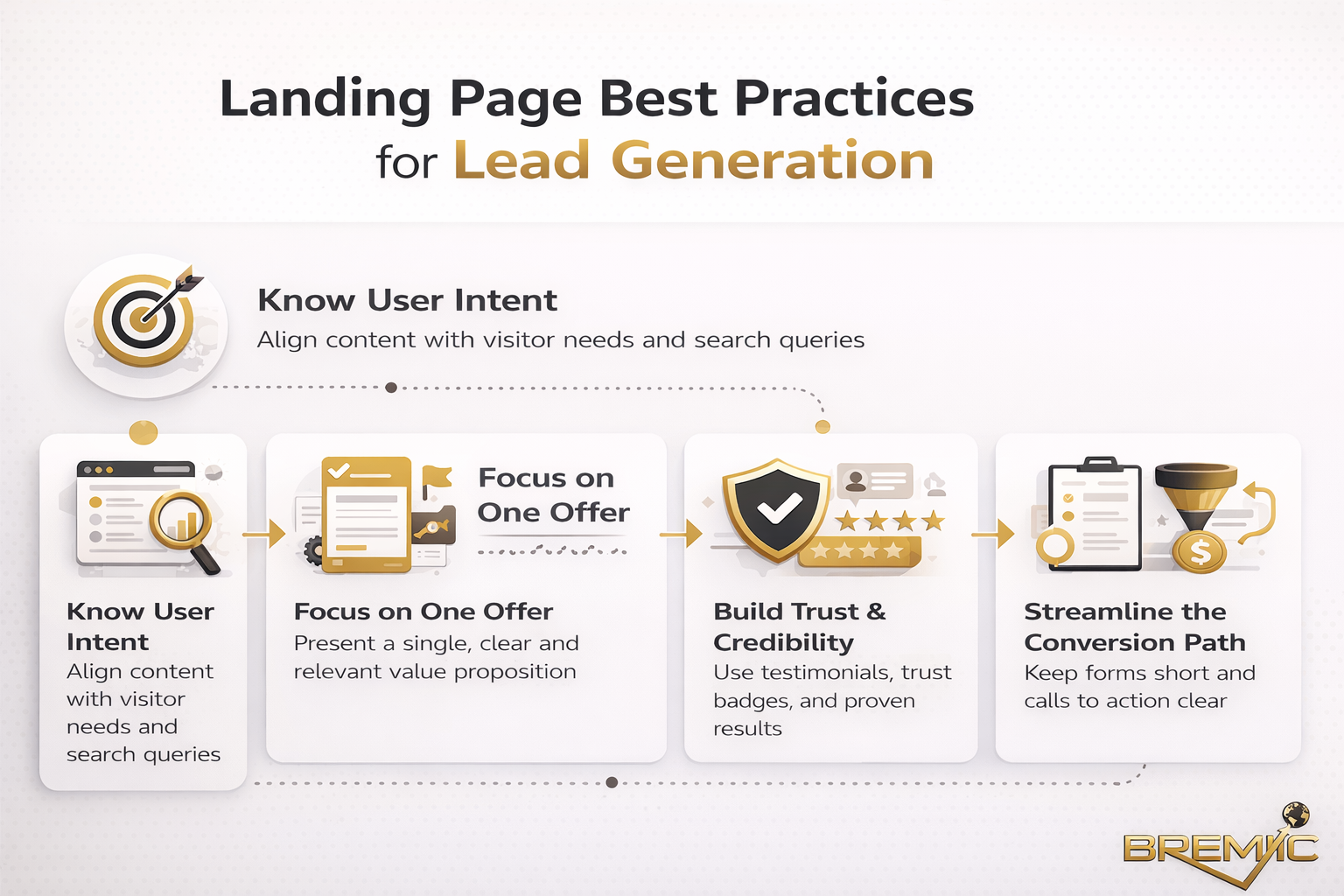
The core elements are straightforward: the page should match the ad promise, speak to the search intent, load quickly, work well on mobile, and make the next step obvious. If someone clicks an ad for a specific service and lands on a generic homepage, your CPC problem is partly a landing page problem.
Use Negative Keywords Aggressively and Intelligently
Negative keywords are essential if you want to lower cost per click in Google Ads in a sustainable way.
They prevent your ads from showing on searches that are informational, irrelevant, job-related, support-related, or otherwise outside your target intent. This matters because Google Ads performance is rarely damaged by one large mistake. More often, it is damaged by hundreds of small, low-quality clicks.
Common negative keyword themes include:
- free
- jobs
- training
- definition
- support
- DIY
- competitors you do not want to target
The right negatives depend on your business model, but the principle is universal: protect budget from the wrong search context.
Refine Location, Device, and Schedule Targeting
Not every click has equal value. In many accounts, CPC inflation comes from showing ads too broadly across locations, devices, and times that do not perform well.
Segment performance and ask practical questions. Are mobile clicks converting poorly because the form experience is weak? Are some regions consistently more expensive with no meaningful revenue upside? Are late-night searches generating curiosity rather than sales?
Bid adjustments, campaign segmentation, and exclusions can improve efficiency quickly when performance patterns are clear.
Choose the Right Bidding Strategy for the Account Stage
Bidding strategy affects CPC, but it should fit the account’s maturity and conversion data quality.
Manual bidding can offer control when you are still learning. Maximize Clicks can sometimes reduce CPC, but it may prioritize cheap traffic over qualified traffic if left unchecked. Smart bidding strategies such as Target CPA or Maximize Conversions can work well when tracking is accurate and conversion volume is strong.
The mistake is assuming there is one universally “cheaper” bid strategy. There is not. The right approach depends on how much reliable data the account has and what outcome the business actually cares about.
Important Subtopics That Affect CPC
Lowering CPC Without Lowering Intent
This is the balancing act that matters most. Cheap traffic is not inherently efficient traffic. If you remove all high-intent keywords because they are expensive, you may lower CPC while damaging revenue.
Sometimes the best move is not to chase the absolute lowest CPC, but to reduce waste around profitable keywords so you can afford to stay competitive where intent is strongest.
Quality Score Is Useful, but Not a Goal by Itself
Quality Score can help diagnose problems, but it should not become the optimization target. A keyword with an average Quality Score can still be highly profitable. Focus on the underlying drivers: relevance, CTR, and landing page fit.
CPC Must Be Judged Against Conversion Value
A $12 click is expensive only if it does not produce meaningful outcomes. In a strong SEM program, CPC is one metric among several. It should always be interpreted alongside conversion rate, cost per acquisition, lead quality, and revenue contribution.
Common Mistakes
One common mistake is trying to lower CPC by reducing bids everywhere. That may lower click costs, but it can also reduce impression share on the terms that matter most.
Another is overusing broad match without enough conversion data or negative keyword control. This often expands reach faster than it improves performance.
A third is treating all keywords equally. Brand, non-brand, high-intent, research-stage, and competitor terms do not behave the same way. They should not be managed the same way either.
Many businesses also ignore account structure. When campaigns are too consolidated, relevance suffers. When relevance suffers, CPC usually becomes harder to control.
Practical Guidance
If you want a realistic path forward, start in this order:
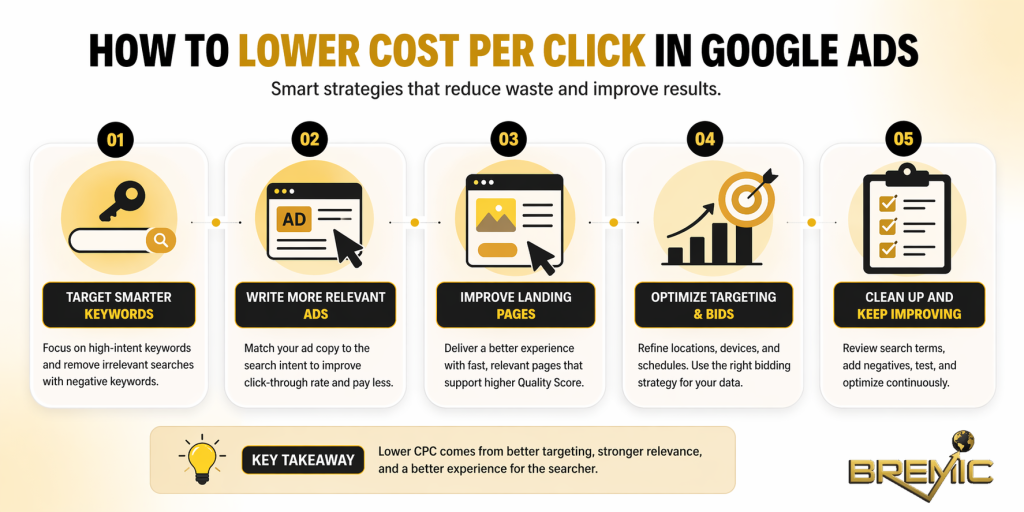
First, clean up search terms and add negatives.
Second, tighten campaign and ad group structure where relevance is weak.
Third, improve ad copy and landing page alignment for your best commercial keywords.
Fourth, review segmentation by device, location, and schedule.
Fifth, evaluate whether your bidding strategy matches the amount and quality of conversion data in the account.
This order matters because it fixes waste and relevance before making bigger bid-level decisions.
Timing and Expectations
Some CPC improvements can happen quickly. Negative keyword cleanup, structure refinement, and targeting exclusions often produce visible changes within days or weeks.
Other improvements take longer. Better landing pages, stronger ad testing, and smarter bidding need enough traffic and conversion data to stabilize. In competitive markets, meaningful CPC reduction may be gradual rather than dramatic.
It is also worth accepting that some industries simply have high baseline CPCs. In those cases, the objective is not to force costs below market reality. It is to build a more efficient account than competitors within that reality.
Conclusion
If you want to know how to lower cost per click in Google Ads, the answer is rarely just “bid less.” Lower CPC comes from better targeting, stronger relevance, tighter structure, cleaner traffic, and more disciplined SEM management.
The best advertisers do not obsess over cheap clicks in isolation. They build campaigns that earn efficient clicks because the account is well structured, the ads match intent, and the landing pages do their job.
That is the strategic takeaway: lower CPC is usually the result of better decisions across the system, not a single shortcut inside the Google Ads interface.